

After opening the day in the green, share markets in India witnessed positive trading activity throughout the day and ended the day on a positive note. Sectoral indices traded on a mixed note, with stocks in the oil and gas sector and stocks in the banking sector, leading the gains.
At the closing bell, the BSE Sensex stood higher by 416 points (up 1.2%) and the NSE Nifty closed up by 122 points (up 1.2%). The BSE Mid Cap index ended the day down 0.2%, while the BSE Small Cap index ended the day down by 0.6%.
The rupee was trading at Rs 67.49 against the US$ in the afternoon session. Oil prices were trading at US$ 77.37 at the time of writing.
Asian stock markets finished in green. As of the most recent closing prices, the Hang Seng was up by 1.3% and the Shanghai Composite was up by 1.8%. The Nikkei 225 was up by 0.8%. Meanwhile, European markets, too were trading mixed. The FTSE 100 was up by 0.1%, The DAX, was down by 0.5 while the CAC 40 was up by 0.1%
HDFC Bank was among the top gainers in the markets today as interest surged ahead of the Foreign Institutional Investors (FII) buying window for the stock opening up on June 1.
In news about the economy, the government is set to release the GDP numbers for the quarter, and full year today. Ahead of the official numbers, the global rating agency, Moody's downgraded its forecast for the country. India's GDP is set to grow by 7.3% in 2018, according to a Moody's report, a cut from its previous forecast of 7.5%. However, it maintained its 7.5% growth forecast for 2019.
The report states that growth should benefit from an acceleration in rural consumption, supported by higher minimum support prices and a normal monsoon. According to the global rating major, despite the moderation in March, industrial production growth averaged 6.2% in the January-March period, up from 5.9% in the previous quarter.
The private investment cycle will continue to make a gradual recovery, as twin balance-sheet issues -- impaired assets at banks and corporates -- slowly get addressed through deleveraging and the application of the Insolvency and Bankruptcy Code.
However, Moody's showed concern over government's tight fiscal condition.
According to official data, industrial output growth fell to a five-month low of 4.4% in March due to decline in capital goods production and deceleration in mining activity and power generation.
Industrial growth as measured by the Index of Industrial Production (IIP) in 2017-18 too decelerated to 4.3% from 4.6% in the previous fiscal.
The Indian economy grew 6.6% in the last fiscal as it battled the lingering effects of demonetization in 2016. Teething issues related to the implementation of GST, which hampered operations of small and medium-sized enterprises and exporters, also contributed to growth moderation.
GDP Growth Getting Back on Track

Moody's growth forecast for this period is in line with that of the Reserve Bank and the International Monetary Fund (IMF) which projected India to grow 7.4%, and Asian Development Bank and Fitch which estimated growth at 7.3% over the financial year.
If the internal bottlenecks are not alleviated, a subdued private investment would put downside pressures on India's potential growth.
India's GDP grew by 7.2% in Q3 FY18. Cement, electricity, coal, and steel, the bedrock of the economy, all witnessed robust growth.
India also surpassed China as the world's fastest growing economy.
With the official numbers being released today, we'll be sure to keep a close eye on the trend.
Moving on to news from stocks in the auto sector. Mahindra & Mahindra (M&M) share price, was among the stocks in focus today after the auto major signed a memorandum of understandings (MOUs) with the Maharashtra government, for electric vehicles (EVs).
M&M signed two MOUs with the government of Maharashtra to further commit additional investment Rs 5 billion in the manufacturing of electric vehicle components at its Chakan Plant and deploy 1000 electric vehicles in the state in the next one year.
The company will make efforts to become fully electric ready by further investing in its Chakan plant for manufacture of EVs, e-motor, controller, battery pack and other electric vehicle components for multiple mobile applications related to battery pack assembly of EVs.
Currently, electric vehicle sales are low in India, rising 37.5% to 22,000 units in the year ended 31 March 2016 from 16,000 in 2014-15. Only 2,000 of these were cars and other four-wheelers, according to automobile lobby group society of Indian Automobile Manufacturers (Siam).
The government wants to see 6 million electric and hybrid vehicles on Indian roads by 2020 under the National Electric Mobility Mission Plan 2020.
The government is targeting to have all cars propelled with electric engine by 2030. The target is more daunting than in many advanced countries.
According to the industry, the 2030 target would require eight to ten times the global stock of such vehicles. India would need to sell more than 10 million electric cars in 2030, compared to 5,000 electric vehicles India had on the road in 2016.
As you can see from the chart above, India is barely visible compared to other developed countries when it comes to battery cars.
As an article in Business Standard suggests, such a big jump in scale for the auto industry in 13 years seems difficult. The basic infrastructure is missing. There are not enough charging stations. For this massive shift, the charging stations will need to be as ubiquitous as petrol pumps.
Another issue is the price of the lithium-ion battery, which constitutes 30% to 40% of the cost of the car. For this plan to succeed, the price of the battery needs to come down.
The auto industry is already facing regulatory headwinds. The shift from BS-IV emission norms to BS-VI has been two years ahead of schedule without an intermediate stage. The government, if it is serious about such ambitious targets, should offer the necessary infrastructure support and do its bit for a smooth transition.
And here's a note from Profit Hunter:
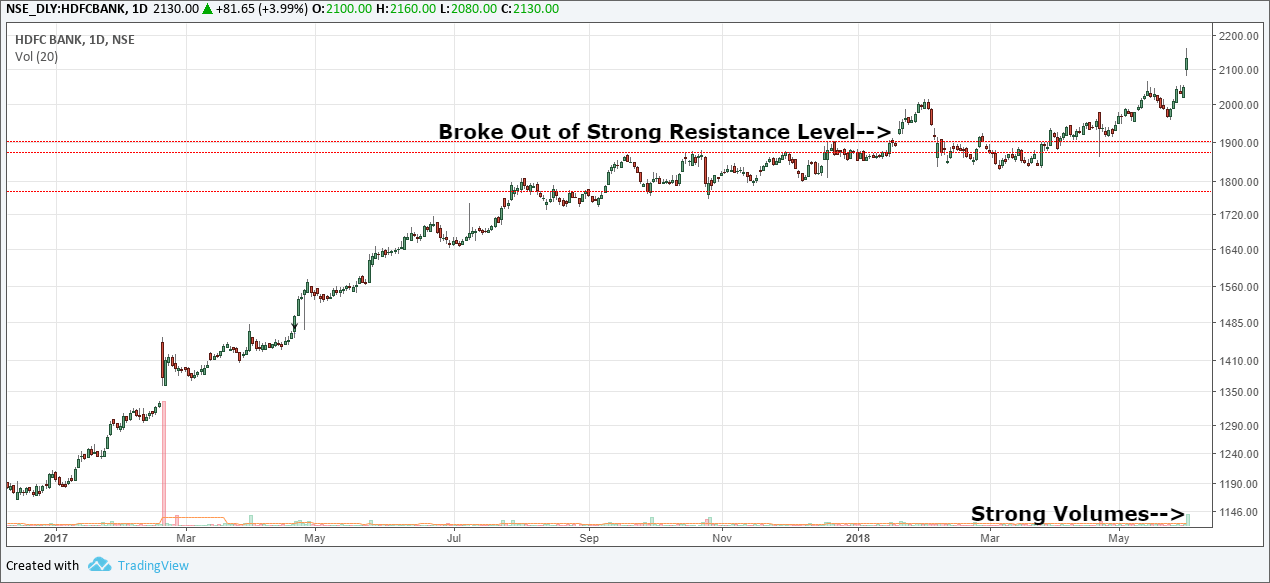
HDFC Bank is the top gainer in the Nifty 50 Index - up 5%. Let's have a look at its chart.
After the stock bottomed out at 1,158 in November 2016, it traded in a smooth uptrend to touch a high of 1,868 in September 2017. It then consolidated in a range of 1,780 - 1,875. It broke out of this range on the upside in January 2018 to touch a fresh life-time high of 2,015 in February 2018.
It corrected for a while to find support near the upper end of 1,780-1,875 range. It resumed its up move and today, the stock rallied 4% to touch a fresh life-time high of 2,160 with strong volumes. The rally was seen after the market regulator allowed a special window to be opened for Foreign Institutional Investors (FIIs) on June 1.
Now will the stock continue with the momentum or will it find some selling at its lifetime high? Let's keep a track of it...
HDFC Bank Hits a New Lifetime High
(Click on image to enlarge)
Comments
Log in or sign up to join the conversation.