

Share markets in India are presently trading deep in the red, tracking a collapse in global equities amid mounting concerns about the impact of coronavirus on global economy.
The BSE Sensex fell over 1,250 points, extending the selloff to the sixth day, while Nifty slipped below 11,250.
Global markets are on track for the worst week since the global financial crisis in 2008 as investors braced for the coronavirus to become a pandemic and rapidly spread around the world.
All sectoral indices are trading on a negative note with stocks in the metal sector, IT sector and automobile sector witnessing most of the selling pressure.
The BSE Sensex is trading down by 1,257 points (down 3.2%), while the NSE Nifty is trading down by 379 points (down 3.3%).
The BSE Mid Cap index and the BSE Small Cap index are trading down by 3.2%.
The rupee is trading at Rs 72.15 against the US$.
In news from the energy sector, Indian Oil Corporation (IOC) has made an investment of around Rs 30 billion to upgrade its refinery at Haldia to meet BS-VI emission norms. The new norms will come into force from April 1.
The company will invest another Rs 3.9 billion for setting up a grassroot bottling plant at Kharagpur, diesel exhaust fluid (DEF) plant at Budge Budge and lube blending unit at Paharpur in West Bengal.
IOC share price is presently trading down by 2.4%.
Moving on to news from the mutual funds space, the markets regulator has urged the mutual fund industry to build an adequate 'liquidity buffer' for debt schemes to be better prepared for any event of a crisis in future.
The regulator has also asked mutual funds to participate more in the voting process of company resolutions rather than abstain from them.
It said the ongoing credit crisis that resulted in returns of various debt mutual fund schemes taking sharp hits has brought to surface the kind of liquidity pressures that the industry could face.
Note that, last year in September, the regulator had brought in compulsory liquidity buffer in overnight and liquid funds, where in funds were mandated to invest 20% in liquid assets.
While speaking at the 14th edition of CII Mutual Fund Summit, the market regulator's whole time member G Mahalingam said MFs need to play a more constructive role when it comes to monitoring corporate governance practices followed in investee companies.
He questioned the practice of MFs staying away from casting their votes on company resolutions and pointed out that the 'abstain' votes were still as high as 12%. He directed the MF industry to reduce 'abstain' votes to 1-2% in the next few years.
He also warned the industry about mis-selling of MF products. "We don't want to be in a situation where we get complaints from investors that they were not well-informed about the risk profile of the product," he said.
The senior official told the industry to take more efforts to facilitate the growth of direct plans. He pointed out that the recent move by the regulator to allow MF investors to buy and sell units on exchanges could contribute significantly to the growth of direct plans.
What effect the above classification will have on Indian stocks remains to be seen. We will keep you updated on all the news from this space.
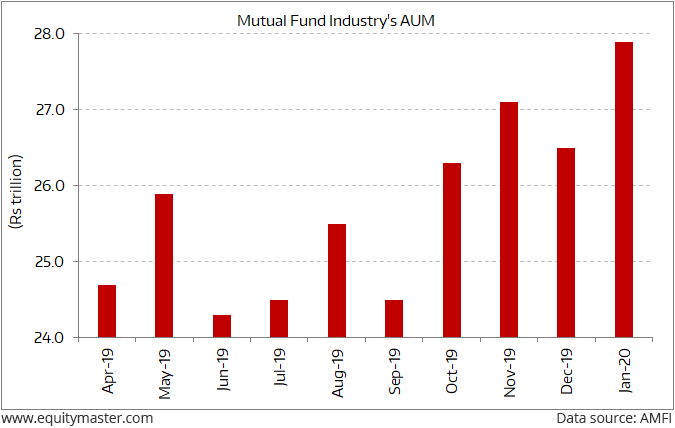
Speaking of mutual funds, Tanushree Banerjee wrote to you about an irreversible megatrend in the mutual funds space. It is the growth in the assets under management (AUM) of the Indian mutual fund industry.
This is evident in the chart below...
New High for Mutual Fund AUM



Comments
Log in or sign up to join the conversation.