

Asian stock markets are trading in red today with the Hang Seng trading down by 0.23%, while the Nikkei is down 1.6%.
Meanwhile, Indian share markets have opened the day marginally lower. The BSE Sensex is trading down by 111 points and the NSE Nifty is trading down by 42 points. Meanwhile, both the S&P BSE Mid Cap and S&P BSE Small Capare trading lower by 0.5%. Losses are largely seen in realty stocks and capital goods stocks.
The rupee is trading at 64.38 against the US$.
As per an article in the Economic Times, India's stock market capitalization has crossed US$ 2 trillion.
This makes it the ninth-largest equity market globally and second, after China, among the emerging markets.
Also, the spurt in stock prices has pushed up India's market cap-to-GDP ratio well above the 10-year average.
One must note that domestic share markets are trading near lifetime highs. Most of this buying interest is seen on the back of quarterly result announcements, proposed good rainfall this monsoon season, and positive cues from global financial markets.
However, more than fundamentals, it's liquidity driving the markets and valuations. As we stated in our recent, The 5 Minute WrapUp...
- One must note that currently, in most of the cases, it is liquidity driving the valuations, and not fundamentals. And this is exactly the time when one must allow fear to substitute greed.
Also, this is precisely the time when it is most difficult to overpower greed and stay disciplined.
Among all this hoopla, it's necessary to focus on the fundamentals and long term moats of companies before deciding to invest in them.
The Centre and states are expected to keep the exemption list short under the goods and services tax (GST) regime.
As per the news, goods of common use and consumed largely by the masses could be spared in the final list. Salt, primary produce, fruits and vegetables, flour, salt, milk, eggs, tea, coffee and prasad sold at temples could figure on the exemption list.
Finance minister Arun Jaitley has been in talks with states for deciding on rates.
Under GST, India has adopted a four-tier tax structure of 5%, 12%, 18% and 28%.
The common rate applicable on most products is decided at 18%.
Market participants are now awaiting the final set of rules that will be decided at the proposed GST Council meeting this week.
The Modi government plans to roll out GST from July 1.
Implementation of the GST promises to transform India into a single common market and there are many sectors which stand to gain immensely from this transition.
The tax regime is said to bring about a structural change in the Indian economy. The implementation of the same is bound to bring more companies under the new tax regime. This will provide a level playing field to organized players forming part of sectors having a high proportion of the unorganized segment.
Shrinking share of India's informal economy
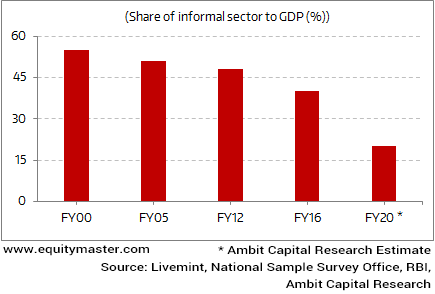
This could be a positive for stock market participants too, as the above transition will lead to a value migration from unorganised players to organised players. And companies with solid fundamentals and a competitive moat will capture most of this value.
Our Hidden Treasure team is already on the lookout for opportunities in such companies.


Comments
Log in or sign up to join the conversation.