

Asian stock markets are trading in green today with the Hang Seng trading up by 0.25%, while the Nikkei is up 0.28%. The Nikkei 225 is up 0.2%.
Meanwhile, Indian share markets have opened the day on a positive note. The BSE Sensex is trading higher by 58 points and the NSE Nifty is trading higher by 28 points. Meanwhile, S&P BSE Mid Cap and S&P BSE Small Cap are trading higher by 0.6% and 0.4% respectively. Gains are largely seen in metal stocks and healthcare stocks.
The rupee is trading at 64.53 against the US$.
The dream run in Indian share markets is showing little signs of coming to an end. This we say as domestic equity benchmarks BSE Sensex and NSE Nifty are trading near their life-time highs.
Buying interest is seen on the back of Indian Metrological Department's (IMD) forecast of a normal rainfall this calendar year and the ongoing earnings season.
As per a leading financial daily, India's largest two-wheeler firm Hero MotoCorp posted a 13.9% decline in net profits for the fourth quarter ended March 31, 2017 on a YoY basis.
Sales volumes during the quarter under review dropped by 5.8%. Hero MotoCorp sold 16,21,805 two-wheelers last quarter compared to 17,21,240 units sold in the fourth quarter of the last financial year.
The decline came on the back of sluggish demand for two-wheelers especially in the rural areas post the government's notebandi exercise.
Also, most of the brunt in profits came on higher discounting to liquidate stocks of BS-III compliant vehicle in March. Owing to this, the company is estimated to have taken a one-time hit of Rs 2 billion to liquidate BS III stocks last month.
One shall note that, as per ratings-firm ICRA, the two-wheeler industry is estimated to have incurred a loss of Rs 6 billion due to the three-day discount offered to customers after the Supreme Court ordered a ban on sale of BS-III vehicles.
The apex court on March 29 banned the sale and registration of BS-III category vehicles or those not compliant with Bharat Stage IV (BS IV) emission norms from April.
This will impact the revenues and profitability of Indian auto players and auto ancillaries.
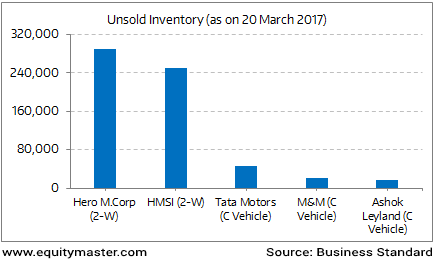
The decision by the SC left automobile companies saddled with a large inventory of BS-III vehicles estimated to be worth Rs 60-70 billion, as can be seen from the chart below:
Inventory Pile of Unsold BS III Vehicles
To minimise the damage, companies diverted the vehicles to export markets. Likewise, they also offered higher discounts to clear the inventory.
This was the second major blow for the automobile industry from the SC in the past 15 months. In December 2015, the SC had imposed a ban on sales of diesel vehicles with an engine of 2,000 cc and above in the National Capital Region. This ban was lifted in August 2016.
For investors, this comes as a reminder for considering the impact of regulatory risks such as the above while considering auto stocks for investment.
Comments
Log in or sign up to join the conversation.