

Asian stock markets are lower today as Chinese and Hong Kong shares fall. The Shanghai Composite is off 0.9% while the Hang Seng is down 2.1%. The Nikkei 225 is trading down by 1.1%. Meanwhile, the S&P 500 and Nasdaq closed slightly lower on Thursday after a Federal Reserve statement, and energy stocks were the biggest drag on the S&P as US crude oil prices fell.
Back home, India share markets have opened the day on a negative note. The BSE Sensex is trading down by 130 points while the NSE Nifty is trading down by 32 points. The BSE Mid Cap index and BSE Small Cap index both opened the day on a flat note.
Sectoral indices have opened the day on a mixed note with healthcare stocks and energy stocks witnessing maximum buying interest. While information technology stocks and metal stocks have opened the day in the red.
The rupee is trading at Rs 72.76 against the US$.
As per Moody's Investors Service, Indian economy will expand at 7.4% in 2018, but the growth will slow down to 7.3% in the next year as domestic demand tapers on higher borrowing costs due to rising interest rates.
As per the report, the economy grew 7.9% in the first half (January-June) of 2018, which reflects post demonetization base effect.
Stating that borrowing costs have already increased on higher interest rates, the Moody's said it expects the Reserve Bank of India will continue to steadily raise the benchmark rate through 2019, which will further dampen domestic demand.
These factors will limit the pace of the economy's growth over the next few years, with real GDP growth of 7.3% in 2019 and 2020, from around 7.4% in 2018.
It said the greatest downside risk to India's growth prospects stem from concerns about its financial sector.
The impact of higher global oil prices compounded by sharp rupee depreciation raises the cost of households' consumption basket and will weigh on households' capacity for other expenditures. Borrowing costs have already risen because of tightening monetary policy, it said.
Moody's said, in the short term while measures to stabilize the financial sector are put in place, credit growth is likely to slow.
Downside risks from a prolonged liquidity squeeze for non-bank financial institutions, which could lead to a sharper slowdown in their credit provision, remain, the report stated.
Moody's said global economic growth will slow in 2019 and 2020 to a little under 2.9% from an estimated 3.3% in 2018 and 2017.
It expects trade and geopolitical frictions between the US and China to persist for some time.
Moving on to the news from the US economy. The Federal Reserve left interest rates unchanged and stayed on course to hike in December as strong economic growth, higher tariffs and rising wages look set to spur inflation.
The central bank said that the economic activity has been rising at a strong rate and job gains have been strong, acknowledging a drop in the unemployment rate, while repeating its outlook for further gradual rate increases in its statement Thursday following a two-day meeting in Washington.
The statement overall reflected little change in the Fed's outlook for the economy since its last policy meeting in September. Inflation remained near its 2% target, unemployment fell, and risks to the economic outlook were still felt to be "roughly balanced."
Speaking of fed rates, how does a fed rate hike affect Indian investors?
Federal Reserve Rate Hike in the Past 3 Years
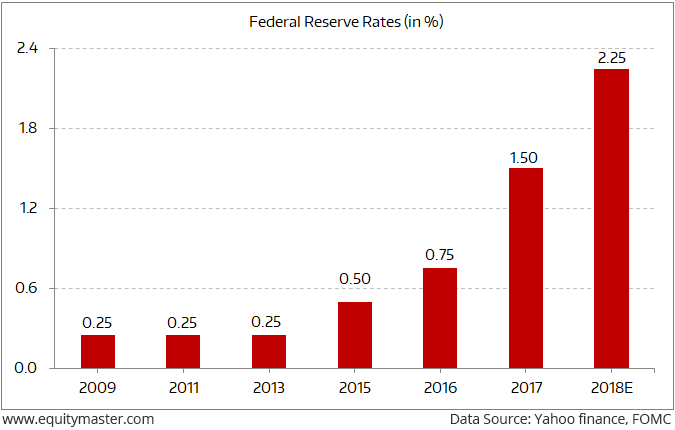
The instant effect is foreign money moving out of India's vaults. This means a slight correction in the share market in India, albeit temporarily.
While this might provide a good buying opportunity in long-term stocks, the main thing to look forward would be capex and earnings trends.
The first half of the fiscal year saw corporates stumble under the after-effects of demonetization and GST. The second half will show if these effects have been temporary or a long lasting one.
In the end, Indian investors are better off staying informed about the corporate earnings revival than Fed rate hikes.
Comments
Log in or sign up to join the conversation.