

Indian share markets continue to trade just below the dotted line amid weak global markets. Gains were largely seen in consumer durables stocks and FMCG stocks. Metal stocks and energy stocks witnessed majority of the selling pressure.
The BSE Sensex is trading lower by 45 points and the NSE Nifty is trading lower by 18 points. Meanwhile, the BSE Mid Cap index is trading up by 0.3% & the BSE Small Cap index is up by 0.4%. The rupee is trading at 64.43 to the US$.
Biocon share price surged over 2% after the European Medicines Agency (EMA) accepted for review Mylan's Marketing Authorisation Applications (MAA) for proposed biosimilar Trastuzumab and proposed biosimilar Pegfilgrastim.
Trastuzumab is used to treat certain HER2-positive breast and gastric cancers. Pegfilgrastim is used to reduce the duration of neutropenia (low count of neutrophils, a type of white blood cells) and the incidence of fever associated with neutropenia in adult patients treated with chemotherapy in certain types of cancer.
Reportedly, EMA acceptance of the submissions follows an earlier withdrawal of both applications in response to an audit conducted by the European inspecting authority of Biocon's drug product facility.
Biocon has completed the Corrective and Preventive Actions (CAPAs) outlined as a result of the audit observations. The CAPAs will be confirmed during re-inspection, which will be completed as part of the regulatory review process, the reports noted.
Further, Good Manufacturing Practice (GMP) compliance certificates for Biocon's two drug substance manufacturing facilities in Bangalore have been issued previously. Approval of these sites is key in the development and approval process as drug substance manufacture is core to the production of the actual biologic product in GMP compliance.
One shall note that, Biosimilars and Biologics are burgeoning sectors in 2017 also major scientific and technological advances, coupled with socio-demographic changes and increasing demand for medicines will revive the pharma industry's fortunes in another 10 to 20 years.
But given the complexity of biologics, will Indian companies be able to break some ground in this space?(Subscription Required). Going forward, whether the monetization of biosimilars prove to be a big growth driver for the company will be the key thing to watch out for.
Pharma stocks are trading on a mixed note with Natco Pharma share price and Orchid Pharma share price leading the gains.
Meanwhile, The BSE Sensex will include Private sector lenders - IndusInd Bank and Yes Bank from December 18, while two pharmaceutical stocks - Cipla and Lupin will exit the index.
With this change, the weight of the pharmaceutical industry in the index declines to a five-year low. As on Friday, four drug makers, namely, Sun Pharma (1.7% weight), Dr Reddy's Laboratories (0.8% weight), Lupin (0.6% weight), and Cipla (0.9% weight) together had a 4% weight in the Sensex. With Cipla and Lupin dropping from the index, the pharmaceutical industry's weight would drop to 2.5%, assuming that the rest of the Sensex stocks remain in the index. And with this, only two pharma companies will represent the Sensex.
The last time the index had only two pharma companies was in FY12 when the industry's weight in the index was 2.7%.
Pharma Weightage in BSE Sensex Going Down
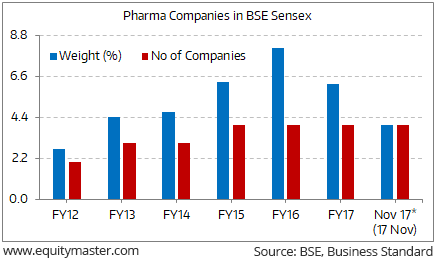
The changes in index composition reflect the challenges faced by Indian drugmakers, such as increased competition, pricing pressure, and regulatory hurdles in the key US market. However, this doesn't mean the end of the story for these companies, as there are many companies that make a comeback in indices once they start performing again.
In news from the international markets, Japan's industrial output rose 0.5% in October from 1% decline in September. The rise was seen due to increased production of semiconductors, car parts, and machines used to make flat panel displays.
The increase was less than expected but companies forecast production to rise strongly in November and December as robust overseas demand continues to support factory activity and broader economic growth.
Japanese retail sales fell 0.2% in October compared with the same month last year. The retail sales fell for the first time in a year on back of weak sales of food and beverages. This as mainly because of poor weather including two typhoons kept consumers away from stores and restaurants.
Japan's economy grew faster than expected in the third quarter thanks to strong exports, posting the longest period of uninterrupted growth in more than a decade, data showed earlier this month.
The government stuck to its moderately upbeat view on the economy in November, the monthly economic report showed. The government said that it remained on a recovery path helped by consumer spending and business investment.
The Bank of Japan (BOJ) is likely to point to the country's steady economic growth as an indication that price pressures will eventually build up and inflation reach the central bank's 2% target.
And thus, there has been an ongoing debate on whether to exit the ultra-easy money policy or keep the stimulus on.



Comments
Log in or sign up to join the conversation.