

Indian share markets rallied in the afternoon session as both Sensex and Nifty hit fresh all-time highs in early trade. The rally is a result of the positive sentiment among investors due to World Bank's latest report on Ease of Doing Business, where India, on the back of recent reforms, jumped 30 places to 100th rank.
At the closing bell, the BSE Sensex closed higher by 387 points. While, the NSE Nifty finished higher by 105 points. Meanwhile, the S&P BSE Midcap Index finished up by 0.4% while the S&P BSE Small Cap Index ended up by 0.6%.
BSE sectoral indices ended the day on a mixed note. Among them, the realty sector gained the most by 2.9%, followed by banking sector 2%, while consumer durables sector & automobiles sector both finished down by 0.6% & 0.2% respectively.
Bharti Airtel, SBI, ICICI Bank and HDFC were top gainers on BSE with gains to the tune of 8.5%, 4.6%, 4.4% and 2.7%, respectively.
Overseas, Asian equity markets finished broadly higher today hitting a 10-year high on the back of solid economic growth globally. The Nikkei 225 is up 1.86% while Hong Kong's Hang Seng is up 1.23% and China's Shanghai Composite is up 0.08%. European markets are broadly higher today with shares in Germany leading the region. The DAX is up 1.26% while France's CAC 40 is up 0.47% and London's FTSE 100 is up 0.13%.
The rupee was trading at Rs 64.77 against the US$ in the afternoon session. Oil prices were trading at US$ 55 at the time of writing.
In the news from oil & gas sector, as per an article in the Economic Times, Hindustan Petroleum Corporation Ltd (HPCL) is likely to acquire Mangalore Refinery and Petrochemicals (MRPL) in a share-swap deal.
The merger is likely to take place after Oil & Natural Gas Corporation (ONGC), the country's biggest oil and gas explorer, completes acquisition of HPCL in an all-cash deal by December or January.
The above development will make HPCL the second-largest oil refiner in India.
In the news from the banking space, bank credit to all major sectors has continued to witness slowdown.
This comes as credit to industry contracted by 0.4% on a year-on-year (YoY) basis in September 2017. This was as against an increase of 0.9% in September 2016.
Going by the individual sectors, as per the news, credit growth to major sub-sectors such as infrastructure, all engineering and vehicles, vehicle parts & transport equipment contracted. On the other hand, however, credit growth to basic metal & metal products, textiles and food processing witnessed a rising trend.
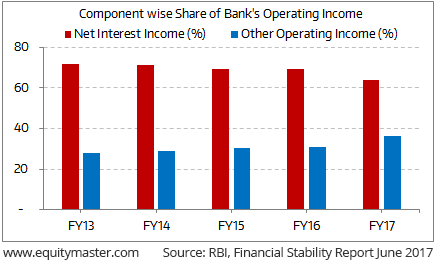
Note that the above slowdown in credit growth has been curtailing the Net Interest Income lately, which forms the core source of income for banks. Net Interest Income is the interest income earned after adjusting for interest expense made in the form of cost of funds and deposits.
If one has to look at the trend over the years, the share of Net Interest Income in the bank's total operating income fell from 72% in FY13 to 64% in FY17, as can be seen from the chart below:
Slow Credit Growth Impairs Core Income Driver for Banks
As per RBI data, the incremental credit-deposit ratio for banks crossed 100 in July 2017 for the first time since 2011. At the same time, the incremental investment-deposit ratio has been on a steady decline. This shows that as huge deposits garnered by public sector banks post notebandi are stabilising, lending is slowly gaining traction.
For the above reasons, public sector banks like State Bank of India, Bank of Baroda and Punjab National Bank recently reduced their savings rate by 0.5% as they shifted their focus towards lending. And going by the troubles, even the smaller banks are expected to follow the same route.
This will further pave way for rate cuts in corporate loans to fuel the pick-up in credit demand and boost interest income for banks. But for most of the smaller state-run banks saddled with huge bad loans, recovery may still be a long road ahead.
In the news from the commodity space, crude oil is witnessing buying interest today. Most of the gains are seen after it was reported that the Organisation of the Petroleum Exporting Countries (OPEC) has significantly improved compliance with its pledged supply cuts and Russia is also seen keeping to the deal.
Also, earlier last week, Saudi Arabia had said it was determined to end a supply glut.
As per the news, Saudi Arabia's Energy Minister Khalid al-Falih said that the focus remained on reducing oil stocks in industrialized countries to their five-year average. He also raised the prospect of prolonged output restraint once an OPEC-led supply-cutting pact ends.
One shall note that the OPEC and non-OPEC producers including Russia have agreed to reduce crude oil output by about 1.8 million barrels per day (bpd) until March in order to reduce global oil inventories and support prices.
The group is now in talks to extend the above expiry in March.
To keep a tab on the movements in crude oil and other commodities, you can read the stock market commentary from the Daily Profit Hunter team. Their commentary tracks the developments in the global economy as well as stock, currency, and commodity markets.
And here's a note from Profit Hunter:
Bharti Airtel declared its Q2FY18 results last evening. Consequently, the stock reacted positively, rallying 8% today.
In an earlier note, we had mentioned 450 as an important resistance level. This level has acted as a strong ceiling several times in the past eight years. Every time the stock found resistance from this level, it dragged down to trade between 250-280 levels.
But, the last time we reviewed this stock, it had broken out of this resistance level with strong volumes. And the question we raised was, 'Will this mark the end of an eight-year consolidation and lead to a new trend?'
And it seems the answer is, Yes.
The stock rallied more than 20% from the 450 level and today it touched a fresh ten-year high of 544. The volumes during this up move are also quite encouraging, indicating a strong buying interest.
How long can the bulls sustain this rally? Let's see what the trade winds have in store.
Bharti Airtel Hits 10-Year High




Comments
Log in or sign up to join the conversation.