

After opening the day flat, share markets in India witnessed negative trading activity throughout the day and ended well below the dotted line. Sectoral indices ended the day in red, with stocks in the FMCG sector and stocks in the consumer durables sector leading the losses.
At the closing bell, the BSE Sensex stood lower by 139 points (down 0.4%) and the NSE Nifty closed down by 43 points (down 0.4%). The BSE Mid Cap index ended the day down by 0.6%, while the BSE Small Cap index ended the day down by 0.5%.
Asian stock markets finished in red. As of the most recent closing prices, the Hang Seng was down by 2.6% and the Shanghai Composite was down by 1.7%. The Nikkei 225 was down by 0.5%. Meanwhile, European markets too were trading in the red. The FTSE 100 was down by 0.5%, The DAX, was down by 0.6% while the CAC 40 was down by 1%.
The rupee was trading at Rs 71.74 against the US$ in the afternoon session. Oil prices were trading at US$ 77.22 at the time of writing.
In news from stocks in the pharma sector. Lupin share price was in focus today as the company said that the US Food and Drug Administration (USFDA) inspected its Tarapur facility and issued one observation for the same.
The USFDA, after the completion of the inspection of the facility, issued a single observation in form 483 to the company.
As per USFDA, observations are made in Form 483 when investigators feel that conditions or practices in the facility are such that products may become adulterated or render injuries to health.
The inspection focused on current good manufacturing practices compliance and also on the safety of Lupin's Valsartan, Losartan and Irbesartan active pharmaceutical ingredients (commonly known as 'Sartans') in light of the safety alert issued by regulatory authorities on the NDMA (classified as a probable human carcinogen) impurity in Valsartan API (active pharmaceutical ingredient) supplied by some companies, it added.
Lupin said during the inspection, the U.S. FDA concluded that the manufacturing processes of Lupin 'Sartans' are safe with no chance of the presence of the NDMA impurity in the APIs.
The USFDA carried out an inspection of the company's Tarapur, Maharashtra facility from 27-31 August.
Indian pharma companies catering to the US markets are breathing a sigh of relief. After being adversely affected by import bans and the suspension of new drug approvals from manufacturing facilities in the past three years, there has been a sharp pick-up in new drug approvals in FY17. Lupin share price ended the day up by 6.2%.
With an aim to lower the overall health care costs in the country, the US Food and Drug Administration (FDA) approved a record 763 generic drugs for the financial year ending 30th September. As per Mint Analysis, Indian pharma companies received 295 approvals accounting for 40% of the overall approvals during the year.
Generic Drug Approvals Hit the Roof
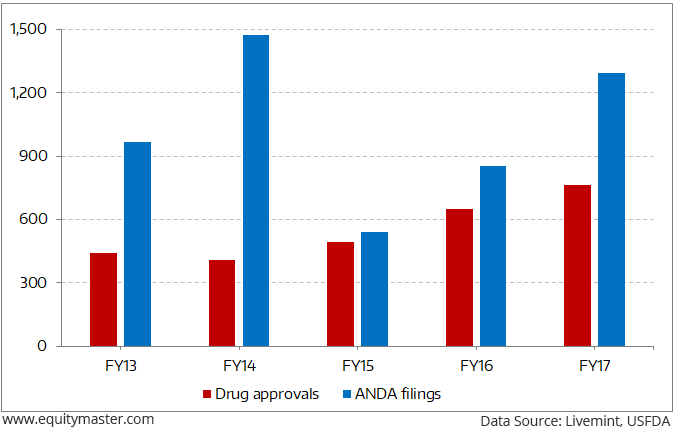
Even the total filings of abbreviated new drug applications (ANDAs) for generic drugs rose to 1,292 in FY17 from 852 in the previous year. While faster approvals expedite the commercialization of product pipelines of domestic pharma companies spurring growth. At the same time, however, it has raised the intensity of competition resulting in pricing pressures. The price erosion has been further compounded by a consolidation among US distributors and the decline in the number of products going off-patent over the past few years.
In other words, acceleration in generic drug approvals is like a double-edged sword. The growth boost can be quickly offset by the ensuing pricing pressures. Pharma companies that invest in creating a pipeline of complex generics or building competencies in alternative dosage forms are better equipped to tackle the changing dynamics in the US generics market.
Moving on to news about the economy. India's services sector witnessed a slowdown in expansion in August on subdued demand and new business orders.
India's dominant services industry activity showed signs of slowing as new business continued to increase. Albeit at a slower pace, the country's predominant sector witnessed expansion, with new orders rising due to an improvement, according to the Nikkei Services Purchasing Managers' Index (PMI) survey by Markit.
The Services PMI is the reading of the country's services sector output and is updated monthly. A reading above 50 indicates expansion, while any score below the mark denotes contraction.
A moderate slowdown in new business resulted in a monthly decrease in activity. The services PMI for August finished at 51.5, from 54.2 in July.
On the price front, an uncertain global climate, currency weakness and a strong inflation may continue to put pressure on the central bank to hike interest rates over the coming months.
The data comes as the Reserve Bank of India's (RBI's) Monetary Policy Committee hiked repo rate by 25 basis points to 6.5% in its third bi-monthly monetary policy review of 2018-19.
The latest PMI data suggests that the recent surge in the price of oil, India's biggest import item, and a sharp weakness in the rupee will keep risks for inflation remain on the upside.



Comments
Log in or sign up to join the conversation.