

After opening the day in green, share markets in India witnessed negative trading activity throughout the day, and ended below the dotted line. Sectoral indices ended the day in mixed, with stocks in the FMCG sector and stocks in the IT sector leading the losses.
At the closing bell, the BSE Sensex stood lower by 10 points (down 0.1%) and the NSE Nifty closed down by 6 points (down 0.1%). The BSE Mid Cap index ended the day up 1.21, while the BSE Small Cap index ended the day up by 1%.
Asian stock markets finished mixed. As of the most recent closing prices, the Hang Seng was up by 1.6% and the Shanghai Composite was up by 0.7%. The Nikkei 225 was down by 1.1%. Meanwhile, European markets were trading in green. The FTSE 100 was up by 0.5%, The DAX, was up by 0.6% while the CAC 40 was up by 0.4%.
The rupee was trading at Rs 73.57 against the US$ in the afternoon session. Oil prices were trading at US$ 74.22 at the time of writing.
In news from the Goods and Service Tax (GST) space. GST collections for October crossed the Rs 1 trillion mark after 5 months on the back festive demand and anti-evasion measures.
The Finance Ministry said that over 6.7 million businesses filed GST returns in October and deposited Rs 1,007 billion in taxes.
GST revenue had first crossed the landmark figure in April when the collections were Rs 1,035 billion. Since then collections have maintained above Rs 900 billion mark.
The October revenue collections reflect the purchase and sales activities conducted in the month of September.
The pick-up in collections will provide respite to a government struggling to meet its fiscal deficit target.
The buoyancy in tax collections could be attributed to consumer spending for Diwali and improvement in compliances, but the higher numbers could be partly due to the closing adjustment
The latest Economic Survey released in January this year revealed that more than 10 million taxpayers have registered under GST, as against 6.5 million registered under the old tax regime, but after discounting for multiple counting.
Further, the direct taxpayer base has increased by around 1.8 million due to demonetization and GST, the Survey said.
The Survey, authored by Chief Economic Advisor Arvind Subramanian said, preliminary analysis of data shows GST registrants rose mainly on account of large increase in voluntary registrations, especially by small enterprises that buy from large enterprises and want to avail themselves of input tax credits.
India's Tax Revenues to Get a GST Boost
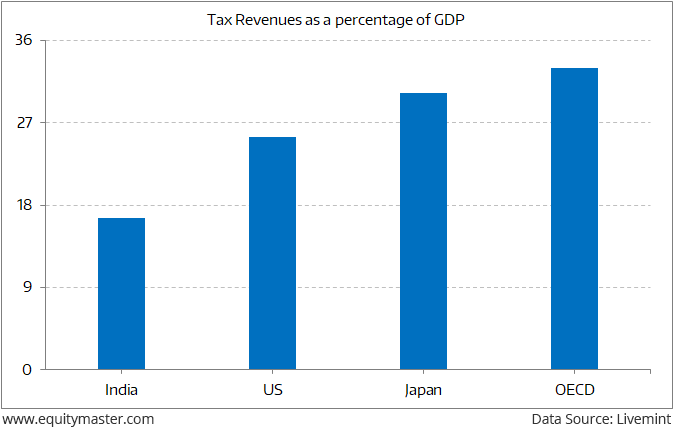
Implications of this increase in tax compliance and widening of tax base is clear. India's tax revenues will get a much-needed boost in the coming future. This augurs well for the country that has one of the lowest tax revenue as a percentage of GDP compared with other countries. We believe this higher tax revenue receipt will help bolster the country's financials and also provide further ammunition for the government to spend on social welfare and providing additional infrastructure to its citizens.
A wider tax base will also allow the government to lower its tax rates in future.
After studying these and other finer aspects of GST, our in-house macroeconomics guru Vivek Kaul, has penned his views on what could go right and wrong. Get a balanced perspective on the entire GST saga from Vivek in the report - The Good, the Sad and the Terrible (GST).
Moving on to news from the manufacturing sector. Activity in India's manufacturing sector expanded at its fastest pace in four months in October supported by strong domestic and export orders.
According to the Nikkei Purchasing Managers' Index (PMI) survey by Markit, India's manufacturing sector continued its fast pace of expansion in October after a good showing in September.
The PMI is the reading of the country's manufacturing sector output and is updated monthly. A reading above 50 indicates expansion, while any score below the mark denotes contraction.
PMI in October stood at 52.3, an increase from the 52.2 reading in September, indicating a sustained expansion. This is the fifteenth consecutive month that the manufacturing PMI remained above the 50-point mark, which separates expansion from contraction.
The surge came on the back of increase in demand, technological advancements and favorable market conditions, the survey said. Job creation was the strongest since December 2017, it said, adding that businesses were able to lower their outstanding business volumes for the second straight month.
On the prices front, a build-up of inflationary pressures continued as input cost and output inflation was at the strongest since February due to the upswing in global oil prices.
Though Indian manufacturers remained cheerful about growth prospects, worries about the possibility of unexpected policy decisions and a risk of an international trade war weighed on confidence.



Comments
Log in or sign up to join the conversation.