

After opening the day flat, share markets in India witnessed volatile trading activity throughout the day and ended the day flat. All sectoral indices ended in the red, with stocks in the realty sector and stocks in the metal sector leading the losses.
At the closing bell, the BSE Sensex stood higher by 16 points (up 0.1%) and the NSE Nifty closed down by 21 points (down 0.2%). The BSE Mid Cap index ended the day down 1.1%, while the BSE Small Cap index ended the day down by 1.2%.
Asian stock markets finished in red. As of the most recent closing prices, the Hang Seng was down by 3% and the Shanghai Composite was down by 0.1%. The Nikkei 225 was down by 0.2%. Meanwhile, European markets were trading in green. The FTSE 100 was up by 0.4%, The DAX, was up by 1.1% while the CAC 40 was up by 0.2%.
The rupee was trading at Rs 66.64 against the US$ in the afternoon session. Oil prices were trading at US$ 67.39 at the time of writing.
In news from the Goods and Service Tax (GST) space. GST collections set a record high in April 2018 as the total collections hit the Rs 1 trillion mark for the month.
To be sure, GST revenue buoyancy is expected to improve in the coming months with the implementation of the e-way bill or electronic tracking of goods movement from 1 April. This is expected to become a deterrent for tax evaders looking to keep transactions completely off their books or to under-report their turnover.The buoyancy in tax collections could be attributed to economic recovery and improvement in compliances, the finance ministry said in a statement, but cautioned that the higher numbers could be partly due to the payment of tax arrears.
The latest Economic Survey released in January this year revealed that more than 10 million taxpayers have registered under GST, as against 6.5 million registered under the old tax regime, but after discounting for multiple counting.
Further, the direct taxpayer base has increased by around 1.8 million due to demonetization and GST, the Survey said.
The Survey, authored by Chief Economic Advisor Arvind Subramanian said, preliminary analysis of data shows GST registrants rose mainly on account of large increase in voluntary registrations, especially by small enterprises that buy from large enterprises and want to avail themselves of input tax credits.
India's Tax Revenues to Get a GST Boost
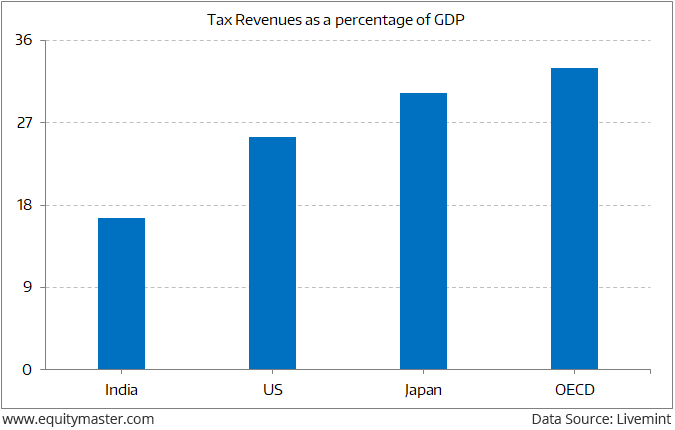
Implications of this increase in tax compliance and widening of the tax base is clear. India's tax revenues will get a much-needed boost in the coming future. This augurs well for the country that has one of the lowest tax revenue as a percentage of GDP compared with other countries. We believe this higher tax revenue receipt will help bolster the country's financials and also provide further ammunition for the government to spend on social welfare and providing additional infrastructure to its citizens.
A wider tax base will also allow the government to lower its tax rates in future.
After studying these and other finer aspects of GST, our in-house macroeconomics guru Vivek Kaul, has penned his views on what could go right and wrong. Get a balanced perspective on the entire GST saga from Vivek in the report - The Good, the Sad and the Terrible (GST).
Moving on to news from stocks in the FMCG space. Dabur share price hit an all-time high today after the FMCG major declared results for the quarter ended March 2018.
The stock surged well over 3% to scale all-time high levels on the back of a strong quarterly performance.
The company reported a 19% year on year (yoy) increase in the March quarter as volumes in domestic packaged goods business grew 7.7%. The FMCG outfit reported a consolidated net profit of Rs 3.96 billion as compared to Rs 3.3 billion a year ago.
Dabur's revenues too showed healthy growth. Revenues for the quarter stood at Rs 20.3 billion, up 6.2% from 19.1 billion a year ago. However, net of GST, the comparable revenues grew by 11.1%.
During the quarter, Dabur's operating margin touched a record 27.2%.
According to the company, its shampoo business reported a 31% growth in the quarter ended 31 March 2018, followed by home at 24%, health supplements and oral care at 14%, health care at 11% and hair oil business at 9%
Dabur share price ended the day up 0.5%.
And here's a note from Profit Hunter:
Vedanta is among the top loser in the Nifty 50 Index. Let's have look at its chart.
The stock rallied strongly from its February 2016 low of 58 to a high of 346 in November 2017, clocking a massive 500% gain. It corrected nearly 19% from this high to find support from 280 level in December 2017. The level which acted as a resistance on the way up is now acting as a support for the stock.
By November 2017, it had rallied to re-test its high but failed to cross over it. In March 2018, the stock slipped back to the 280 level from where it had bounced up nearly 12%.
But it couldn't hold its position for long and corrected. Today, the stock is 5% down and is trading very close to 280 level.
So it will be interesting to see if the stock will feature a rebound from this level, or it will break the support this time around? If it does, it might worry the bulls.
Vedanta Trading at a Crucial Level
(Click on image to enlarge)




Comments
Log in or sign up to join the conversation.