

Indian share markets ended their volatile day on a positive note today.
Gains were seen in the IT sector and energy sector, while telecom stocks witnessed selling pressure.
At the closing bell, the BSE Sensex stood higher by 66 points (up 0.2%) and the NSE Nifty closed higher by 4 points (up 0.03%).
The BSE Mid Cap index ended up by 0.1%, while the BSE Small Cap index ended the day up by 0.4%.
Asian stock markets finished on a positive note as of the most recent closing prices. The Hang Seng stood up by 0.4% and the Nikkei was trading up by 0.3%, while the Shanghai Composite was trading up by 0.6%.
European markets were trading on a negative note. The FTSE 100 was down by 0.1%. The DAX was trading down by 0.4%, while the CAC 40 was down by 0.6%.
The rupee was trading at 69.70 to the US$ at the time of writing.
Speaking of Indian share markets, what should be your investing strategy be for Modi's second term?
As per Richa Agarwal, Modi's victory seems to be the inflection point for a rebound in smallcap stocks.
In the last week itself, the small cap index is up nearly 8%. And this is just the beginning...
You see, over the last one and a half year, a huge gap has emerged between smallcap index and Sensex.
Despite a lackluster performance on earnings front for both, smallcap stocks crashed...while Sensex flirted with lifetime highs.
Have a look at the chart below.
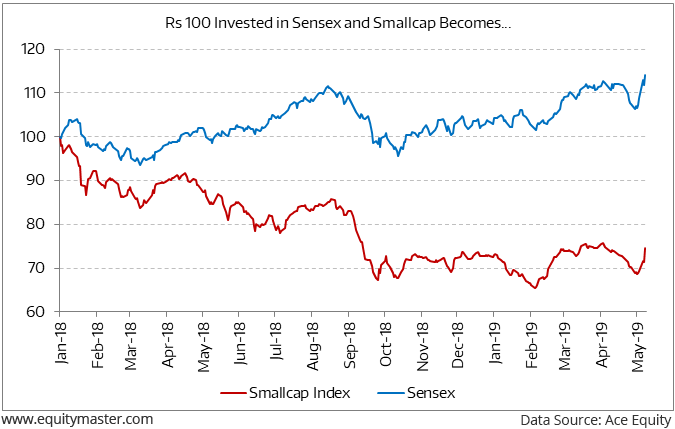
Since Jan 2018, the Sensex has gained 14% while smallcap index has lost 25%. That's a relative underperformance of 39%.
But this dichotomy cannot keep on growing forever.
As Richa writes in today's edition of The 5 Minute WrapUp...
- You see, last time the market showed a similar trend was in the year 2013...just before Modi rose to power.
Between January 2013 to August 2013, the smallcap index has crashed by over 30%, while Sensex stayed put. And smallcaps were approached with the same scepticism they have witnessed over the last year.
But what happened after that was even more interesting.
Within a few months post August 2013, the smallcap index caught up with the Sensex. And it didn't just catch up.
Under Modi's first term, until January 2018, the smallcap index rose nearly four times versus a less than 2 times gain in Sensex.
As per Richa, history is going to repeat itself.
If you are interested in riding the volatility and earning great returns in the long term, you could join Richa's small cap club and invest in these 4 solid small caps.
In the news from the commodity space, India's crude oil production during April stood at 2.71 million tonnes while gas production was at 2655.89 million standard cubic meters (mscm).
According to data shared by the Ministry of Petroleum and Natural Gas, India's crude oil production during April was 6.9% lower than April 2018 levels.
Natural gas production was at 0.26% lower than April 2018 production. Refinery production was at 20.70 million tonnes, 4.2% higher compared to April 2018 production.
Speaking of crude oil, Vijay Bhambwani, editor of Weekly Cash Alerts, called the US President Donald Trump's bluff on crude oil in his recent article. Here's an excerpt of what he wrote...
- From 2018 US is the largest oil producing country in the world with 13.4% of the global oil output daily.
The USA has jumped ahead of Saudi Arabia and Russia in oil output. My question to every oil trader out there is this - as long as the USA was an importer, it made sense to push for lower oil prices. There were tangible benefits in doing so.
President Donald Trump runs the world's largest debtor nation. One that is gasping for export income and a strong dollar. A firm USD ensures easier servicing and repayment of debt and vice versa. So now that Trump wants to export oil, and earn petro dollars does it benefit him if oil prices were to go up or down? So why does he tweet for lower oil prices?
To know more, you can read Vijay's entire article here: Crude Oil - What 'Trump Nation' Really Wants
In the news from the banking sector, Punjab National Bank (PNB) share price was in focus today as the state lender reported its March quarter results.
The bank narrowed its loss to Rs 47.5 billion in January-March quarter and also improved its asset quality and provision coverage ratio.
It had reported a huge loss of Rs 134.2 billion in the corresponding period last fiscal on the back of Nirav Modi-led alleged fraud.
The lender's net interest income grew 37.1% from a year ago to Rs 42 billion in the March quarter.
During the quarter, the bank improved its provision coverage ratio to 74.5% against 68.9% in the December quarter. However, net interest margin contracted sequentially to 2.45% in March against 2.64% in the previous quarter.
On the assets front, gross non-performing assets (NPAs) as a percentage of gross advances reduced to 15.5% against 16.3% in the previous quarter. Likewise, the net NPAs as a percentage of net advances also dropped to 6.56% against 8.22% sequentially.
Market participants were also tracking Yes Bank share price today after reports suggested that the lender is looking to exit the asset management business.
As per the news, the lender believes that scaling up operations at Yes Asset Management could be difficult amid intensifying competition. The bank could either sell the business to another asset manager, or wind it up over a period of time.
DHFL share price was in focus today after the ministry of home affairs (MHA) issued a lookout notice against DHFL promoters in an investigation pertaining to shell companies.
The instruction has come on request of the Ministry of Corporate Affairs (MCA), which had earlier found shell companies associated with DHFL.
In a reply to exchanges, the company clarified that the company and/or its promoter-directors have not received any communication from the authorities regarding issuance of any look-out notice. The company is currently focused in getting a strategic partner, fulfilling all its obligations on time and in building strategy for the company's back-to-business growth.
Earlier in January, Cobrapost had alleged that the promoters of the company had siphoned off Rs 310 billion.
Last week, the NBFC witnessed huge selling pressure after the housing finance company said it has decided to temporarily stop taking fresh deposits and hold premature withdrawals from existing deposit schemes as it tries to manage its tight liquidity position.
The above move came after the recent downgrade of the credit rating of DHFL's fixed deposit (FD) programme.
Note that DHFL's fixed deposit programme was downgraded by Brickwork Ratings India Ltd on Friday to BBB+ from AA- and had been put on credit watch with negative implications due to the limited build-up of liquidity. In its rating release, Brickwork Ratings pegged the size of DHFL's fixed deposit programme at Rs 120 billion.



Comments
Log in or sign up to join the conversation.