

Indian share markets continued to trade negative on caution that Union Budget could push up inflation and prompt the central bank to raise interest rates soon. At the closing bell, the BSE Sensex finished lower by 309 points. While, the NSE Nifty finished lower by 94 points. Meanwhile, the S&P BSE Midcap Index and S&P BSE Small Cap Index ended down by 0.1% & 0.4% respectively.
Sectoral indices ended the day on a mixed note with automobile stocks and power stocks leading the pack of gainers. While, capital goods stocks and bank stocks witnessed maximum selling pressure.
Overseas, Asian stock markets finished mixed as of the most recent closing prices. The Shanghai Composite gained 0.73%, while the Nikkei 225 led the Hang Seng lower. They fell 2.55% and 1.09% respectively. European markets also opened sharply down as futures trading indicated a weaker US opening. In initial European trade, London's FTSE 100fell 1%, while the Europe-wide Stoxx 600 lost 0.8%.
The rupee was trading at Rs 64.03 against the US$ in the afternoon session.
Bharti Airtel share price was among the top gainers on the bourses today. The surge came after the company said that Singapore Telecommunications Ltd (Singtel) will increase its stake in Bharti Airtel, by investing Rs 26.5 billion in parent Bharti Telecom.
Steel stocks ended the day on a mixed note with Adhunik Metaliks & Bhushan Steel leading the loses. As per an article in a leading financial daily, JSW Steel, Tata Steel and a group of employees along with a private equity firm have submitted bids for the bankrupt Bhushan Steel.
Bhushan Steel, which involves a Rs 440 billion default, is the biggest bankruptcy to go under the hammer thus far after the Reserve Bank of India and the government pushed banks to clean up the bad loan mess through the Insolvency and Bankruptcy Code (IBC).
As many as 451 cases with an exposure of Rs 1.28 trillion are pending in the bankruptcy courts. Essar Steel and Electrosteel Steels are the other big metal companies undergoing the bankruptcy process.
Bhushan Steel has an annual steel capacity of 5 million tonnes.
Further, the resolution professional has set the liquidation value at Rs 150 billion, below which no bid will be accepted. Most bids are expected to be in the Rs 250-300 billion range.
Interestingly, bidding for Bhushan has witnessed some twists in the past month with many global giants showing initial interest then withdrawing from the race.
For JSW, Bhushan Steel will provide a gateway to the east and north, as most of its existing facilities are concentrated in the east. For Tata Steel, which is predominantly in the east, acquiring the company makes sense as its grip on the eastern region will continue.
Moving on to the news from the economy. In the latest development, activity in India's services sector grew at the fastest pace in three months in January, with recovery in new business orders.
Signaling a further increase in activity at the start of 2018, the seasonally adjusted Nikkei Services Business Activity Index remained above the neutral mark of 50 in January, posting reading at 51.7, up from 50.9 in December.
Besides, as manufacturing production growth eased from December's 60-month high, the Nikkei Composite Output Index, which measures both manufacturing and services, fell to 52.5 in January from 53 in December.
Reportedly, the new orders rose for the third consecutive month at manufacturing companies.
The higher backlogs partly reflected delayed customer payments for orders. Reflecting improved demand conditions, manufacturers raised their payroll numbers for the sixth consecutive during January.
Job creation accelerated to the second strongest in over six-and-a-half years, but, as firms struggled in receiving timely payments, the Goods and Services Tax (GST) continued to be a key constraint to businesses and the service sector remained a laggard relative to its manufacturing counterpart.
As per the report, Indian manufacturers registered a further marked increase in their average cost burdens during January. Subsequently, manufacturing companies reportedly raised their output charges to pass on higher input costs to consumers.
On inflation front, the service sector input price inflation stabilized at a moderate pace in January, remaining below the long-run survey average. That said, costs rose sufficiently to generate another increase in prices charged by service providers, with those in the Information & Communication sector registering the strongest inflation of charges.
One shall note that, despite contributing a major chunk of economic growth, the sector's contribution to total employment is miniscule. The gap between services sector employment and total employment is wide.
In most economies, both growing and developed, the sector's GVA rate is similar to the sector's contribution to total employment.
For example, in Mexico, services are 60.4% of the overall economy and provide 61.2% of the jobs. In India, the sector is 53.2% of the overall economy but only contributes 28.6% to total employment.
India's Services Sector Growth Not in Line with Employment Growth
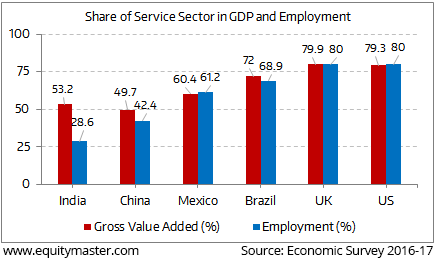
The services sector in India, however, remains dynamic and growth is very high. But that growth is not commensurate with employment growth, which could very well be a cause for concern going forward as the sector takes an even more prominent role in the economy without providing significant employment growth.
And here's a note from Profit Hunter:
The benchmark indices are down by a percent. The heavy weights like Housing Development Finance Corporation (HDFC) Ltd (-4%) and Larsen and turbo (-3.4%) are weighing on the index.
Last time we reviewed HDFC Ltd, it had broken out of the 1,650 - 1,800 range on the upside with heavy volumes. This indicated a resumption of the uptrend. As a result, the stock rallied nearly 10% from the break-out level to touch a life-time high of 1,986 just a few days back.
But as the broader market indices corrected in the last one week, the stock also witnessed selling pressure. Today, it opened gap down and is trading 4.5% lower. At the moment, it is trading near the break-out level (1,800).
After a stock breaks out of a range on the upside, the break-out level usually acts as a support during a subsequent decline. This means the previous resistance level act as support level post the break out.
So will the stock find a support here or will it continue to decline? Let's wait and watch...
HDFC Ltd Plunges 4% for the Day
(Click on image to enlarge)




Comments
Log in or sign up to join the conversation.