

Indian share markets witnessed selling pressure throughout the day today, tracking weak global cues as coronavirus cases continue to surge across the world.
The Standard and Poor's warning that the Indian economy is in deep trouble also weighed on investor sentiment. The rating agency has projected the Indian economy's growth to contract by 5% this fiscal.
Further, geopolitical tensions like India-China border issue and US-China trade dispute kept investors on edge.
At the closing bell, the BSE Sensex stood lower by 210 points, down 0.6%. The NSE Nifty closed down by 71 points, down 0.7%.
SGX Nifty was trading at 10,269, down by 63 points, at the time of writing.
The BSE Mid Cap index ended the day down by 1.4%, while the BSE Small Cap index ended down by 1.2%.
Among sectoral indices, metal stocks and realty stocks were among the hardest hit.
Asian stock markets fell today as the number of coronavirus cases around the world exceeded 10 million and the epidemic accelerated in the United States.
As of the most recent closing prices, the Hang Seng ended down by 1% while the Shanghai Composite stood lower by 0.6%. The Nikkei declined 2.3%.
On Friday, the Dow Jones index tumbled more than 700 points as some states were forced to pause their reopening amid rising Covid-19 cases.
Gold prices are trading up by 0.1% at Rs 48,227 per 10 grams.
The rupee is trading at 75.58 against the US$.
Moving on, market participants were tracking Ruchi Soya's share price.
The unstoppable rally in the shares of Ruchi Soya, which Baba Ramdev's Patanjali Group acquired last year in a bankruptcy sale, has made the edible oil maker one of the top 60 companies on Dalal Street in terms of market capitalization.
In terms of market-cap, Ruchi Soya is now bigger than companies like Lupin, Torrent Pharma, Tata Steel, Ambuja Cements, HPCL, Grasim, Punjab National Bank, Hindalco, UPL, Colgate-Palmolive and Havells India.
After a sharp rally in the stock price, analysts have turned cautious on the stock. They feel markets regulator should take note and probe what is driving the ongoing rally on the counter.
They said the market regulator should ask the company when it is planning to meet the minimum public shareholding norms of 25%.
As of March 31, 2020, the promoters held a 99.03% stake in the company. Retail investors currently own less than 1% in the company.
Shares of the company declined 5% today post its March quarter earnings.
The company on Friday posted a net loss of Rs 412.4 million for the quarter ended March 31 against a net profit of Rs 321 million posted for the corresponding quarter last year.
Net sales came in at Rs 31.9 billion, up 1.42% from Rs 31.5 billion in March quarter of 2019.
In news from the FMCG sector, shares of ITC gained as much as 4% today after the company on Friday reported a 9.1% rise in standalone net profit rose to Rs 38 billion for the quarter ended March 31, 2020 (Q4FY20).
The increase in ITC's profit came on account of a lower corporate tax outgo despite a decline in revenues.
ITC's revenue from operations declined 6.3% to Rs 113 billion in the fourth quarter of the financial year 2019-20, from Rs 120.6 billion in the year-ago period.
The company's profit before tax (PBT) declined by 7.8% to Rs 47.4 billion. The fall in PBT was due to a sharp decline in consumption, especially in rural areas due to the COVID-19 pandemic.
During the quarter, ITC paid Rs 8.5 billion in taxes, as against Rs 15.7 billion in the same quarter a year ago.
ITC said that in the initial stages, the pandemic had a significant impact on its hotels, education, and stationery products businesses as it coincided with the peak period and the onset of the school season, which were closed owing to the pandemic.
The company's board recommended a dividend of Rs 10.15 per share for the financial year 2019-20.
ITC share price ended the day up by 1.4%.
To know more, you can read ITC's latest result analysis on our website.
In other news, Hindustan Unilever (HUL) was among the top buzzing stocks today.
HUL got a long-awaited boost on the Nifty 50 index following a delayed rebalancing that took place on June 26, making it the largest FMCG stock in the index.
HUL's weightage in the Nifty now stands at 4.4%, as against the previous weightage of 3.63% before the rebalancing.
ITC had the highest weightage among FMCG stock in the Nifty but HUL has caught up with it.
As per reports, there are two factors behind the change, i.e. stock price outperformance and higher free-float market capitalization.
In April, HUL informed the stock exchanges that it would be allotting 186.4 million of its shares to GSK Consumer Healthcare shareholders under the pre-agreed ratio of 439 HUL shares for every 100 GSK shares. This resulted in higher free-float market capitalization.
Last week, the company announced that it would stop using the word 'Fair' in its 'Fair & Lovely' skin cream, in a move that comes after years of protests that it promotes prejudice over skin color.
HUL share price ended the day up by 1.2%.
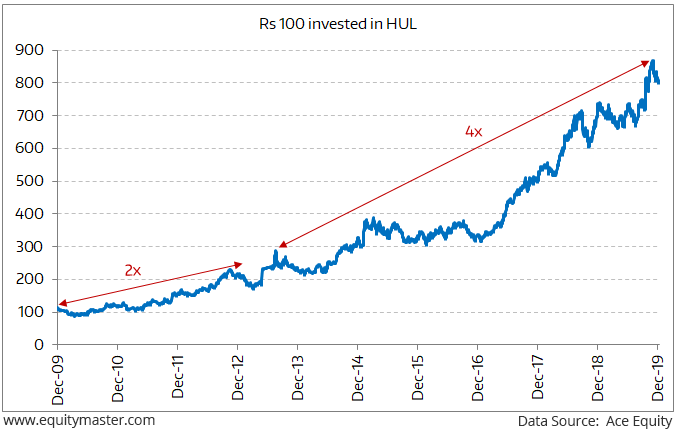
Here's an interesting data of HUL, until 2013, the company had products and categories customized for Indian market. That made it difficult for the company to sell its overseas products in the country. Nor could it reach out enough to a global customer base with Indian products.
A change of strategy suddenly opened up Unilever's global markets to HUL for both sourcing and selling.
The result was evident in profit growth and stock price over the next few years.
Stock of HUL Had the Crorepati Trigger in 2013
Comments
Log in or sign up to join the conversation.