

India share markets witnessed selling pressure during closing hours and ended their day on a negative note.
At the closing bell, the BSE Sensex stood lower by 126 points (down 0.3%) and the NSE Nifty stood down by 54 points (down 0.5%).
The BSE Mid Cap index ended the day down 1%, while the BSE Small Cap index ended the day down by 0.7%.
Sectoral indices ended on a mixed note. Stocks in the telecom sector and metal sector witnessed huge selling pressure, while realty stocks were trading in the green.
The rupee was trading at 71.54 against the US$.
Asian stock markets finished on a mixed note. As of the most recent closing prices, the Hang Seng was down by 0.20% and the Shanghai Composite was up by 0.31%. The Nikkei 225 was down 0.64%.
European markets were also trading on a mixed note. The FTSE 100 was down by 0.58%. The DAX was trading up by 0.86%, while the CAC 40 was also up by 0.13%.
In the news from the capital markets space, foreign institutional investors (FIIs) pumped a net of US$ 3.2 billion into Indian equities in November. This number was the highest seen so far this financial year.
However, market watchers warn that the so-called hot money flow is part of incremental allocation to emerging markets.
Note that in the third-week of November, EPFR-tracked emerging markets equity funds continued to benefit from the easing bias of major central banks and hope that the US and China would reach an agreement on trade issues.
During the week ending November 20, emerging markets funds posted their fourth consecutive inflows, with major regional groups taking in fresh money as retail redemptions moderated for the second consecutive week, fund flow tracker EPFR said in a note.
However, India-specific flows are yet to revive on lack of near-term catalysts, specifically after economic growth tumbled to its lowest level in more than six years.
For the year-to-date period, FIIs have invested a net of US$ 13.5 billion in Indian shares, having been net buyers for three months in a row.
How this pans out in the coming months remains to be seen.
Moving on to the news from the commodity space, India's gold imports in November jumped 78% from a month earlier. This was the highest level in 5 months and the growth came in as jewellers in the world's second-biggest consumer of the metal restocked after a fall in prices.
As per a government source, New Delhi imported 71 tonnes of gold in November, compared with 40 tonnes in October.
Imports, however, were down 16% from November 2018.
In value terms, November imports totalled US$ 2.94 billion, slightly higher than last year's US$ 2.76 billion.
It would be interesting to track the above numbers in coming months and see how this trend pans out. Meanwhile, we will keep you updated on all the developments from this space.
Speaking of gold, how lucrative gold has been as a long-term investment in India?
The chart below shows the annual returns on gold over the last 15 years...
Gold Has Been a Shining Long-Term Investment
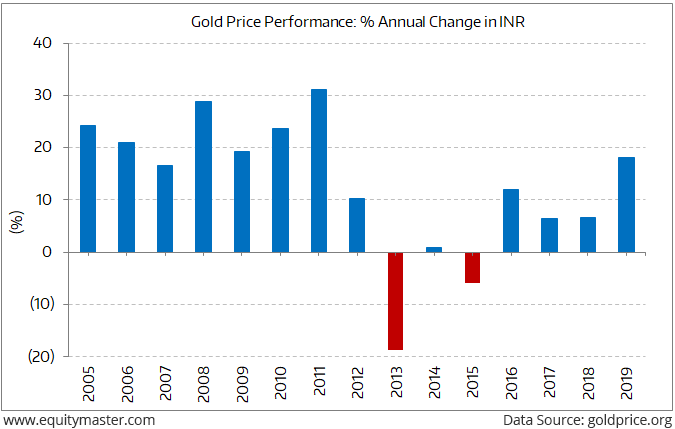
As you can see, barring just two years - 2013 and 2015, gold has delivered positive returns in 13 of the last 15 years.



Comments
Log in or sign up to join the conversation.