

After opening the day on a flat note, share markets in India witnessed choppy trades and are trading in red. Except for stocks in the IT sector, all sectoral indices are trading in red. Stocks in the pharma sector and stocks in the banking sector are leading the losses.
The BSE Sensex is trading down by 104 points (down 0.3%), and the NSE Nifty is trading down by 40 points (down 0.4%). Meanwhile, the BSE Mid Cap index is trading down by 0.7%, while the BSE Small Cap index is trading down by 0.6% The rupee is trading at 64.31 to the US$.
Stocks in the metals sector are trading are in focus today, after the government imposed anti-dumping duty on imports of steel products for five years.
Continuing its tough stance against cheap steel imports, the government levied anti-dumping duty on 47 steel products.
The anti-dumping duty is to be levied on hot-rolled flat products of alloy or non-alloy steel, originating in or exported from China, Japan, Korea, Russia, Brazil and Indonesia.
An anti-dumping duty is a protectionist tariff that a domestic government imposes on foreign imports that it believes are priced below fair market value.
Dumping is a process where a company exports a product at a price lower than the price it normally charges on its own home market.
The government has consistently resorted to protectionist measures as regards the steel sector, to protect steel companies from international competition.
Consequently, India's steel imports dropped 36% in 2016-17 to 7.4 million tons (MT). Meanwhile, steel exports in 2016-17 registered a growth of 102%. But, the steel makers are chasing imports out by ramping up production. In March, domestic steel output rose by 17.4% YoY, as large private steel producers such as Tata Steel and JSW Steel ramped up output.
India has become a net exporter of steel in 2016-17 as imports fell gradually.
No Takers for Domestic Steel
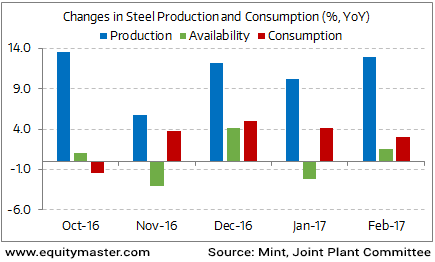
The quantum jump in exports comes as the government is providing extensive support to the domestic steel industry by way of trade remedial measures, including anti-dumping.
But the bigger concern is weak consumption growth. The consumption data over the past few months clearly show that there are no takers for domestic steel.
We do not think the trend is sustainable. And unless domestic consumption picks up, steel producers may have to take price cuts to utilize their capacities.
In news from stocks in the pharma sector. Glenmark pharma share price hit a seven year low in today's trade after the company declared its March quarter results. The stock plunged over 16%.
Glenmark Pharma posted a 23% rise in net profits in the fourth quarter of FY17 as compared to the previous year.
On a year-on-year (yoy) basis, Glenmark's net profit rose to Rs 1,837 million for the quarter compared to the previous year's Rs 148 million, while revenues rose by 6% to Rs 24.6 billion.
Despite the good quarterly financial results on a yoy basis, the Glenmark Pharma stock is the top loser in the pharma bunch today on concerns over the company's inability to reduce debt and overhang of pricing pressure in the US, its biggest market as the pharma sector continues to reel under pressure from the Trump administration in the US.
At the time of writing, Glenmark Pharma share price was trading down by 14%.
The Indian pharmaceutical industry has come under a lot of regulatory pressure in the past few years. The poor show by Glenmark in the quarter underlines the volatility in the sector.
We had written about the current predicament of Indian pharma companies in one of the premium editions of the 5 Minute WrapUp:
- Over the past few years, risk in the US markets has increased. The US Food and Drug Administration has become stricter on products entering US borders. Surprise inspections have increased and companies are being issued warning letters. This has impacted the business and earnings of Indian pharma players, causing major volatility for the sector.
In such a volatile environment, how can earn good returns from the stock markets?


Comments
Log in or sign up to join the conversation.