

The Wyden-Grassley report on Gilead GILD has caused quite the stir; the 18-month investigation into the pricing and marketing of Gilead's HCV regimen highlighted that [i] Sovaldi's $1,000 per day pill or $84,000 per regimen treatment was designed to maximize revenue, [ii] affordable access was not a key consideration in setting Sovaldi's price and [iii] there was no concrete evidence "that basic financial matters such as R&D costs or the multi-billion dollar acquisition of Pharmasset, the drug's first developer, factored into how Gilead set the price."
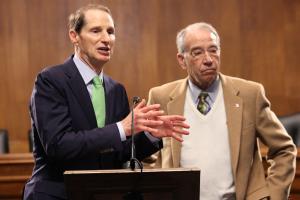
I found the allegation that Gilead's HCV pricing was divorced from R&D costs the most troubling. First of all, that was a basic argument by GILD longs to justify the pricing. Secondly, if R&D costs or the cost of acquire Pharmasset were not factors in setting the price, then what separates Gilead from Turing Pharmaceuticals or Valeant VRX?
Longs Are Apoplectic ...
Longs are apoplectic over the Wyden-Grassley report. Criticisms have ranged from the government singling out Gilead, to socialism, to election year saber rattling. Commenters on my previous article had the following to say:
Commenter 1: This is not about economics or fairness. This is just headline risk in the worst possible environment of an election year.
Commenter 2: Shock Exchange are you a capitalist or socialist? Does public good always translate to socialized medicine with a single (government) payer? So which is for better social good ... paying $240K to prolong merely two months life of a terminal cancer patient or paying $84K to CURE a HCV patient?
Commenter 3: There are two threads to this conversation. The first is the presumption that Gilead has outrageously priced their HCV treatment and is supported by demagoguing politicians and backed by (mostly liberal) anti-business media. This meme has a life of its own now after being popularized by the mainstream media and these grandstanding politicians ... Pharmaceutical and biotech companies are just the latest hated capitalist company sector somewhat replacing oil companies, and banks.
GILD is off about 4% for the week after the Wyden-Grassley findings. On Friday European Central Bank President Mario Draghi pledged his support for more economic stimulus, buoying the markets. Otherwise GILD may have fallen further.
... But Were Silent On Government Bailouts
While longs have excoriated the government for suggesting the price of HCV drugs could be more affordable, there has been little mention of the trillions in aid to banks, and big business.
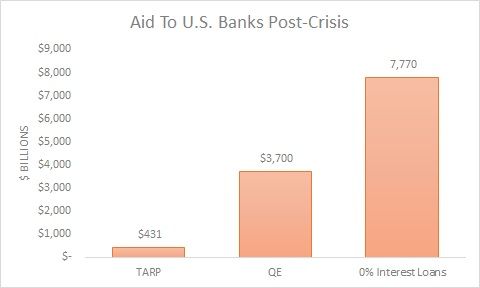
Source: Shock Exchange
Since the financial crisis of 2008/2009, the government has spent $431 billion on TARP, $3.7 trillion on quantitative easing ("QE") and $7.8 trillion in zero interest loans to Wall Street. In my opinion, zero interest rates have pumped up asset prices of stocks, bonds and real estate.
Gilead and its shareholders have enjoyed the appreciation in GILD's share price after the crisis, which could partially be attributed to the stock market bubble created by the Fed. Secondly, without the buoyancy of U.S. capital markets after the crisis, would Phamasett have had the capital to spend on R&D to develop Sovaldi/Harvoni? Would Gilead have had the capital to pay $11 billion to purchase Pharmasett? I highly doubt it.
At this juncture the economy can be divided between those who benefited from government bailouts and those who have not. For those who have not benefited, it could be difficult for them to afford an $80 thousand HCV regimen. This all begs the question, "Has the government arbitrarily picked the winners."
Senator Grassley Is Battle-Tested
For longs who think that Senator Wyden (Oregon) and Grassley (Iowa) will quietly go away, think again. Grassley, in particular, is battle-tested. He railed against abuses of bailouts by former AIG AIG executives. In March 2009 AIG, which had received $182 billion in taxpayer bailouts, planned to pay $165 million to the same unit that created the losses. This came on top of $121 million in previously scheduled bonuses to senior management. According to Shock Exchange: How Inner-City Kids From Brooklyn Predicted The Great Recession And The Pain Ahead, severance packages to departing AIG executives really got Grassley's dander up:
AIG's general counsel, Anastasia Kelly, is expected to receive approximately $3 million in severance pay upon her departure from the insurer. In December [2009] Kelly announced she was leaving AIG because of pay cuts imposed by Kenneth Feinberg, President Obama's federal pay czar. Feinberg capped 2009 annual cash salaries for most AIG executives at $500,000 ... She also drew scrutiny for advising other AIG executives chafing under the pay cuts; at least four other AIG executives are expected to join Kelly in departing ... Senator Chuck Grassley (R. Iowa), echoed our sentiments, calling the severance a "windfall" and exclaiming, "The taxpayers are fed up with massive payouts to executives at companies that took tax-payer money."
If the government can provide aid to help investment bankers maintain their stone mansions in the Hamptons or keep their Hermes tie collections intact, then why can't it help saves lives by making HCV drugs more affordable? This is the question Grassley and Wyden must answer when they face their constituents. I believe Grassley's answer will result in lower prices for Harvoni and declining sales growth for Gilead.


Comments
Log in or sign up to join the conversation.