

Workplace safety often depends on small design details that prevent routine movements from turning into serious hazards. One example is the use of Self Closing Safety Gates at access points, elevated platforms, ladders, walkways, and restricted industrial areas.
Unlike conventional gates that may remain open after use, self closing gates are designed to return automatically to a closed position. This simple function helps maintain a continuous physical barrier without relying entirely on workers to remember to close the gate manually.
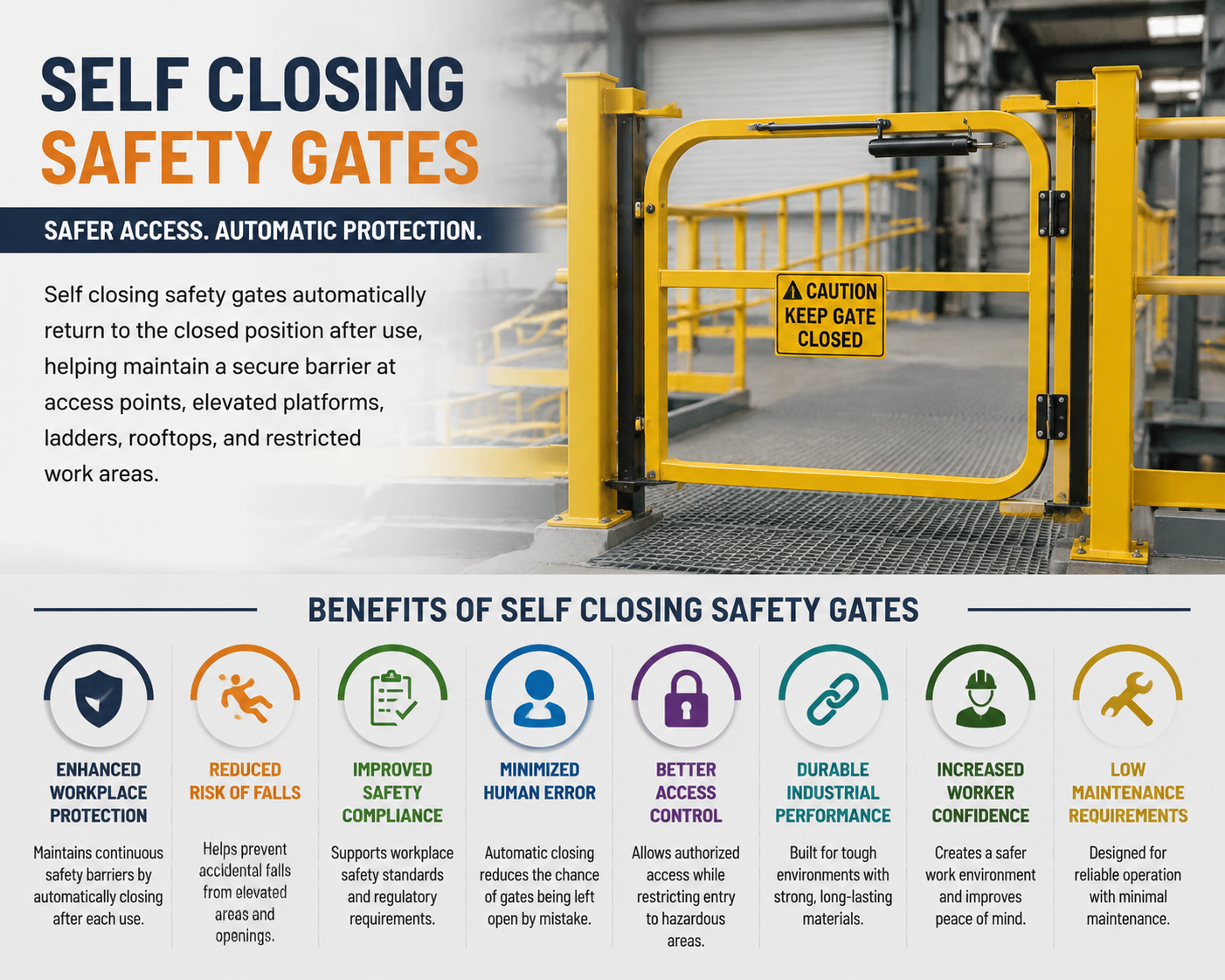
Why Self Closing Gates Matter in Industrial Environments
Industrial facilities contain many areas where employees move between different levels or enter controlled zones. Open access points near ladders, platforms, mezzanines, and rooftop areas can increase the possibility of falls or unauthorized access.
Using workplace safety gates at these locations provides a controlled passage while helping maintain the protective barrier after a person has passed through.
The self-closing mechanism is particularly useful in busy workplaces where employees may frequently carry equipment or materials and may not always be able to close a conventional gate manually.
How Automatic Closing Safety Gates Work
Automatic closing safety gates normally operate through a spring-loaded, gravity-assisted, or mechanically controlled closing mechanism. Once a worker pushes the gate open and passes through, the gate automatically moves back toward its closed position.
This design reduces the possibility of an access opening being left unprotected.
Safety gates with self closing mechanism can therefore support consistent access control in environments where repeated entry and exit are part of normal operations.
Common Applications
Self closing access gates can be installed in several workplace environments depending on the type of hazard and access requirement.
Typical applications include:
Elevated industrial platforms
Fixed ladder access points
Rooftop maintenance areas
Mezzanine floors
Machinery access zones
Loading and service platforms
Pedestrian pathways
Restricted maintenance areas
In each application, the purpose of the safety barrier gate is to create controlled access while keeping the surrounding protective system intact.
Benefits of Self Closing Safety Gates (Explained)
1. Enhanced Workplace Protection
Self closing safety gates help maintain a permanent protective barrier around dangerous areas such as rooftops, platforms, ladders, and elevated walkways. Unlike traditional gates that may remain open after use, these gates automatically return to the closed position, helping prevent accidental exposure to hazards.
2. Reduced Risk of Falls
Falls from height are a major workplace safety concern, especially in industrial and maintenance environments. Installing self closing gates at roof access points, ladder openings, and elevated platforms helps reduce the chance of workers accidentally stepping into unprotected areas.
3. Improved Safety Compliance
Many workplaces follow strict occupational safety requirements to protect employees from hazards. Self closing safety gates support these safety practices by providing controlled access points and helping maintain protective barriers in accordance with workplace safety guidelines.
4. Minimized Human Error
Manual gates depend on workers remembering to close them after every use. In busy industrial environments, this step can easily be forgotten. The automatic closing mechanism ensures the gate closes itself, reducing dependence on human action.
5. Better Access Control
Self closing gates allow authorized personnel to pass through while maintaining separation between safe and hazardous zones. They are commonly used in factories, warehouses, rooftops, and maintenance areas where controlled movement is required.
6. Durable Industrial Performance
Industrial safety gates are designed to withstand demanding conditions such as frequent operation, outdoor exposure, and heavy workplace use. Quality materials and strong construction help provide long-term reliability in industrial environments.
Roof Access and Fall Protection
Rooftop areas deserve particular attention because maintenance personnel may work close to edges, ladders, hatches, or changes in elevation.
Roof access safety gates can be positioned at ladder openings or designated access points to reduce exposure to an unprotected opening. When incorporated with guardrails or other collective safety measures, fall protection safety gates provide an additional layer of protection around frequently used access routes.
A properly positioned self closing safety gate also allows workers to move through the protected area without permanently opening the surrounding barrier.
Pedestrian Safety and Controlled Movement
Pedestrian safety gates are also useful at ground-level industrial sites. Warehouses, production facilities, utilities, and logistics areas often have locations where pedestrian routes intersect with equipment zones or restricted workspaces.
A self closing security gate can help guide workers through a designated entry point instead of allowing unrestricted movement through the barrier system.
This contributes to clearer traffic management and improved workplace gate safety.
Important Considerations During Safety Gate Installation
Effective safety gate installation requires more than simply fixing a gate to an existing structure. The installation location should be reviewed carefully to confirm that the gate operates correctly and does not introduce another obstruction.
Important considerations include:
Width of the access opening
Gate opening direction
Mounting surface and structural strength
Required clearance
Frequency of access
Surrounding guardrail configuration
Environmental exposure
Maintenance requirements
The gate should also close reliably after repeated use. Periodic inspection of hinges, springs, mounting points, and other moving components helps maintain proper operation.
Supporting a Consistent Safety Environment
One of the main advantages of industrial safety gates is consistency. A manually operated barrier provides protection only when workers remember to close it. A self-closing design reduces this dependency by returning the barrier to its normal protective position automatically.
For industrial facilities, rooftops, maintenance platforms, and pedestrian access areas Self Closing Safety Gates can therefore form an important part of a broader workplace safety strategy.
Conclusion
When correctly selected, positioned, and maintained, these systems help create safer access points while supporting continuous protection around workplace hazards.
Self Closing Safety Gates play an important role in improving workplace protection by maintaining continuous barriers around access points, elevated areas, and restricted zones. Their automatic closing function helps reduce human error and supports safer movement in industrial, commercial, and rooftop environments. When combined with proper planning, installation, and maintenance, these safety systems contribute to a more controlled and secure workplace environment.
#SelfClosingSafetyGates#WorkplaceSafety#IndustrialSafety#SafetyGates
Comments
Log in or sign up to join the conversation.