

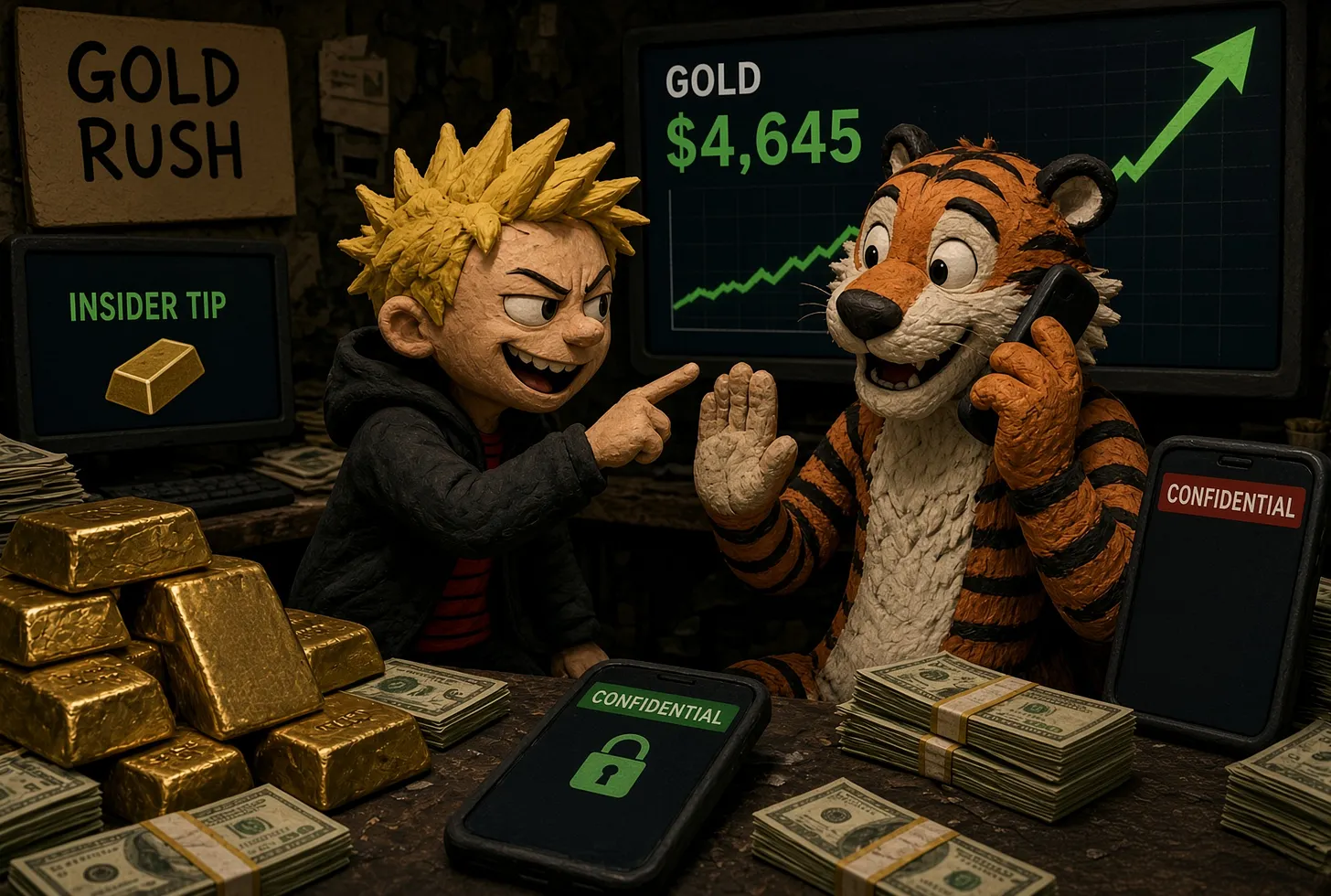
There was a weird moment yesterday where Treasury Secretary Bessent said on oil markets that “[He and the administration] have asymmetric information, and I’m not sure why oil has popped up on this.”
Then… later… Emphasis mine.
““People have bad information. I have asymmetric information, so I think that the market should think, well, why would we have joined the Japanese in the intervention at this time? Do we know something the market doesn’t know that, in terms of being willing to do you know what I would call a Treasury twist here in terms of the bond market? What do I know that the market doesn’t know? So, I think the market’s probably gotten a little ahead of itself…”
Let’s start with the first thing… What does asymmetric information mean in markets?
Well, information asymmetry breaks down like this.
One trader has information… MATERIAL information… that the second trader lacks.
Therefore, the second trader could incorrectly price an asset, and make mistakes.
Bessent is effectively telling the collective market, “You’re trading on an incomplete information set. Mine is better.”
Which, I’ll be candid, is a hell of a thing for the Treasury Secretary to say.
I Am The Market.
We know that Bessent and the White House have classified information, work back channels with diplomats, and know their own intentions (which energy traders are likely just measuring on a string of probabilities.)
But that just creates an odd public reality (and does raise questions about the people who DO have access to the information that they have and have traded with it.)
Bessent’s telling us… “I know the market is wrong because I have information that the market doesn’t have… BUT I can’t provide you with any of this information… even though that data would allow you to determine that I’m right about the markets.”
Now… Here me out, because this is an up-or-down statement…
It’s not a left-or-right one.
The first person I thought about was Anthony Fauci in 2021 saying that his critics were “really criticizing science because I represent science.”
This line created a Mandela effect, where certain media members now have a recollection of Fauci saying “I am the science” when he really said he represents it.
Bessent’s argument that “we have asymmetric information” hit a similar nerve for me...
I simply laughed and said… “Did he just say “I am the market?” like he’s Jeff Goldblum running around Oz as The Wizard, all seeing and all knowing…?
Bessent has said to the market… You see one thing. I know what you can’t see, so therefore, your interpretation is not as good as my interpretation.
The funny thing is that markets exist for one major reason, which is price discovery (something destroyed by policy and incentives in the last two decades).
They exist because no one person or group is suppose to ever have a complete data set, and prices are the chaotic attempt to discover information and tell the story of the world.
When I think about what I just wrote, I feel like I’m living in Through the Looking Glass.
Looking at History
So, this morning… when I was doing our daily live Money Printer Pro show (and going through our platform and daily write up on momentum readings - Currently Yellow)…
People asked me about financial history tied to asymetric events.
There are three precedents that always stand out.
Nothing in markets is every really new, and history has a way of rhyming.
Back in 1869, for example, two men tried to corner the gold market. Jay Gould had gotten access to President Grant’s brother in law. And he had befriended another man named Daniel Butterfield, a Treasury official who worked at a New York desk that would see if the government was selling any of its gold.
Gould and his buddy James Fisk were betting that the Treasury would sell their gold as they were trying to squeeze this market higher. Butterfield revealed the info…
For a few weeks, these guys were making a killing, while the rest of the market was running gold prices higher.
Then something happened. President Grant got suspicious, and the selling stopped. Gould had learned of the news, and turned around and sold his positions to his partners. They were still buying the story that the government would be selling.
After that… we had the original Black Friday in September 1869.
A gold crash followed.
The Cuban Missile crisis is another example.
On October 16, 1962, President Kennedy saw images of Soviet Missiles in Cuba. For the next week, he went about his business, making sure that no one thought that something was amiss in his scheduling. In this case, he was the person with the asymetic information, and he was deciding what to do next. For a week, the markets traded on the thought that the world was peaceful on the 17th through the 21st. Then, Kennedy gave his speech.
This was an example of the most important information on earth that would quickly move asset prices… was locked in meetings while the market had no understanding of what was to come.
Finally, if we look at the Battle of Midway in 1942, this is another example. Japan had sent its Navy across the Pacific thinking that it had an informational advantage over the United States. But codebreakers had already figured out on the U.S. side that Midway was the next target, so it turns out that Japan was the asymetic information.
The Hole in Bessent’s Argument
Someone over at OptionPit.com asked if we really wanted to bet against the guy at the poker table with the biggest stack of chips. Well… it’s important to note that while Bessent may be holding a Full House, does he know the entire table?
He believes so…

Poker games and markets frown upon games where someone hides cards or deal from the bottom. So, I was somewhat surprised to hear Bessent use the term “Asymmetric information.”
It takes a lot for me to sit up in my chair and say… “Wait… WHAT?”
He’s telling us that the Treasury Department has access to information that most market players do not, including military plans, declassified information, and access to all the data it can store into a server somewhere in Northern Virginia.
But D.C. and their decisions around Iran are only one input in the global oil price, and there isn’t some Great Oz who knows everything about the price of a barrel, and all of the factors heading into it at this exact moment.
Bessent ran a hedge fund, so he knows what this term means, and he used it a few times, which I found to be so remarkable.
To tell the market that it is wrong… is by default to suggest the entire mechanism of price action is wrong. Oil trading is done at the margins… with the marginal barrel.
There are supposed to be many players all following different price signals.
It should be about the one guy who is looking at tanker insurance this morning, or the other trader who has data on Chinese refinery inputs for September… or the person who know OPEC’s spare capacity numbers for 2027.
And probably someone with an options book who is re-evaluating their leverage.
The collision between different data points and all these factors isn’t just why the market exists.
It’s the market itself.
And day by day, I continue to lose faith in what it is becoming…



Comments
Log in or sign up to join the conversation.