

Satyanarayana, the form of Lord Vishnu who embodies truth itself, is honoured in millions of homes through the sacred Satyanarayana Vratam, and a brass Satyanarayana idol gives that worship a serene and lasting focus in the pooja room. The name joins two ideas: Satya, meaning truth, and Narayana, the eternal preserver of the universe. Together they describe a deity who is pleased not by grand ritual but by sincerity, honesty and a promise kept.
The worship of Satyanarayana is one of the most beloved household observances in India, performed at housewarmings, weddings, birthdays and on full-moon days. It is remembered as much for its stories as for its rituals, because the Satyanarayana Katha teaches through the lives of a poor Brahmin, a woodcutter, a merchant and a king. In this blog, we explore who Satyanarayana is, what his form symbolizes, the legend behind the vratam, the shrines that honour him and why he holds a special place among the forms of Vishnu. Brought to you by Idol Brass.
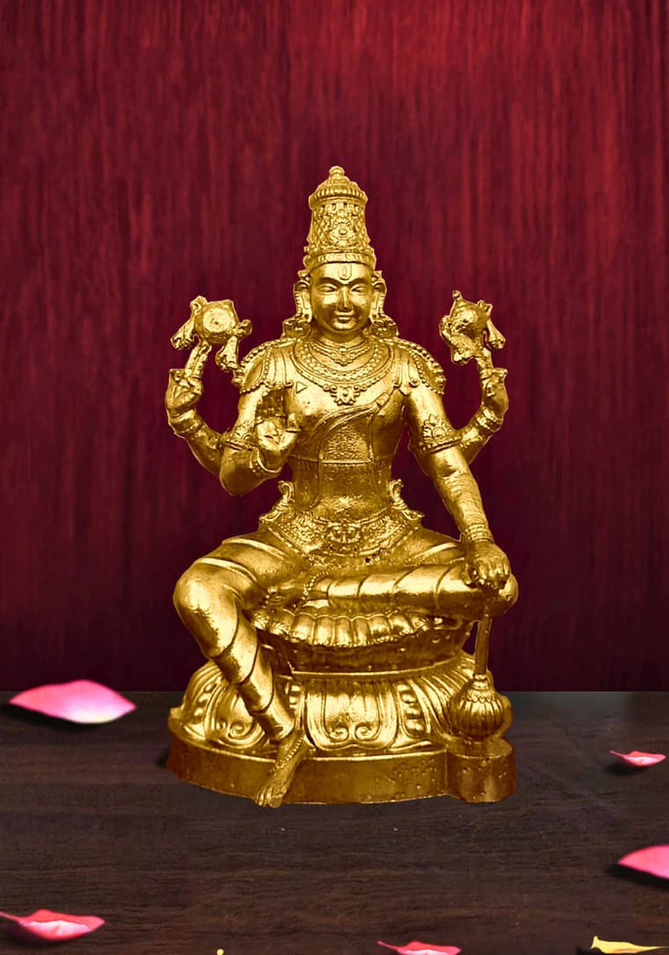
Who Is Satyanarayana?
Satyanarayana is Lord Vishnu worshipped as the Lord of Truth. He is not tied to a single avatar story. Instead, he is Vishnu in his all-pervading, ever-present form, the one who answers the sincere vow of an ordinary householder.
The Meaning of the Name
Satya is truth, and Narayana is the name of Vishnu as the refuge of all beings. The name therefore carries the teaching that the ultimate reality and the divine are the same, and that living truthfully is itself a form of worship. In Telugu, Kannada and Tamil traditions, the name is also spelt Sathyanarayana or Satyanarayan, but the deity is the same.
Satyanarayana and Goddess Lakshmi
Satyanarayana is worshipped together with Goddess Lakshmi, his consort, who represents prosperity and grace. This pairing explains why the vratam is so closely tied with family well-being, wealth earned honestly and a peaceful household. It also explains why the vratam is done at new beginnings, when a family seeks blessings for a fresh chapter in life.
Satyanarayana Among the Forms of Vishnu
Vishnu is worshipped in many forms, including Ranganatha, Venkateswara, Varadaraja and the ten avatars. Satyanarayana is distinctive because his worship is centred on a vow rather than on a particular temple or mythic battle. The Skanda Purana, in its Reva Khanda, is the traditional source of the Satyanarayana Katha.
Iconography and Symbolism of Satyanarayana
The icon of Satyanarayana follows the classical form of Vishnu, and each element is a teaching.
The Four Arms and Sacred Emblems
Satyanarayana is shown with four arms. In the upper hands, he holds the shankha, the conch, and the chakra, the discus. The conch stands for the primordial sound of creation, and the discus stands for the wheel of time and the power to remove adharma. In the lower hands, he carries the gada, the mace, and the padma, the lotus, which represent strength and purity.
The Seated, Serene Posture
Satyanarayana is usually depicted in a calm seated posture, blessing the devotee with a gentle expression. The composure of the face communicates that truth needs no display, and that the divine is ever-calm and approachable for anyone who prays with a sincere heart.
Lakshmi at His Side
Where the icon includes Goddess Lakshmi, she is shown beside him, symbolizing that prosperity comes to those who walk the path of truth. The union of Satya and Lakshmi reminds the devotee that true wealth is built on honesty.
How the Satyanarayana Vratam Began
The Satyanarayana Katha is presented in the traditional telling as a conversation across three levels: Vishnu teaching Narada, Suta narrating to the sages and the stories that are recounted within it.
Narada's Question
The sage Narada, travelling through the worlds, saw the sufferings of living beings and felt deep compassion for them. He approached Lord Vishnu in Vaikuntha and asked whether there was a simple way for people to be freed from their troubles.
Vishnu Reveals the Vratam
Vishnu replied that there was a vow that could be performed by anyone and would bring the fulfilment of righteous wishes, and this vow was the Satyanarayana Vratam. Later, the story was narrated by the sage Suta to the assembled rishis led by Shaunaka in the forest of Naimisharanya, which is how the katha came to be told to the world.
The Stories of Devotion and Forgetfulness
The katha is traditionally divided into five chapters, and each shows a different side of faith.
The Poor Brahmin
In Kashi, a poor Brahmin named Shatananda wandered from door to door to beg for alms. Lord Vishnu appeared before him in the guise of an old Brahmin and taught him the vratam. Shatananda performed it faithfully and soon found that his poverty had vanished.
The Woodcutter
A humble woodcutter saw the Brahmin's change of fortune and asked about its cause. He learned the vratam and performed it, and that day, he found that his firewood sold for far more than usual. It is a story of how a simple, sincere act can transform an ordinary life.
The Merchant Who Broke His Promise
King Ulkamukha and a merchant called Sadhu appear in the central chapters. The childless Sadhu vowed to perform the vratam if he were blessed with a child, and when his daughter Kalavati was born, he kept postponing the promise. When he finally set out on a trading voyage, his vow still unfulfilled, misfortune struck. He and his son-in-law were accused of theft and imprisoned, and his family lost everything. On another voyage, when a sannyasi asked what was in his boat, Sadhu carelessly replied that there were only leaves and vines, and his cargo turned to leaves.
The Return Through Truth
Realizing his mistake, Sadhu remembered his promise and prayed with sincerity. Meanwhile, his wife Lilavati and daughter Kalavati performed the vratam at home, and the family was reunited and restored to prosperity. Kalavati also learned a lesson of her own, because when she once left the vratam without accepting the prasad, her husband's boat sank into the water until she returned and took it with devotion.
King Tungadhvaja and the Prasad
The final chapter tells of King Tungadhvaja, who once passed a group of cowherds worshipping Satyanarayana and did not bother to accept the prasad. He soon lost his fortune and his hundred sons. Only when he returned, offered his respects and performed the vratam, were his blessings restored. The lesson is clear: faith must be humble, and the sacred offering must never be dismissed.
Annavaram and the Shrines of Satyanarayana
Although the vratam is a home ritual, Satyanarayana also has a great temple. The Sri Veera Venkata Satyanarayana Swamy Temple at Annavaram, in East Godavari district of Andhra Pradesh, stands on Ratnagiri hill by the Pampa river. It is one of the most visited Vaishnava shrines in the Telugu-speaking region, and thousands of couples perform the Satyanarayana Vratam there every day, particularly during weddings and auspicious occasions. The shrine is designed in the form of a chariot, and the main deity is worshipped in a form that reflects the harmony of the Trimurti.
The worship of Satyanarayana also has a place in the wider traditions of Maharashtra, Gujarat, Karnataka and Bengal. In Bengal, the observance of Satya Narayan Puja has also been associated with the folk figure of Satya Pir, a reminder of how the ideal of truth has been shared across communities.
How the Satyanarayana Vratam Is Performed
The vratam is traditionally performed by a family, usually with a priest, on a full-moon day, a Sunday or an auspicious occasion such as a housewarming, wedding or birthday.
The altar: An idol or picture of Satyanarayana is placed on a clean, decorated platform, often with a kalasha and a banana-leaf setting.
The worship: The family offers flowers, tulsi leaves, incense and lamps, and the priest recites the sankalpa, the formal vow of the ritual.
The katha: The five chapters are read or narrated, and the family listens together.
The prasad: A special offering is prepared with semolina or wheat flour, ghee, sugar and banana, traditionally measured in one-and-a-quarter portions. It is distributed to all who attend.
The conclusion: The family performs an aarti and shares the prasad, which must always be accepted with respect.
Spiritual Significance of Satyanarayana
Truth as the Highest Devotion
Satyanarayana teaches that honesty in thought, word and action is the foundation of spiritual life. The stories of Sadhu and Tungadhvaja show that broken promises and disrespect carry consequences, while sincerity restores what was lost.
A Vow Within Reach of Every Household
The vratam does not require a temple, a large budget or a rare ritual. It is a devotion that any family can perform at home, which is why it is so deeply woven into everyday Hindu life.
Gratitude for New Beginnings
Families perform the vratam when they begin something new, such as a home, a marriage or a career. It is an act of gratitude before the journey begins, and a way of inviting Vishnu's protection for the path ahead.
Prosperity Built on Righteousness
By worshipping Satyanarayana and Lakshmi together, the devotee is reminded that lasting prosperity depends on ethical conduct. The wealth of the stories comes only after the characters turn back to truth.
Why Is Satyanarayana Different from Other Vishnu Forms?
A vow, not a battle: Many avatars are known for their victories over demons, while Satyanarayana is known for the vow of a devotee.
Worship at home: Unlike forms centred on great temples, Satyanarayana is worshipped chiefly within the family.
Truth as the central theme: His very name declares that honesty is the path to the divine.
Stories for every kind of person: The katha features a Brahmin, a woodcutter, a merchant and a king, showing that the blessing is open to all.
The role of the prasad: The sacred offering is not an afterthought but a central teaching of the katha.
Linked with new beginnings: He is invoked at the start of important life events.
Conclusion
Satyanarayana is Vishnu in the simplest and most accessible of his forms, the Lord who asks only for truth, sincerity and gratitude. The four emblems in his hands, the calm posture and the presence of Lakshmi all point to a single teaching: that a life anchored in honesty is a life the divine will protect. Whether remembered through the annual vratam, a pilgrimage to Annavaram or a brass idol in a family pooja room, Satyanarayana continues to remind devotees that truth is the surest path to peace and prosperity.
Comments
Log in or sign up to join the conversation.