

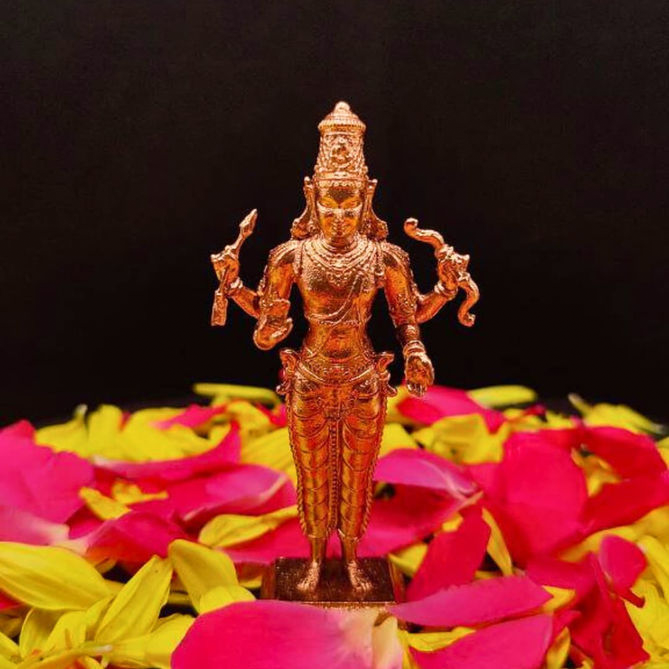
Sani Bhagavan, the Lord of Justice and the slow-moving master of the Navagrahas, is one of the most revered and most misunderstood deities in the Hindu tradition, and a Sani Bhagavan idol with a gold-plated finish gives his worship a radiant and reassuring presence in the home. Known as Shani, Shanaishchara and Saneeswara, he is the deity who presides over karma, discipline and time. Though he is often feared, the traditions that honour him describe a fair judge who rewards honesty, patience and humility.
Every Saturday, devotees across South India light sesame-oil lamps before Sani Bhagavan, and lakhs of pilgrims gather at Thirunallar whenever he moves from one zodiac sign to the next. Behind this devotion lies a rich body of stories, symbols and teachings. In this blog, we explore who Sani Bhagavan is, the meaning of his iconography, the legends of his birth and his trials of devotion, the temples that honour him and why he holds a unique place among the Navagraha deities. Brought to you by Gold Plating Art Studio.
Who Is Sani Bhagavan?
Sani Bhagavan is the deity of the planet Saturn, the seventh of the nine Navagrahas. He is regarded as the dispenser of the fruits of karma, the one who ensures that every action, good or bad, meets its due result.
The Son of Surya and Chhaya
Sani is the son of Surya, the Sun God, and Chhaya, the shadow-form of Surya's consort Sanjna. His elder half-brother is Yama, the lord of dharma and death, and his sister is Tapti, the sacred river. Vaivasvata Manu, the progenitor of the current age, is also a half-brother. The family connection to Yama is often noted, because both brothers are associated with justice.
The Meaning of His Names
The name Shanaishchara means "the one who moves slowly." It is an apt title, because the planet Saturn takes around twenty-nine and a half years to orbit the sun and stays for about two and a half years in each zodiac sign. In Tamil tradition, he is Saneeswaran, and in North India, he is often called Shani Dev. The name Mandan, the "slow one," also appears in older texts.
Sani Among the Navagrahas
In the Navagraha system, Sani rules Makara (Capricorn) and Kumbha (Aquarius), is exalted in Tula (Libra) and is considered debilitated in Mesha (Aries). He governs Saturday, and his transit through the zodiac is one of the most closely followed events in the Hindu calendar.
Iconography and Symbolism of Sani Bhagavan
The form of Sani Bhagavan is designed to convey his character, and each element has a specific teaching.
The Dark Complexion and Black Attire
Sani is depicted with a deep blue-black complexion and dressed in dark clothes. The colour signifies depth, seriousness and the mystery of time. It also recalls his birth to Chhaya, the shadow, and reminds the devotee that even the darkest hour has a purpose.
The Crow as His Vahana
His vahana, or vehicle, is most commonly the crow, and in some traditions, a vulture. The crow is a watchful, resourceful bird that stays close to the human world, and it is associated with ancestors in Hindu ritual. It symbolizes vigilance, patience and the ability to survive in hard conditions.
The Staff and Weapons of Justice
Sani is commonly shown holding the danda, a staff that represents authority and discipline, and depending on the regional tradition, he may also carry a bow and arrows or a trident. These are not weapons of cruelty but emblems of a judge who upholds order.
The Calm, Composed Posture
In classical icons, Sani stands or sits with a grave, composed expression. The stillness of his posture communicates that justice is neither hurried nor emotional, and that he acts only according to the dharma of each person's deeds.
Sani Bhagavan in Gold-Plated Bronze and Brass
Idols of Sani Bhagavan are traditionally cast in metal by South Indian artisans and then hand-finished to bring out the fine details of the crown, ornaments and the crow. A gold-plated finish gives the idol a lustrous surface that stays bright in the flicker of a lamp, and it offers a warm counterpoint to the dark and solemn character of the deity.
The Birth and Rise of Sani Bhagavan
The best-known legends of Sani begin before his birth, in the story of a mother's devotion.
Chhaya's Penance
When Sanjna left the palace of Surya, unable to bear his heat, she left behind Chhaya as her substitute. While she was expecting Sani, Chhaya devoted herself to intense penance to Lord Shiva. She stood in the blazing sun, fasting and forgetting her own needs, and the child in her womb absorbed the effects of that austerity.
The Dark Child and Surya's Doubt
When Sani was born, his complexion was dark, and Surya, struck by the difference, doubted his paternity. The doubt wounded the child, and his powerful gaze fell upon his father. It is said that Surya's brilliance dimmed at that moment, showing the child's extraordinary power from the very beginning.
Shiva's Boon
Surya sought the help of Lord Shiva, who explained the truth and reconciled the father and son. Sani then performed his own penance to Shiva, and pleased with his devotion, Shiva blessed him with the role of the judge of karma and a place among the Navagrahas. From then on, Sani became the deity who rewards righteousness and corrects wrongdoing, as a teacher would.
Sani Bhagavan and the Tests of Devotion
Several legends show that Sani tests people not to destroy them but to transform them.
King Nala and Thirunallar
In the Tamil tradition, the noble king Nala, husband of Damayanti, was afflicted by Sani's influence after a small lapse in his ritual purity. He lost his kingdom, was separated from his wife and wandered for years in disguise. Nala was finally relieved when he bathed in the sacred tank at Thirunallar and worshipped Lord Dharbaranyeswarar, and the tank is known as the Nala Theertham to this day.
King Dasharatha's Courage
In another story, the king Dasharatha of Ayodhya learned that Sani was about to enter the constellation of Rohini, an event said to cause a long famine. Dasharatha rode out to confront him and won his admiration with his courage and a heartfelt hymn. Sani granted him a boon and promised not to cause the calamity, and the hymn is still recited by devotees today.
Hanuman and the Promise of Protection
Devotees also recall the tradition that Lord Hanuman once helped free Sani from a difficult captivity. In gratitude, Sani is said to have promised that those who worship Hanuman would be spared his harsher influence. It is one reason why Saturdays are also associated with the worship of Hanuman.
Sani Bhagavan Temples and Worship
Sani Bhagavan is honoured at both grand temples and simple roadside shrines.
Thirunallar, the Foremost Sani Shrine
The Dharbaranyeswarar Temple at Thirunallar, near Karaikal, is the most renowned pilgrimage centre for Sani Bhagavan. Here, the Saneeswarar shrine draws vast crowds, especially during the Sani Peyarchi, the transit of Saturn from one zodiac sign to the next, which occurs roughly every two and a half years.
Shani Shingnapur and Kuchanur
At Shani Shingnapur in Maharashtra, Sani is worshipped as a self-manifested black stone under the open sky, and the village is famous for its houses without doors. In Tamil Nadu, the Kuchanur Saneeswarar Temple in Theni district and the shrine of Pongu Sani at Thirukollikadu are also greatly revered.
Worship, Festivals and Offerings
Saturday is the day of Sani, and devotees light lamps with sesame oil, offer black sesame seeds and blue flowers and recite the Shani mantra. Shani Jayanti, observed on the new moon day in the month of Vaishakha or Jyeshtha, celebrates his birth.
Spiritual Significance of Sani Bhagavan
The Lord of Karma and Justice
Sani embodies the teaching that every action carries a consequence. Worship of Sani is therefore an invitation to live honestly and to take responsibility for one's choices.
The Teacher of Patience and Discipline
Because Saturn is the slowest of the visible planets, Sani teaches that lasting results come with time and steady effort. Hardship endured with patience is seen as a form of tapas that purifies the mind.
Sade Sati as a Season of Growth
The seven-and-a-half-year period known as Sade Sati, when Saturn transits the signs around a person's moon sign, is often described as difficult. Yet the tradition also presents it as a time of maturity, self-examination and inner strength, when one learns what truly matters.
Compassion Behind the Strictness
Sani's stories show him rewarding courage, honesty and devotion, from Dasharatha to Nala. The devotee is encouraged to approach him not with fear but with humility and a clear conscience.
Why Is Sani Bhagavan Different from Other Navagraha Deities?
He is the judge of karma: While other grahas govern specific areas of life, Sani is especially known for ensuring that deeds meet their consequences.
He moves the slowest: His long transit makes his influence felt over years rather than days, which is why he is associated with patience and endurance.
He is feared and revered together: Few deities inspire the same mix of respect and caution, and few reward sincere devotion so generously.
He has dedicated shrines: Thirunallar, Shingnapur and Kuchanur are centres of pilgrimage focused on his worship.
He is a devotee of Shiva: His authority is rooted in his penance to Shiva, and he acts within dharma.
He teaches through hardship: His lessons come through challenge rather than comfort, and they are meant to build character.
Conclusion
Sani Bhagavan is the deity of justice, discipline and patience, the slow-moving planet whose path teaches that time and karma are always at work. His dark form, his crow and his staff may seem stern, but the legends of Nala, Dasharatha and Hanuman reveal a deity who tests in order to teach and who protects those who walk the path of truth. Whether honoured through a Saturday lamp, a pilgrimage to Thirunallar or a gold-plated idol in a home shrine, Sani Bhagavan invites devotees to live with integrity and to meet every season of life with courage.
Comments
Log in or sign up to join the conversation.