

Sanctions Against The Iran May Not Generate Regime Change, But They Are Seriously Hurting The Iranian Economy And Its People
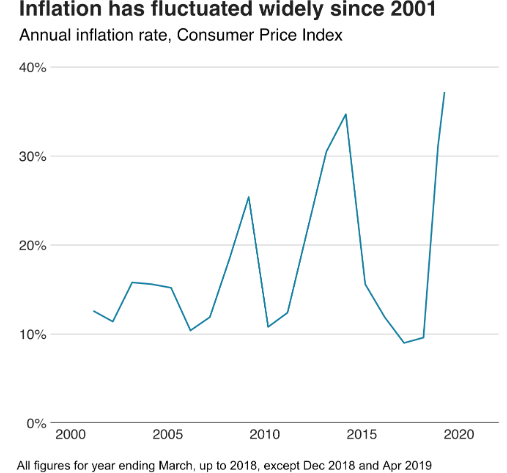
“The sanctions imposed on Iran by US President Donald Trump have begun to bite the country’s economy hard. Inflation, seemingly defeated by President Hassan Rouhani, has returned with a vengeance, hitting 31% in 2018. According to the International Monetary Fund, the economy is poised to shrink by 6% this year, and inflation could reach 37%. Many industries are experiencing severe difficulties, and unemployment is mounting. Aiming to cut Iranian oil exports to zero, Trump is threatening to sanction countries – like China, India, and Japan – that continue to buy Iranian oil.” (Hassan Hakimian, Seven Fallacies of Economic Sanctions, Project Syndicate, May 7, 2019)
While it seems highly unlikely that Iran will change its policies or even change its regime because of Trump’s investment and trade sanctions, nonetheless the oil-dependent Iranian economy has been badly affected by the US sanctions.
The charts presented below provide a compelling narrative on the economic harm to the Iranian economy.
The charts were published on a BBC web site on May 2nd, as “Six charts that show how hard US sanctions have hit Iran.”
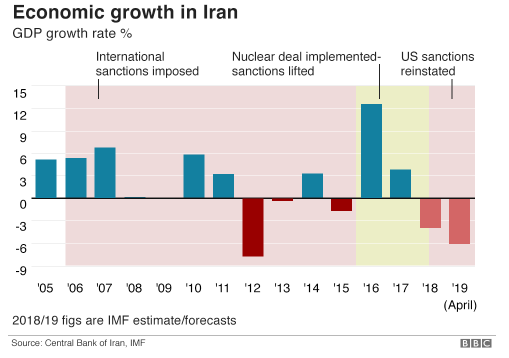
In 2015, Iranian President Hassan Rouhani agreed to a deal with the US and five other world powers to limit its nuclear activities in return for the lifting of those sanctions. Iran’s real GDP immediately bounced higher by 12% in 2018 and then posted a 3.7% gain in 2017.
As the following charts indicates, the reinstatement of US sanctions last year - particularly those imposed on the energy, shipping and financial sectors in November – have effectively devasted the Iranian economy.
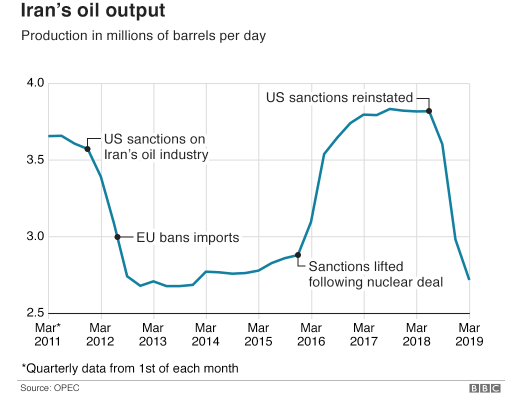
According to the IMF real GDP contracted by 3.9% in 2018, and the agency expects real GDP to shrink by a further 6% this year. Of course, the sanctions have caused foreign investment in the Iranian economy to shrink even as oil production and exports decline further.
The US strategy intends to bring a halt to all of Iran’s exports. Trump recently announced new sanctions on Iran’s iron, steel, aluminum, and copper sectors, which according to the White House, are Tehran’s largest non-petroleum sources of export revenue.
While the sanctions may not generate the regime change that Trump desires, there is no doubt that the sanctions have imposed a tremendous economic hardship on that country.
For example, at the start of 2018, Iran's crude oil production reached 3.8 million barrels per day (bpd), of which about 2.3 million bpd was exported.
By March 2019, Iran's oil exports had dropped to an average of about 1.1 million bpd.
As well, the hardship on the domestic population has also intensified.
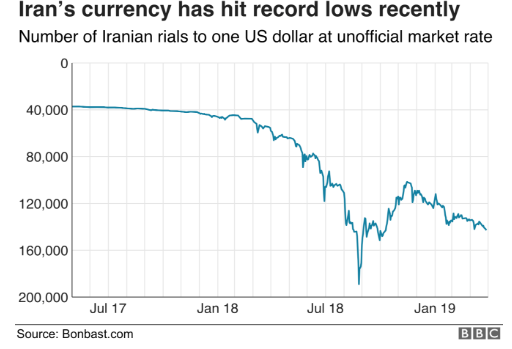
Inflation has soared to about 37% this year, and the currency has plummeted, which adds to the inflation pressure.
Iran Is Experiencing Run Away Inflation And A Plunging Currency


Comments
Log in or sign up to join the conversation.