

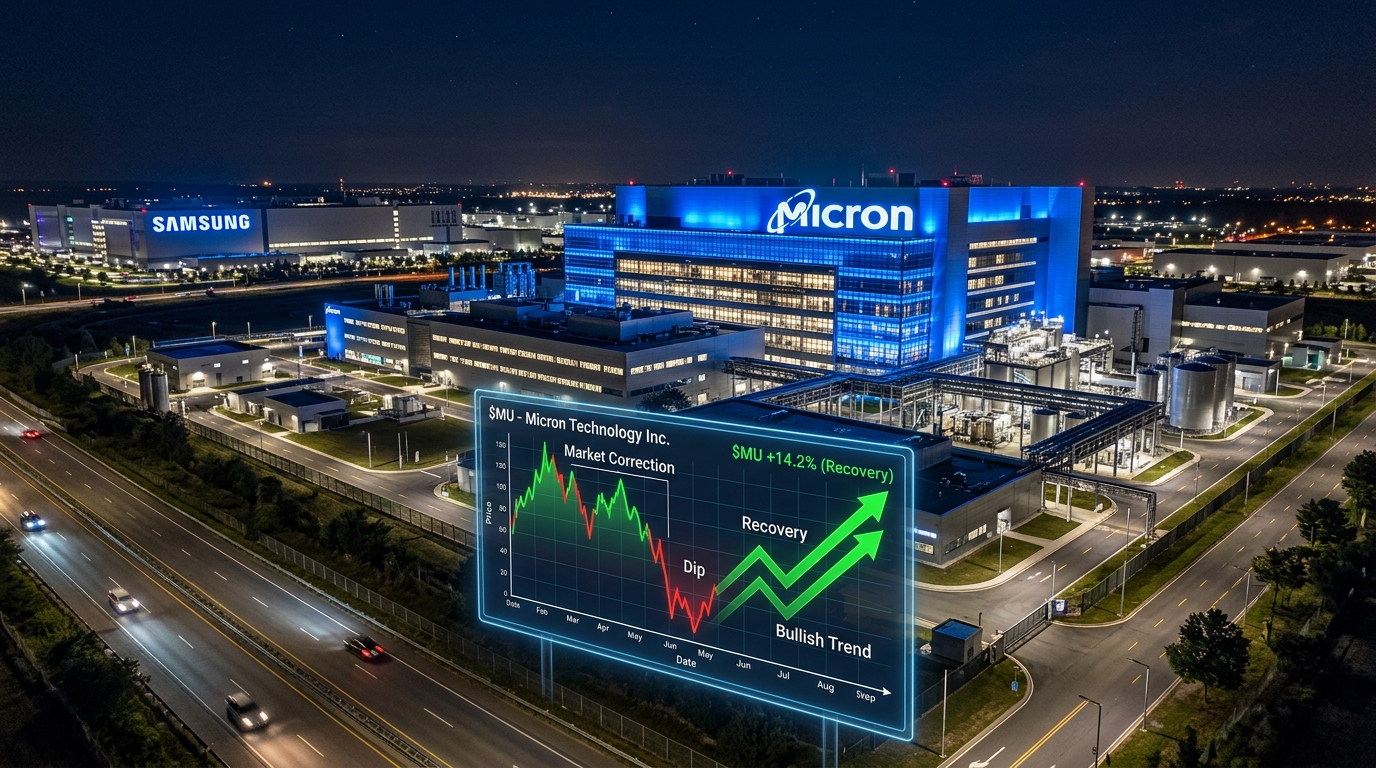
Samsung (SSNLF) just reported a 19-fold jump in quarterly operating profit. It was one of the most impressive earnings reports in the history of the memory chip business. And Micron Technology (MU) promptly fell 7.5%.
If that sounds backwards, that's because it is backwards. And if you understand why, you're ahead of most people selling right now.
What Samsung Actually Said
Samsung's preliminary Q2 2026 results showed a massive surge in operating profit, driven almost entirely by AI-related memory demand. High Bandwidth Memory chips -- the stacks of DRAM that Nvidia (NVDA) shoves inside its H100 and B200 GPUs -- are sold out everywhere. NAND prices are climbing. Server DRAM is in tight supply through the end of 2026.
This is good news for Micron. It makes the same chips. It sells to the same customers. Micron already reported its own fiscal Q3 2026 numbers: $41.5 billion in revenue, up 346% from a year ago. EPS came in at $24.67, up 13-fold. The company guided Q4 2026 to approximately $50 billion in revenue.
So why did Micron fall 7% the same day Samsung posted blowout numbers?
The Market Is Asking the Wrong Question
The selloff isn't about whether memory chips are in demand. They clearly are. The selloff is about whether the party can last. Investors started asking: if Samsung is putting up these kinds of numbers, does that mean production is ramping too fast? Are we near the top of the cycle?
Hold on. Let me stop here. This is the exact fear that hits every semiconductor cycle at its peak -- and it almost always triggers early. Memory chip shortages don't resolve in a quarter. Analyst consensus shows the memory shortage continuing into 2027 at minimum. Some projections see it persisting into 2028.
The "peak cycle" trade is real. But the data doesn't support it yet. AI training runs are getting longer and larger. Inference at scale requires more memory per chip than anyone modeled two years ago. The demand driver here isn't consumer smartphones. It's hyperscalers pouring $100 billion-plus into GPU infrastructure.
The Analyst Math
Cantor Fitzgerald analyst C.J. Muse just raised his price target on Micron to $2,000 from $1,500 following the Q3 earnings blowout. Before the July 7 selloff, the stock was trading around $1,145. At $2,000, that's roughly 75% upside.
The Wall Street consensus target across 29 analysts is $1,311. Even that number implies meaningful upside from post-selloff prices. At the current fear-driven discount, the average analyst sees more room to run than the pessimists are giving them credit for.
You don't have to trust me. Trust the math: $50 billion revenue guidance for a single quarter is not a company in trouble. It's a company at the center of the most capital-intensive technology buildout in history.
The Risk They're Actually Pricing In
The real worry isn't demand. It's affordability. As memory prices climb, consumer devices get more expensive. Smartphone makers face pushback. PC refresh cycles slow. That's a real risk -- but it affects the commodity NAND market, not the AI server DRAM market. Those are two different businesses, and investors keep conflating them.
Michael Burry reportedly flagged the memory boom as near its end. He may be right about the consumer cycle. He is almost certainly wrong about the AI cycle. Those are different clocks.
Bottom Line
Micron Technology (MU) is down roughly 7% on a day when its main competitor proved memory demand is surging. The consensus price target from 29 analysts is $1,311. Cantor Fitzgerald targets $2,000. The Q4 revenue guidance is $50 billion. At current post-selloff prices, this looks like the kind of dip that makes you regret not buying six months later.
P.S. The Samsung earnings selloff in memory stocks is a known pattern. Strong earnings from a competitor raises peak-cycle fears. This is the same trade that hit Micron in 2021. Those who sold then missed the AI supercycle that followed.



Comments
Log in or sign up to join the conversation.