

The Sai Baba idol draws devotees from every faith and background, honoring a figure whose life continues to defy easy categorisation nearly a century after his passing. Revered by both Hindus and Muslims, Sai Baba of Shirdi remains one of the most widely worshipped spiritual figures in India, admired as much for his humility and healing as for the mystery surrounding his origins.
His life offers a rare example of devotion that crosses religious lines entirely, built not on doctrine but on two simple principles — faith and patience. This blog looks at his story, his teachings and why his presence continues to be welcomed into homes today, brought to you by Gold Plating Art Studio.
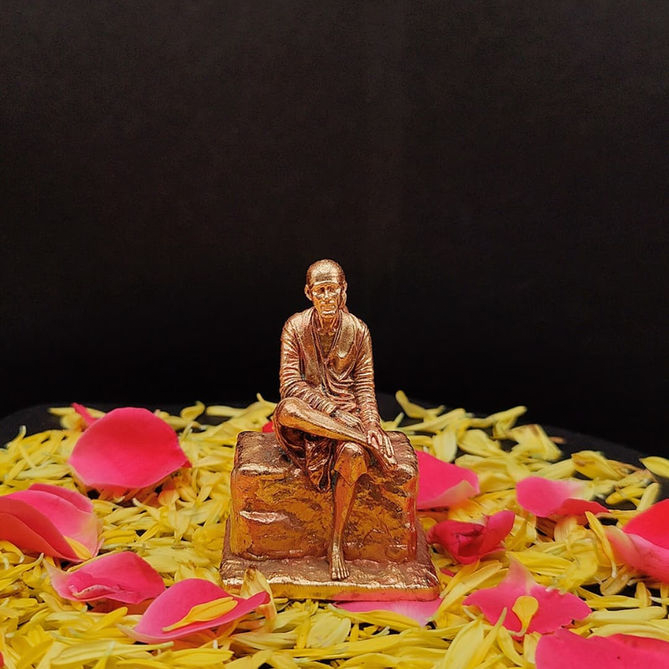
Who Is Sai Baba?
Sai Baba of Shirdi (c. 1838–1918) was a spiritual master whose true origins — his birthplace, parentage and even his given name — remain unknown to this day, despite decades of devotee research. What is known is that he arrived in the small village of Shirdi in Maharashtra as a young ascetic and remained there for nearly sixty years, becoming one of the most quietly influential religious figures of 19th and early 20th century India.
A Guru Claimed by Two Faiths
Unlike most revered spiritual figures, Sai Baba is not claimed exclusively by any single religion. He lived in a mosque he called Dwarkamai, practiced elements of both Hindu and Muslim ritual, and refused throughout his life to identify himself with either faith to the exclusion of the other. Hindu devotees came to regard him as an incarnation of the sage-deity Dattatreya, while Muslim devotees honoured him as a Sufi-style fakir — a duality he never resolved and, by most accounts, never wished to.
Comparisons to Other Saints and Gurus
Sai Baba is often grouped with other great Indian saints known for teaching beyond caste and creed, yet his particular insistence on the unity of Hindu and Islamic devotion — worshipped in a mosque that stood beside a temple — remains almost without parallel among widely worshipped Indian spiritual figures.
The Teachings and Symbolism of Sai Baba
At the centre of Sai Baba's teaching were two Hindi words that devotees still repeat today: Shraddha and Saburi — faith and patience. He taught that these two qualities, practiced steadily, were enough to carry a devotee through any hardship, without requiring elaborate ritual or scholarly study.
Dwarkamai — The Mosque as Mother
Sai Baba named the dilapidated mosque he occupied "Dwarkamai," merging "Dwarka" — the sacred town associated with Krishna — with "mai," meaning mother. He described the mosque itself as a nurturing, fearless refuge for anyone who climbed its steps, regardless of their faith, turning an abandoned structure into a symbol of shelter open to all.
Udi and the Symbol of Sacred Ash
Sai Baba distributed Udi, sacred ash from the dhuni (a continuously burning sacred fire) that he tended in Dwarkamai, believed by devotees to carry protective and healing power. This simple, freely given gift became one of the most enduring symbols of his ministry — grace offered without hierarchy or cost.
The Mysterious Arrival at Shirdi
A Young Ascetic Under the Neem Tree
Around 1854, villagers in Shirdi were startled to find a teenage ascetic sitting motionless in deep meditation beneath a neem tree at the edge of the village, seemingly unaffected by hunger, heat or cold. Some dismissed him as unwell; others sensed something more.
The Marriage Procession and the Name "Sai"
He left the village for a time before returning permanently a few years later, arriving with a wedding procession. As he stepped down, a temple priest named Mhalsapati instinctively greeted him with the words "Ya Sai" — "Welcome, saint" — and the name Sai Baba remained with him from that day forward.
Settling into Dwarkamai
Sai Baba eventually took up permanent residence in the abandoned mosque he would rename Dwarkamai, where he lived, taught and received devotees for close to sixty years, right up until his passing in 1918.
Shirdi and the Samadhi Mandir
Sai Baba's final resting place, the Samadhi Mandir in Shirdi, has grown into one of India's most visited pilgrimage sites, drawing devotees of every religious background year-round. The temple was originally built by a devotee who had intended to install an idol of Krishna as Murlidhar there — but after Sai Baba's passing, the shrine instead became his own samadhi. A marble statue of Sai Baba, completed by the sculptor Balaji Vasant Talim and installed in 1954, now sits behind the samadhi beneath a silver umbrella.
Dwarkamai itself still stands beside the Samadhi Mandir, its sacred dhuni kept burning, its ash still distributed freely to visitors just as it was in Sai Baba's lifetime — making it one of the rare pilgrimage sites where a mosque and a temple share the same sacred ground.
Spiritual Significance of Sai Baba
Faith and Patience as a Complete Path
His central teaching, Shraddha and Saburi, offers devotees a path to spiritual steadiness that requires no particular ritual knowledge — only sustained trust and patience through hardship.
Unity Across Religious Boundaries
By living and teaching from within a mosque while being embraced by Hindu devotees as a divine incarnation, Sai Baba embodies the idea that devotion transcends any single religious label.
Compassion Without Hierarchy
Sai Baba treated the poor, the outcast and the powerful with the same regard, distributing blessings, food and Udi without any distinction of caste or status.
Healing and Protection Through Udi
The sacred ash he distributed remains a living symbol of his healing power, still sought by devotees who visit Shirdi or keep his image at home.
An Ever-Present Guru
Sai Baba is remembered for promising his devotees that he would continue to guide them even after his passing — a belief that continues to draw pilgrims to Shirdi generations later.
Why Is Sai Baba Different from Other Revered Figures
Most widely worshipped Indian spiritual figures are associated firmly with a single tradition, lineage or scripture. Sai Baba is unusual in that his devotees never fully agreed — and still do not — on whether to regard him primarily as a Hindu saint, a Sufi fakir, or something that sits outside both categories entirely. His mosque-temple at Shirdi, his refusal to discuss his own origins, and his simple, ritual-free teaching of faith and patience set him apart from gurus whose authority rests on scripture, lineage or caste standing.
Conclusion
Sai Baba's story resists tidy explanation — a saint of unknown origin, worshipped equally within a mosque and a temple, whose entire teaching rested on nothing more elaborate than faith and patience. It is precisely this simplicity, paired with his refusal to divide devotees along religious lines, that continues to draw people of every background to his memory.
Comments
Log in or sign up to join the conversation.