


“If you are not having fun, it is not worth doing it” - Tommy Bolin
In June, Aramco announced the successful closure of its acquisition with SABIC. The acquisition purchase price aggregated to SAR 259.125 Billion (US$ 69.1 Billion). Recently, Aramco and SABIC announced the release of the Q1-2020 financial interim. In addition, Aramco announced the release of Q2-2020 financial results by August 10th. This reminded me of my thoughts regarding Aramco initial IPO valuation and contemplated synergies of SABIC acquisition.
By that time the global markets did not foresee two black swan events; first, the COVID-19 outbreak and its associated partial and full lockdown. Secondly, the sharp decline in oil prices beside WTI futures prices turning negative for the first time in history.As a result, economic reports are expecting the Saudi economy to contract by almost 5% during 2020. In addition, it is still unclear the duration of the pandemic impact on global economy. It is also unclear the shape of economic recovery for each country. Combining the entire news, raise some curious questions. What is next for Aramco? Is the $1.7 Trillion valuation still attainable and under what assumptions?
As usual, unleash your imagination and all the puzzle pieces will fall in place formulating the full picture. To answer this question, we will be assuming a different perspective including a hypothetical scenario based on Aramco and SABIC Q1-2020 earnings results since the acquisition is currently approved. In my humble opinion, Aramco $1.7 Trillion valuation is still attainable under certain assumptions. First, assuming a declining EBITDA by 5% each year during the period (2021-2025) relying on 2020 EBITDA as a base year. Worth noting that Aramco original IPO valuation assumed a no growth EBITDA for the 5-year period (2020-2024) relying on 2019 EBITDA as a base year. The same methodology was applied here, yet stressing Aramco 5-years cash flows by the 5% contraction rate expected to occur in the Saudi economy during 2020. This stressed scenario was also assumed for SABIC 5-years cash flow.
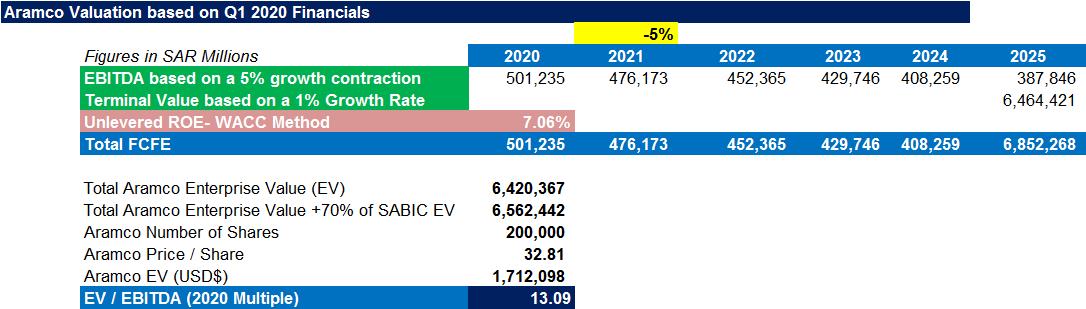
That being said, an interesting question raised itself. How to calculate Aramco 2020 EBITDA? In other words, how to annualize Q1-2020 EBITDA in light of the recent crude oil prices fluctuations? As per Aramco financial footnotes, Q1 earnings were calculated based on an oil price of $ 51 / barrel. By further researching the matter, oil prices declined by almost 50% during Q2 reaching a level of $ 25 / barrel. Later on during the current Q3, oil prices plunged up again to a level of $ 43 / barrel. Hence, it is prudent to assume that 2020 EBITDA will annualize Q1 EBITDA for three quarters (representing Q1, Q3 and Q4) besides adding only 50% of Q1 EBITDA to represent the last quarter (i.e. Q2). This methodology generated an annualized EBITDA of around SAR 501 Billion as illustrated in Figure 1. Frankly speaking, this annualized figure is lower than the 2019 EBITDA of around SAR 840 Billion. Nevertheless, Aramco financial footnotes entailed some good news. First, the tax decline from 50% to 20% since January 2020. Secondly, the decrease of the royalty rate from 20% to 15% on Aramco downstream portfolio. The latter has a direct positive impact on Aramco’s operating cash flow and ultimately its EBITDA. This is stemmed from the fact that oil prices are still below the maximum threshold of $ 70/ barrel. That being said, a different methodology from the original IPO was applied under this scenario. Terminal value is assumed with an economic growth rate of 1% for the time period beyond 2025. The original IPO assumed a doomsday scenario. It was assumed that Aramco is a company that will last only for 5 years with no growth. In my humble opinion, COVID-19 impact could be considered as a doomsday scenario but the world including the company survived it evidenced by the lockdown easing and Moderna vaccine positive news. Hence, assuming a terminal value cash flow is appropriate and more realistic.
Now, we move on to the last pieces of the puzzle which is the valuation parameters. Comparing apples to apples, the valuation inputs were based on April 1st, 2020. This entailed plugging in Saudi Arabia risk free rate and Saudi stock exchange (Tadawul- TASI) return as of April 2020 which recorded a cumulative return of around 9.34%. Since Aramco Q1 financial figures entailed cash balances surpassing its debts, it was assumed to discount cash flows with un-levered equity return. In addition, SABIC valuation was based on the same inputs generating a total enterprise value of around SAR 203 Billion. Hence, SABIC valuation generated EV/ EBITDA of 8.90 which is considered quite close to Commodity Chemicals EV/ EBITDA 2020 and EV/ EBITDA NTM of 9.54 and 8.50 respectively. Consequently, Aramco enterprise value increased by almost SAR 142 Billion representing Aramco’s 70% stake in SABIC equity. All of these parameters generated the SAR 6.6 Trillion (USD$ 1.7 Trillion) with a share price of SAR 32.8 / Share. Hence, Aramco recorded EV / EBITDA 2020 of 13.09 which is quite close to Saudi Arabia EV / EBITDA 2020 of 13.01 as appearing in Figure 1 below.
(Click on image to enlarge)
So what is next for Aramco? Adding SABIC to its downstream portfolio could be viewed as a synthetic or indirect hedging to its upstream revenues against oil prices fluctuations. During oil downturns, SABIC cost is manageable enhancing its operating margins. Also, good news for Aramco is the launch of equity futures as announced by Tadawul couples of days ago. Hence, Aramco investors will be able to apply direct hedging to their stock position. An important advantage for Aramco’s investors is the ability to adjust their stock portfolios beta by altering the quantity of futures without having to short or long the stock itself. This advantage will minimize the stock price volatility making it more suitable for buy and hold investors. As such, Aramco could be enticed to continue other phases in its original IPO plan and may be conduct a dual listing as the share price range will be more stable, predictable and controllable. Other than that who knows, time will tell..



Comments
Log in or sign up to join the conversation.