


(Today’s Theme Song: Ratt, Round and Round)
Have you ever taken a sightseeing or a whale watching cruise? If so, did your boat do what mine did when the key sights came into view? I remember taking the Circle Line around Manhattan on a school field trip, with everyone rushing to one side when the Statue of Liberty came into view, then rushing to the other as we circled Liberty Island, ostensibly to avoid passengers needing to switch sides. That behavior is afoot in stocks, as we careened into tech in September and away from it this week.
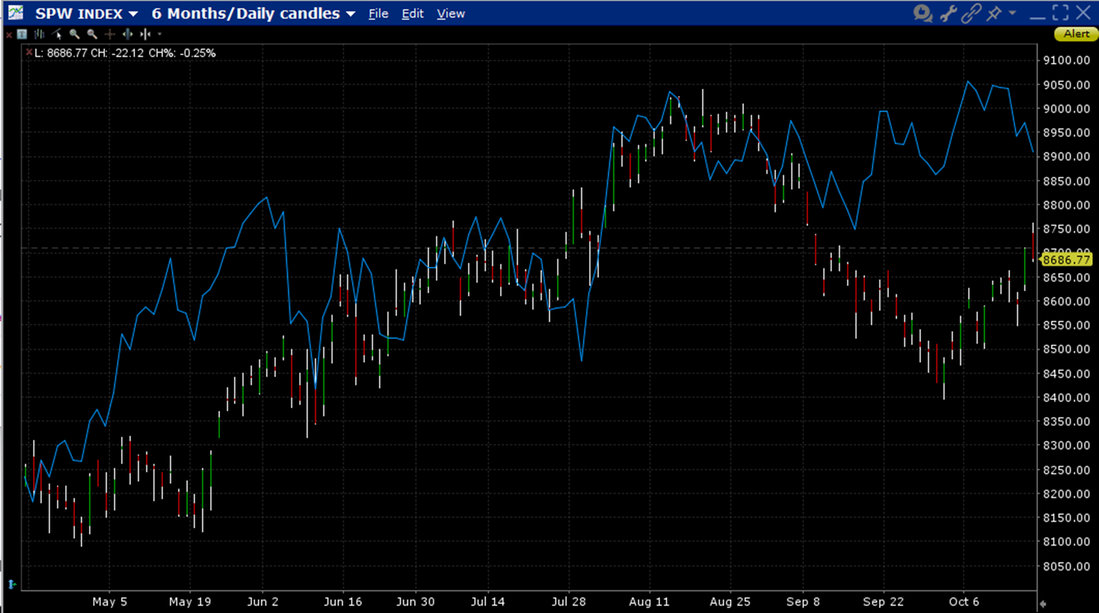
As I type this around 11:30 ET, S&P 500 (SPX) sectoral indices tell the story succinctly. The broad index itself is down about 0.3%, but 9 of the 11 SPX sectors are trading higher, and advancing stocks on the NYSE are outnumbering decliners by about 3:2. The significant outliers are technology and communications (a sector dominated by Meta Platforms (META) and Alphabet (GOOG, GOOGL). As a result, the Nasdaq 100 (NDX) is faring far worse than SPX with a decline of more than 1.3%.
The setup seems rather binary, but that is pretty much the case for the broader market anyway. The technology and communications sectors combine for about 40% or more of the market capitalization of SPX, as does the weight of the top 10 companies in the index – all tech stocks, mind you – so if investors choose to move out of tech into, well, everything else, that is essentially a binary decision.
The good news for investors is that rotation between sectors is that it is far better than outright selling. Indeed, it is not beneficial for an index when its higher-beta sectors are sold in order to reallocate into lower-beta sectors, but it would be much, much worse for investors if the money were allocated to cash when those higher-beta sectors are sold. The relentless rotation is a sign that investors are not willing to exit the stock market entirely and instead are either hoping to play defense or move from one set of “hot stocks” to another.
It does seem as though traders’ love of momentum strategies plays a role in the rotation. Traders who have become adept at following short-term trends are quite likely to be selling into tech’s decline and buying the relatively out-of-favor sectors that now have nascent uptrends. Remember also that longer-term trends for major indices are still pointing higher, so there are many trend followers who want to remain invested as long as that situation is in place.
Rotation of this type does point out the benefits of diversification. Investors who are “all-in” on tech are having an unpleasant week; those who have a more balanced portfolio are having a more placid time. A diversified stock portfolio is not a panacea – it won’t protect against a selloff that encompasses the majority of sectors – but it can certainly smooth out the day-to-day bumps in market performance.
To that end, rotation continues to dampen index volatility. We have discussed how dispersion dampens index volatility because even if individual stocks are having big moves, they have only a minimal effect on index volatility if they are moving in opposite directions. This is why even as stocks have worsened in the time it took me to finish this piece – SPX -0.7%, NDX -1.7% — the Cboe Volatility Index (VIX) has risen only to 17.85. That is well above the 15-ish region that prevailed recently, but hardly at concerning levels. Only if the rotation turns into more broad-based selling might we expect to see VIX rise above 20 and beyond.
6-Months, SPW (Equal-Weighted S&P 500, candles), SPX (blue line)



Comments
Log in or sign up to join the conversation.