

Wall Street got kicked in the stomach on Friday, or maybe a little further south than that. Stocks were down a lot. Big tech was down a lot more. Bonds with duration were down a good bit, not a ton. Managed futures were mostly lower. Gold was also down a lot. Broad commodities were down a little less than gold. Bitcoin (BTC.X) spent a little time below $60,000 for the first time in ages.
Client/personal holding BTAL was up a lot....yay? I'm glad it "worked" today but if BTAL is your best performer then things are going badly. REITs, staples, some financials and healthcare were generally green.
Are markets worried that rates won't get cut anytime soon with the jobs data the most recent nail in that coffin, or are markets worried that there is no end in sight to the war, is it the excesses related to capex spending/debt issuance/equity issuance in the AI/data center theme, were we simply overdue for a pullback or was it something else? Yes.
Today is a great microcosm though for a lot of the portfolio construction theory we play around with here. Let's detour for a moment to what today's blog post was originally going to be about. Finomial Tweeted out a thread of a portfolio review for a capital efficient strategy that looks a lot like something we would work on here.
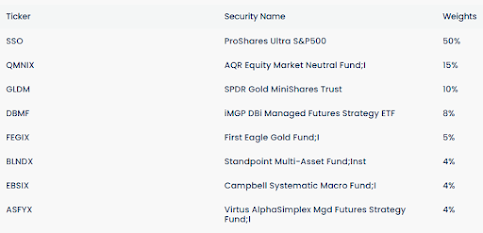
Here's the backtest result versus 80% equity/20% bonds (Finomial chose that benchmark).
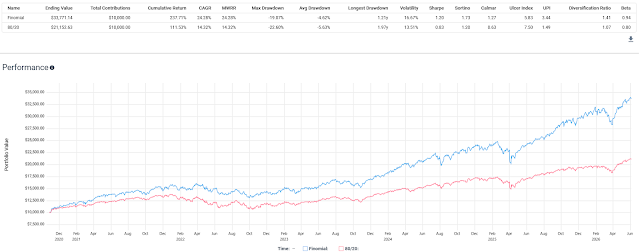
The portfolio that Finomial posted has certainly been more volatile but hard to argue with the longer term result. It's easy to see that volatility on display in both the Tariff Panic last year and the broad reaction to starting the war with Iran. In the Tariff Panic it was down 18% versus 13.8% for 80/20. That is probably attributable to managed futures getting hit very hard during that event and the portfolio has close to 18% in managed futures.
The point isn't to pick on the portfolio, it is to understand what the experience of riding through with some huge number in managed futures, or gold, or broad commodities or something else would actually feel like and how difficult it might be emotionally.
This sort of day would be challenging for anyone who is heavy in any of these.
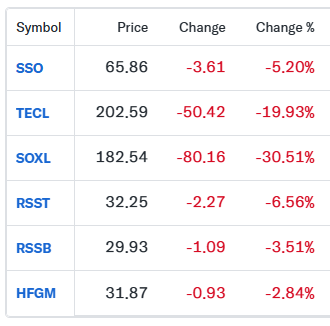
We've talked about 5% in TECL which is not heavy IMO but 20% in one day is not nothing. We've never talked about SOXL which is 3x semiconductors. If it is as simple as looking at RSST and subtracting SPY's result to see how their managed futures sleeve did, then it was the biggest decliner of the ones I follow. I threw in HFGM because it targets twice the volatility of global macro.
What would that table look like if this was the start of a meaningful move lower? Do you remember that fast panic that happened at the end of 2018? Most clients don't but in that fast event but TECL fell by 60%. Sixty percent in an event that many people don't remember. From July 2024 into early August, so just one month, RSST fell by 18%. I remember one or two very bad days in the first week of August but I'm not sure why RSST would have fallen that much but at the same time VBAIX was only down 4%. RSST came back obviously without issue but how difficult would it have been for someone who was heavy in RSST going down 18% in a down 4% world?
This is a difference between theory expressed in backtests versus actually enduring a market event. How did the portfolio that Finomial analyzed do today? Down 3.41%. That's probably not a number that will induce a poor decision but what about a week from now if equities continue lower and the things under the hood of managed futures continue to run counter to the recent trend (managed futures is likely long equities, long gold and long other commodities)?
I hope I am consistent in saying not to go too heavy into any of these diversifiers but if you are going to put 20% into something like managed futures or gold, I would spend time envisioning what it would really feel like when things take a meaningfully negative turn.

Comments
Log in or sign up to join the conversation.