

Rooftop access is an important part of maintenance and facility management in industrial, commercial, utility, and infrastructure environments. Workers may need to reach rooftops for HVAC servicing, solar panel maintenance, electrical inspections, communication equipment, drainage systems, and other technical activities.
One area that requires particular attention is the roof access hatch. When a hatch is opened, it creates an exposed opening that can present a fall hazard. A Roof Hatch Guardrail System helps manage this risk by creating a physical barrier around the hatch while maintaining a controlled access point for workers.
For industrial facilities across Saudi Arabia and the wider GCC, roof hatch protection can form an important part of a broader rooftop safety strategy.
What Is a Roof Hatch Guardrail System?
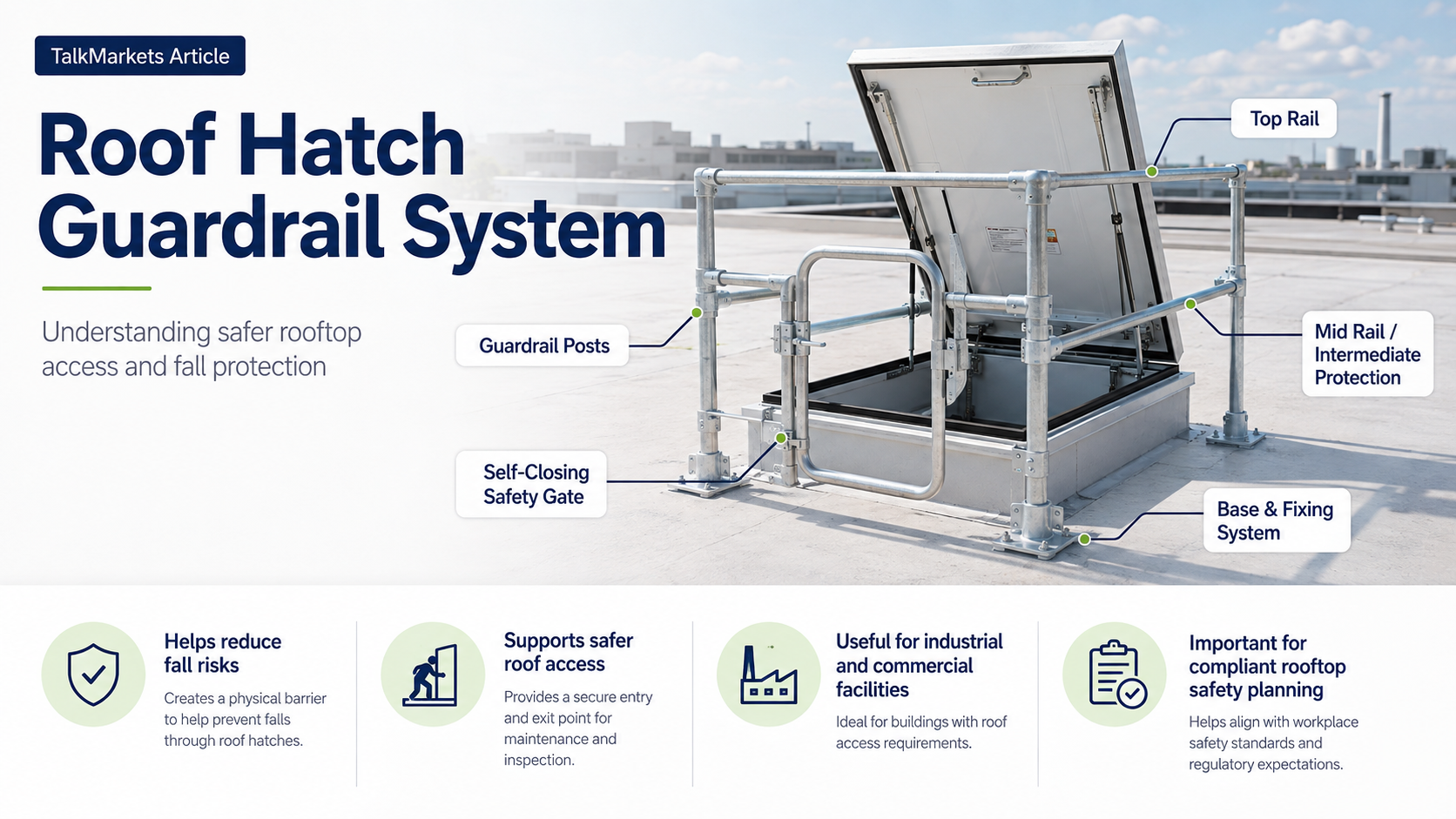
A Roof Hatch Guardrail System is a railing arrangement installed around a roof access hatch or similar opening. Its main purpose is to reduce workers' exposure to an open hatch while they are entering, leaving, or working near the roof access point.
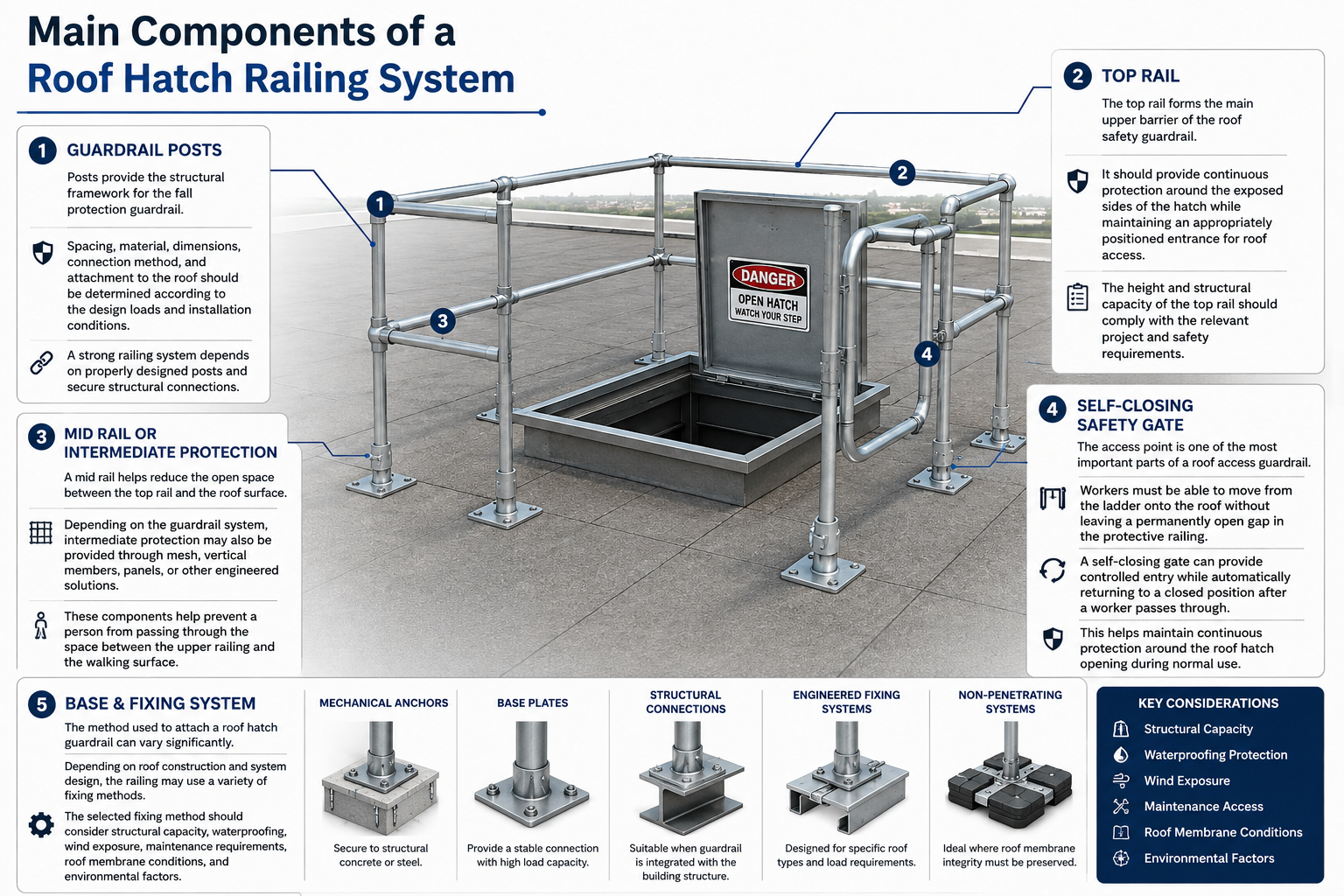
A typical roof hatch railing system may include:
Vertical guardrail posts
A top rail
Mid rails or intermediate protection
A self-closing safety gate
Base plates and fixing components
Corrosion-resistant structural members
The exact configuration depends on the hatch dimensions, roof construction, access arrangement, applicable safety requirements, and project specifications.
Why Roof Hatch Protection Matters
A closed roof hatch may appear to present little risk. However, once opened, the condition of the working surface changes.
Workers entering the roof through a ladderway may have restricted visibility and movement, particularly when carrying tools or wearing personal protective equipment. Other personnel already working on the roof may also approach the open hatch from different directions.
Installing roof hatch guard rails creates a clearly defined barrier around the opening and can help workers recognize the protected access zone.
This is particularly relevant in industrial environments where rooftop maintenance occurs regularly and access hatches may be opened several times during inspection and maintenance activities.
OSHA Roof Hatch Guardrail Considerations
The term OSHA roof hatch guardrail is commonly used when discussing fall protection because OSHA provides specific requirements for guardrail systems, holes, ladderway openings, and walking-working surfaces in the United States.
Where OSHA requirements are applicable to a project, the guardrail design must be evaluated against the relevant criteria relating to factors such as:
Guardrail height
Structural strength
Intermediate protection
Access openings
Self-closing gates
Surface conditions
Fall hazards around openings
It is important to remember that OSHA requirements are U.S.-based standards. Projects in Saudi Arabia and other GCC countries should also consider applicable local regulations, client HSE requirements, project specifications, engineering standards, and manufacturer recommendations.
A guardrail should therefore never be considered compliant simply because it resembles another installed system. The complete design and installation must be assessed against the requirements applicable to the specific project.
Roof Hatch Guardrail vs. Roof Edge Protection
Roof edge protection and roof hatch protection address different rooftop hazards.
A roof edge guardrail protects workers from exposed building perimeters, while a roof hatch guardrail protects the opening used to access the roof.
A rooftop may therefore require several different forms of protection.
A complete risk assessment may consider:
Roof access hatches
Roof edges
Skylights
Fragile surfaces
Equipment platforms
Elevated walkways
Changes in roof level
Maintenance zones
Protecting one hazard does not automatically eliminate the others.
For example, a building may have perimeter guardrails around the entire roof edge while still having an unprotected access hatch near the center of the roof.
Roof Access and Worker Movement
Effective roof access railing should support the way workers actually enter and leave a rooftop.
A worker climbing through a hatch may temporarily have limited balance and restricted visibility. The transition from ladder to roof surface can therefore be one of the most important stages of the access process.
A well-planned railing layout should provide enough space for safe movement without interfering with:
The access ladder
Hatch cover movement
Maintenance activities
Worker circulation
Emergency access
Nearby equipment
For anyone evaluating different approaches to Roof hatch fall protection, the complete access arrangement should be considered rather than focusing only on the railing itself.
Important Roof Hatch Railing Installation Factors
Proper roof hatch railing installation starts with an assessment of the existing roof.
Hatch Size and Orientation
The guardrail should be designed around the actual hatch dimensions and the direction in which the cover opens.
Ladder Position
The position of the ladder determines where workers emerge onto the roof and influences the location of the safety gate.
Structural Support
The roof structure must be capable of supporting the proposed fixing arrangement and expected loading.
Waterproofing
Roof penetrations should be carefully coordinated to avoid unnecessary damage to waterproofing systems.
Environmental Exposure
Outdoor roof hatch safety equipment may be exposed to heat, dust, moisture, industrial contaminants, and coastal conditions.
For projects in Saudi Arabia and the GCC, material selection should reflect the actual site environment rather than assuming that one coating or finish will be suitable everywhere.
Maintenance Requirements
The system should remain accessible for inspection, cleaning, repair, and replacement where necessary.
Permanent vs. Temporary Roof Hatch Guardrails
The selection between permanent and temporary protection depends on how the roof is used.
Permanent safety railing for roof hatches may be appropriate where:
Roof access is frequent
Maintenance is routine
The same hatch is used repeatedly
Long-term facilities management is required
A permanently defined access area is preferred
Temporary protection may be used during construction, renovation, or short-duration work where appropriate.
Regardless of the approach, the protection system should be selected based on risk assessment and applicable requirements rather than convenience alone.
Integrating Roof Hatch Safety Into Facility Risk Management
Roof hatch protection should be considered as part of the complete movement of workers through the facility.
A practical assessment may follow this sequence:
Internal Access → Ladder → Roof Hatch → Protected Access Area → Walking Route → Work Zone → Return Route
This approach helps facility managers identify hazards that may otherwise be evaluated separately.
For example, the hatch itself may be protected correctly, but workers may still need to travel close to an exposed roof edge to reach an HVAC unit.
A comprehensive rooftop safety strategy therefore considers both access-point protection and the route workers take after reaching the roof.
Common Roof Hatch Safety Issues
Several recurring problems can reduce the effectiveness of a rooftop safety system.
Leaving an Access Opening Unprotected
An open hatch may remain exposed while workers are performing maintenance elsewhere on the roof.
Leaving a Permanent Gap in the Guardrail
Providing rails around three sides while leaving the access side uncontrolled can reduce the overall effectiveness of the system.
Poor Gate Positioning
The gate should support natural worker movement without creating another obstruction or hazard.
Incorrect Fixing Methods
A poorly selected base or connection system can affect both structural performance and roof waterproofing.
Ignoring Environmental Conditions
Outdoor metal components should be selected with long-term corrosion and weather exposure in mind.
Treating Roof Hatch Protection as an Isolated Measure
A protected hatch does not automatically mean that the entire rooftop is safe.
The Role of Roof Hatch Guardrails in Industrial Facilities
Industrial facilities often depend on regular rooftop inspections and maintenance.
Equipment such as air-handling units, exhaust systems, solar installations, communication devices, and utility infrastructure may require frequent access.
In these environments, permanent roof hatch protection can support a more consistent approach to worker movement and access management.
Rather than relying entirely on temporary precautions each time the roof is accessed, a properly designed guardrail provides a visible and permanent physical barrier around the opening.
Final Perspective
A Roof Hatch Guardrail System is a relatively simple part of a building, but it addresses an important rooftop fall hazard.
Effective protection requires more than placing rails around an opening. Guardrail posts, top rails, intermediate protection, self-closing gates, fixing systems, hatch movement, roof structure, worker access, and environmental conditions should all be considered together.
For industrial and commercial facilities, particularly those with regular rooftop maintenance activities, roof hatch protection should form part of a broader fall-prevention and facility risk-management strategy.
Evaluating the complete route from internal access to the rooftop work area can help organizations create safer, more practical, and better-managed working environments.
Comments
Log in or sign up to join the conversation.