


The US economy expanded robustly in 3Q, driven by strong consumer performance. Business investment surged, led by tech-related activity, but with many inputs imported, net trade fully offset the capex contribution. Cooler momentum points to slower 4Q GDP growth, but with inflation remaining hot, the Fed looks set to hike rates in December
Hot consumer and investment spending held back by surging tech imports
Third-quarter US GDP growth was fractionally stronger than the market anticipated at 3.4% annualised (consensus 3.2%), while the Fed's favoured inflation measure was 0.3%MoM/3.1%YoY in September, as expected.
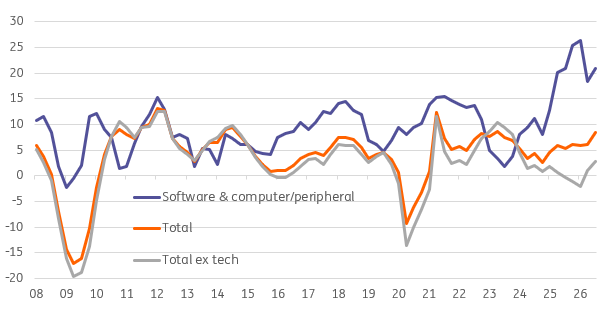
Within the details, consumer spending reported a robust 3.8% QoQ annualised growth, but momentum was lost as the quarter progressed, based on the monthly profile, with September real spending flat on the month. Gross private investment was particularly strong, surging 19.4%, led by a 20.9% gain in equipment. This is overwhelmingly tied to the tech sector, as can be seen in the chart below.
Structures rose 5.4%, which is also tech-related, being heavily oriented towards data centre activity. Intellectual property gained 8.4%, which is also tech-linked, but residential investment fell 3.3% given a lack of affordability for buyers amid elevated mortgage rates.
Business capex: tech versus non-tech (YoY% growth)
Inflation remains too hot for comfort
However, much of the high-value inputs for the tech roll-out are being imported from the likes of Korea and Taiwan. Goods imports leapt 26.4%, a massive drag on headline US growth. So, while gross private domestic investment contributed 3.3%pp to GDP growth, net trade fully subtracted 3.3pp, leaving a net flat outcome. This narrative of tech investment being offset by tech imports looks set to remain a story in 4Q based on orders numbers.
The squeeze on spending power from weak wage growth and a rising cost of living meant real household disposable income fell 0.3%MoM in September, and this is likely to contribute to a cooler consumer spending story in 4Q, while government spending is also likely to partially reverse the 5.3% jump experienced in 3Q. As such, we are looking at 4Q GDP coming in closer to 2%.
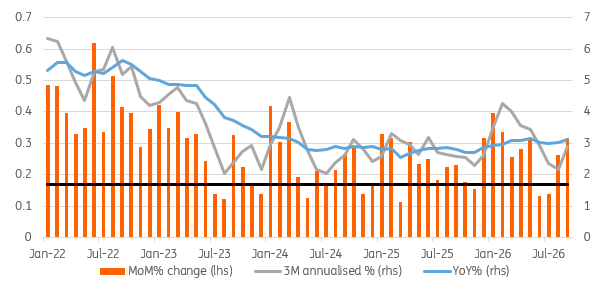
On the inflation metrics, there was no surprise, with the CPI and PPI inputs clearly signalling the prospect of a 0.3%MoM increase. As the chart below shows, this remains too hot for comfort. To achieve 2% annual inflation, the MoM rate needs to trend at 0.17%MoM (the black line). Today’s print was 0.32%MoM.
In consequence, the Federal Reserve is likely to conclude that it has more work to do to bring price pressures under control, leading us to expect a 25bp hike at the December FOMC meeting.
Core PCE deflator metrics (% changes)



Comments
Log in or sign up to join the conversation.