


The Beacon Tactical Alternatives Risk ETF (BTA) just started trading a few weeks ago, and it is a variation on risk parity. Instead of more typical asset classes like stocks, gold/commodities, and bonds, the sleeves for BTA are gold, broad commodities, managed futures, and digital assets, but I don't see any in the fund currently, and US dollar exposure, which means the USDU ETF and a lot of different short-term fixed income.
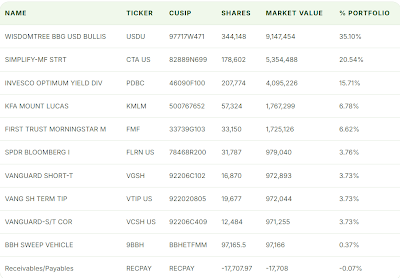
Part of the pitch for this fund is that it can be a "third independent return system to the classic stock/bonds mix." The fund is actively managed, so the above holdings can change, but the list above is easy to backtest. To create a longer backtest, I combined all the managed futures funds into KMLMsim on testfol.io, and I used DBC, which is the older cousin of PDBC.
Looked at as a standalone, the results are uninspiring, compounding at 3.82% for almost 13 years. While those results really are meh, the replication does something interesting when paired with equities.
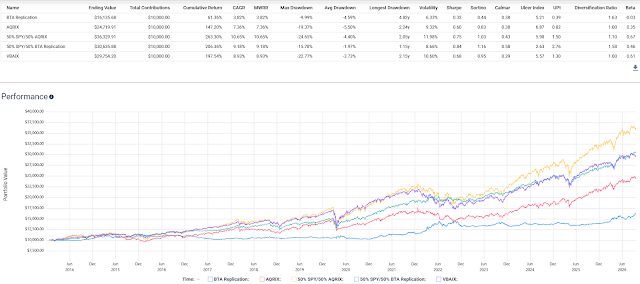
Risk parity has generally been difficult to implement in a mutual fund or ETF; look at how poorly RPAR has done. AQRIX is an AQR fund that used to run a risk parity strategy; it changed a while back, but I think of it as still being risk parity adjacent.
Also in the BTA literature is a mention of 50/30/20 replacing 60/40, where the 20 is alts, and I think they are suggesting the 20% go to BTA. But with all that USDU and the short-term debt, the fund has about 50% in fixed income or fixed income substitutes, so allocating 50% to the BTA replication, as we did in Portfolio 4, gets kind of close to 50/30/20.

Portfolio 4 did better in just about every drawdown in the backtest, both fast and slow, except the tariff panic of 2025. In 14 full and partial years, Portfolio 4 outperformed VBAIX seven times, so that's kind of a push, but in a couple of the years that it lagged, it lagged VBAIX by a lot. In periods where managed futures and commodities both do poorly, obviously BTA as currently constituted should also be expected to struggle.
The fund going forward could be different, and as I said, it doesn't appear to me that there are any digital assets in there, but if BTA uses risk weighting then the allocation to digital should be small enough that a catastrophe in something like Bitcoin (BTC.X) wouldn't wreck the fund; it seems like potentially an asymmetric kicker if/when they actually add it.
For now though, this seems interesting to me. It is only a month old (backtest is long enough to set some expectations), but it makes a good first impression.


Comments
Log in or sign up to join the conversation.