

The Fed is not in a good spot.
Bond Yields Are a Warning
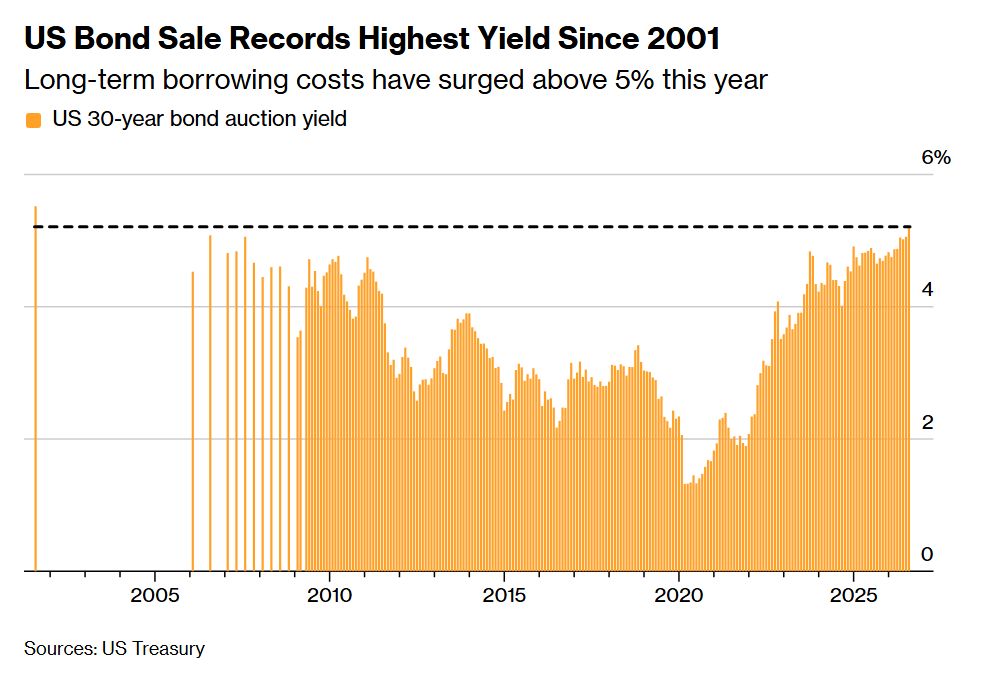
Bloomberg reports Costliest US Bond Sale Since 2001 Is Investor Warning to Bessent
The US government sold 30-year bonds at the highest interest rate in a quarter century, a testament to investors’ demand for greater compensation to finance the nation’s growing deficit.
The yield at the $25 billion sale Thursday came in at 5.216%, the most since 2001, even as a drop in oil prices supported US debt in secondary-market trading.
“The only clear solution I see, is the US government tightening its budget,” said John Fath, a managing partner at BTG Pactual Asset Management US LLC. “The whole game plan of trying to move issuance up to the front end: You can only do that so much, right? Then it becomes what I would call irresponsible.”
No Comment
Representatives for the Treasury didn’t respond to Bloomberg’s requests for comment.
I would not want to comment either.
30-Year Bond Yield
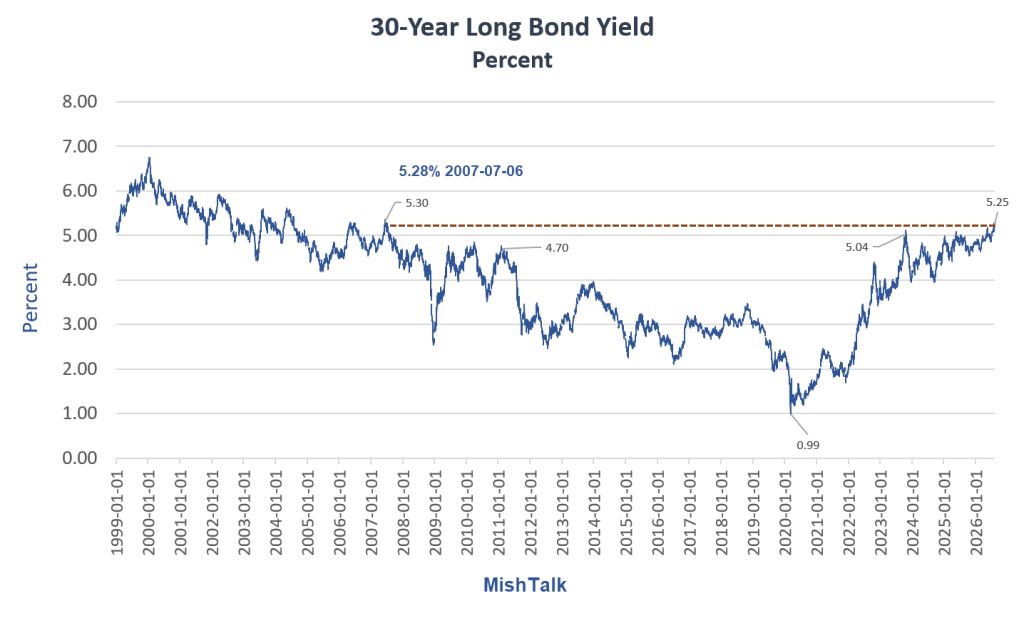
The Fed didn’t issue 30-year bonds for many years. A recent high of 5.27 percent is the highest since 5.28 percent on July 7, 2006.
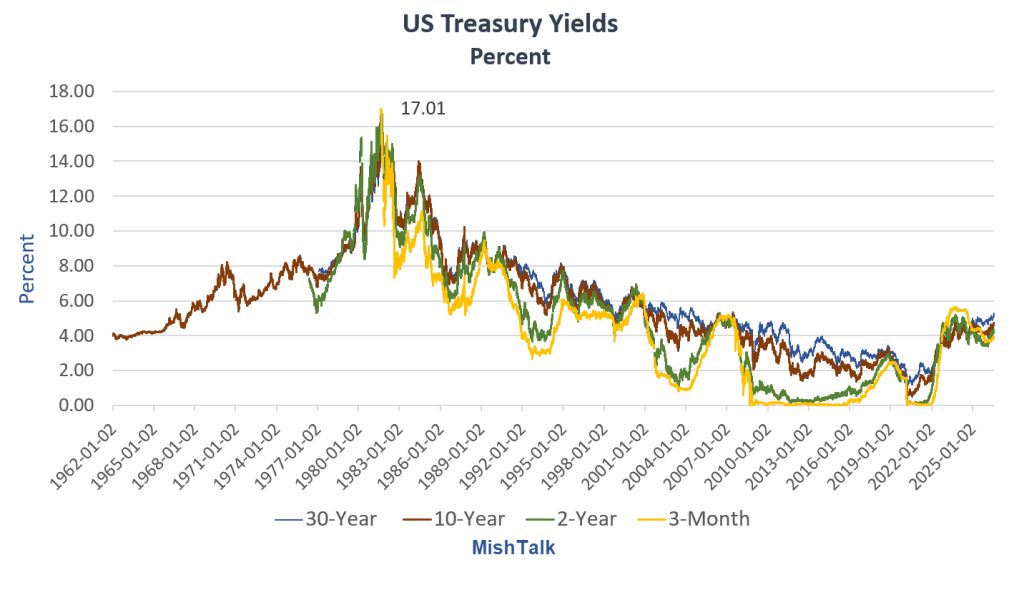
US Treasury Yields Percent
Secular Top
On September 1, 1981, the 3-month yield hit 17.01 percent.
On that date, the long bond yield was 14.70 percent, the 10-year yield was 15.41 percent, and the 2-year yield was 16.78 percent.
That was the secular top in interest rates.
Secular Bottom
The secular bottom was March 9, 2020 when the long bond yield fell to a record low 0.99 percent.
On that date the 10-year hit a record low 0.54 percent.
Secular Treasury Yield Headwinds
US Debt topped $40 trillion
Deficit spending is massive
US debt-to-GDP projected to soon hit 123 percent
Boomer retirements are pressuring Social Security, Medicare, and Medicaid
Just-in-time manufacturing has ended
Global wage arbitrage is over
The only major tailwind is AI, assuming the productivity miracle does happen.
Cyclical recessions may tame inflation for a while, but Congressional spending is deeply entrencehed.
Strong Signal
The long bond yield is a strong signal to Kevin Warsh and the Fed that the Fed is behind the curve.
Incompatible Things
Set an interest rate and defend it, without QE or Interest on reserves, both of which Warsh wants to eliminate.
I suppose if you “study” the problem long enough you can hope the problem goes away.
If you set an interest rate, you have to defend it. And if it’s too low, you defend it with QE and interest on reserves.
Warsh’s Honeymoon Is Over
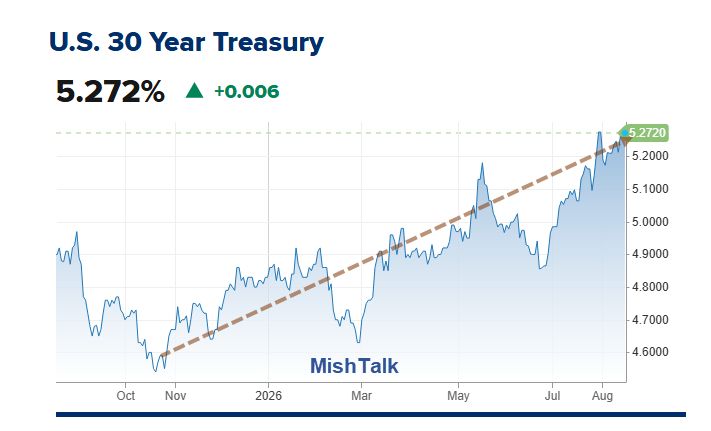
The long bond is revolting for many reasons. One of those reasons is the Fed is behind the curve.
The others are debt, deficit, spending projections, tariffs, the war in Iran, money supply that is out of control, and genuinely stupid economic policy by Trump.
The choice for Warsh is to let the market set the Fed Funds rate, or keep QE.
It now takes over $3 trillion on the Fed’s balance sheet to peg rates where the Fed thinks they should be.
Warsh’s statement that the bond market is doing the tightening is very disingenuous in light of his position on ending QE and free money interest to banks.
Warsh is right about ending QE but so far he is unwilling to walk the walk. He wants to study the issue hoping to buy time.
The bond market says time is up.
But hey, don’t worry because Trump Says “I’ll Never Apologize, You’re Just Paying a Tiny Bit More”
Trump just handed the Democrats another midterm election talking point.
Also note Trump’s Trade War With Canada on Verge of Becoming Economically Nasty
A USMCA trade deal breakdown with Canada is increasingly likely.
The best we can hope for regarding USMCA is that things are only mildly stupid.



Comments
Log in or sign up to join the conversation.