

Using the Lipper Leaders scoring system to analyse the best-performing funds in the IA Technology & Technology Innovation sector.
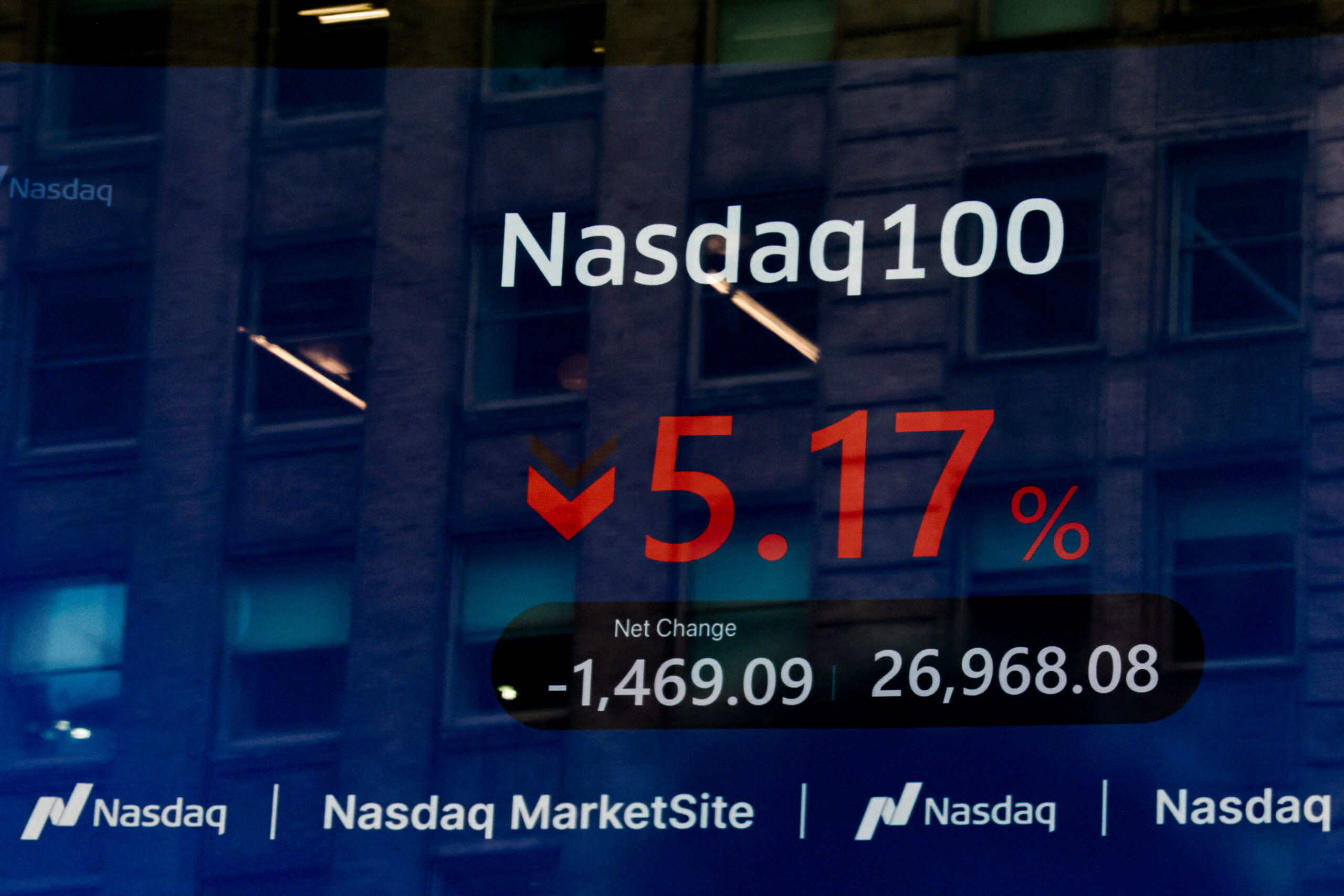
There is unarguably an AI hype cycle, and we are deep within it. The however-many-trillion-dollar question is, however, is the hype merited? Or, rather, can investors continue to make money from a theme that has increasingly dominated financial markets since the initial release of ChatGPT almost exactly four years ago?
I write the same week that Anthropic released its 240,000-word IPO filing. It was also the week Elon Musk’s AI-generated riposte to Christopher Nolan’s Odyssey was released via X. Given the critical reception the former received, one might be forgiven for thinking that if AI can survive panning of this magnitude, it can survive pretty much anything.
So, it’s unsurprising that I have lit upon the Investment Association’s Technology & Technology Innovation sector as the theme for this month’s column. Although, AI bleeds into so many investment sectors. If one includes Amazon (AMZN) within tech, then the sector makes up half the large-cap US Russell 1000. Not only does the US make up about 60% of the FTSE All World index, but one gets considerable tech exposure through emerging markets: whether the highly concentrated Korean market, where Samsung and Hynix dominate, or the daddy of EM stocks, Taiwan’s TSMC (TSM). As a result, EM’s traditional role as a diversifier of returns alongside developed market exposure is now much reduced. By contrast, the FTSE 100 has a roughly 1% tech weighting, so may offer those diversification benefits historically sought elsewhere.
Shifting our attention from equities to bonds, AI hyperscaler debt has made up about 15% of new issuance, year to date.
The argument for is that this is a truly transformative technology, (most) valuations do not seem too stretched by historical standards, and the dominant companies are, to a large degree, strongly cash generative. The bet is that the rapid and widespread adoption of AI will justify both the valuation and the level of investment.
There are many moving parts in this: not least, the flick-flacking between software and hardware. Such internal rotations and general market uncertainty have produced a lot of volatility, with August seeing a rotation to cyclicals and Technology, before September’s leadership narrowed to large-cap Technology. Indeed, FTSE Russell reports that Technology has been the most volatile industry, with significant regional dispersion. For example, Hardware’s sharp sell-off was a major drag in Asia Pacific, not least Korea, while software’s rebound from its struggles earlier in the year contributed strongly to the US. Overall, Software and Computer Services were the strongest performing industrial sector over the third quarter of 2026.
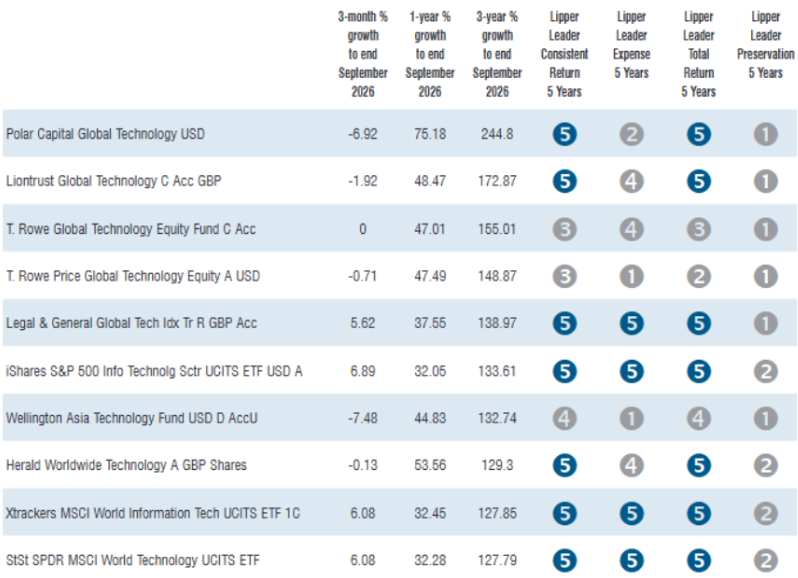
That volatility is evidenced by the capital preservation scores on the table below: ones and twos, the lowest.
UK fund investors have got on board, with flows to the sector increasing from £1.1bn over 12 months to September 2025 to £5.4bn for the 12 months to September 2026. For context, North American funds took £18.5bn over the latter period.
AI hype aside (if that’s possible) there is a wide range of strategies available in the sector: from cybersecurity to quantum computing specialist funds, and three-year returns vary from about 225% to about 25%.
There are four index trackers in the table below, which are more diversified plays: Legal & General Global Tech Index Tracker, iShares S&P 500 Info Technology Sector, Xtrackers MSCI World Information Tech, and the State Street SPDR MSCI World Technology funds, the last three being ETFs.
The fund with the largest three-year returns (that 225%), however, is an active strategy: the Polar Capital Global Technology fund—a high-conviction portfolio investing globally. Its strategy combines bottom-up fundamental research with a thematic framework, focused on earnings and cash-flow growth. Typically holding 60 to 85 stocks, it operates without benchmark or tracking-error constraints. Lipper characterises this as a large-cap growth fund, with the largest two stocks, Nvidia (NVDA) and TSMC currently making up about 15% of the portfolio.
If you do believe the hype and want concentrated exposure to the theme, this sector offers many ways to get it.
Table 1: Top-Performing Technology & Technology Innovation Funds Over Three Years (with a minimum five-year history)
All data as of September 30, 2026; Calculations in GBP
Source: LSEG Lipper


Comments
Log in or sign up to join the conversation.