

Revolut chair Martin Gilbert said on Tuesday, November 17, that the fintech plans to launch four tokenized funds, letting its customers buy small slices of private-market investments on a blockchain. He spoke at Solana’s Breakpoint conference in London.
The funds would hold assets such as private equity, which normally can’t be sold quickly, and use a blockchain to cut them into what Gilbert called “marketable sizes.”
Revolut has more than 80 million customers, so tokenized funds in its app could reach far more everyday savers than most tokenization projects do today. But the timing is awkward. We tracked the share prices of the four firms that already manage Revolut’s private-market funds. All four are down this year, by a median of 28%, while the S&P 500 is up 7%.
So can tokenized funds fix the problem Gilbert describes, getting money out of assets that are hard to sell?
Revolut Tokenized Funds: Announced, but Few Details Yet
Gilbert framed the plan around one problem: getting money back out. “In this world, there is liquidity until there is no liquidity,” he said. “If you can help people get liquidity in illiquid assets, you’re going to solve a lot of problems for a lot of people.”
Liquidity here means being able to sell quickly at a fair price. Private equity funds usually lock money up for years. Splitting a fund into tokens on a blockchain could, in theory, let investors trade those tokens with each other instead of waiting for the fund to pay them out.
Revolut has not shared much beyond that:
Not disclosed: the fund names, managers, strategies, fees, legal structure and launch date.
Blockchain: not named. Gilbert spoke at a Solana event, but Revolut hasn’t confirmed which network the funds will use.
Who can buy: not stated. Revolut’s current private-market funds are open only to eligible customers in Europe.
The plan builds on a product Revolut launched on July 27. Its Private Markets section lets eligible European customers invest from €1 in funds run by Apollo, Ares, Hamilton Lane and Partners Group. Those funds use the EU’s ELTIF 2.0 rules, a framework that lets retail investors buy long-term funds. Subscriptions are generally monthly and redemptions quarterly. Holders can’t move them to another broker or sell them to other investors.
Private Markets Managers Are Down 28% This Year
The four managers Revolut picked are some of the biggest names in private markets. Their share prices show how investors feel about the business right now.
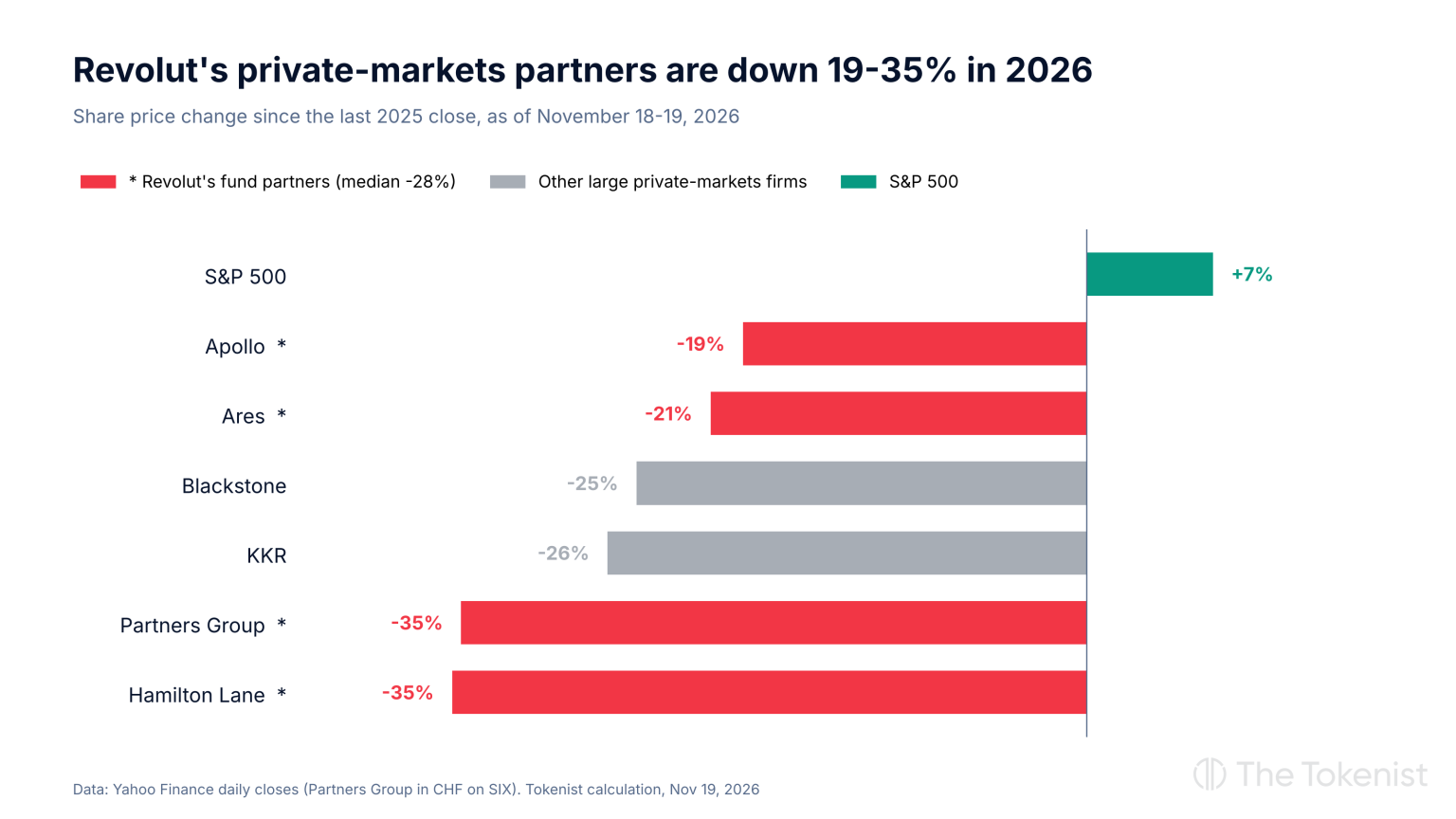
Revolut’s partners: Apollo is down 19% since the end of 2025, Ares 21%, Partners Group 35% and Hamilton Lane 35%.
The wider group: Blackstone, the largest private-markets firm, is down 25%, and KKR 26%.
The market: the S&P 500 is up 7% over the same period.
Since Revolut’s launch: from July 27 to now, Apollo and Partners Group fell about 6%, while Ares and Hamilton Lane were roughly flat.
Part of the worry is exactly the liquidity Gilbert talked about. In June, Partners Group capped withdrawals from an $8.6 billion fund after investors asked for 9.8% of its assets back, nearly double its 5% limit, Bloomberg reported. Apollo and Ares have also limited redemptions on some funds that promise investors regular access to their money.
That’s the case for tokenized funds, and also its limit. A token can make a fund easier to trade, but only if someone wants to buy it. When many holders want out at once, a token changes how a share is sold, not whether a buyer shows up.
Tokenized Funds Already Exist, Mostly for Professionals
Revolut wouldn’t be first. Apollo and Hamilton Lane already offer tokenized credit funds through Securitize, a company that issues fund shares as tokens on blockchains. Those products are mostly sold to institutions and wealthy investors with high minimums.
There is even a token linked to Revolut itself, though Revolut has nothing to do with it. $CREV, issued by Swiss firm Colb Finance on BNB Chain, tracks the value of Revolut shares before any stock market listing. It launched on May 28 with a $25,000 minimum for professional investors, and holders get price exposure only, with no voting rights. Revolut has not announced a date for listing its own shares.
What Revolut could change is scale. Moving funds like these into an app with 80 million users, at small ticket sizes, would test whether tokenized funds can work for ordinary savers.



Comments
Log in or sign up to join the conversation.