

When an employee gets hurt on the job and needs time away to recover, one question dominates every conversation that follows: will there be a job to come back to? For employers, this isn't just a matter of goodwill — it's a legal obligation shaped by workers' compensation law, and it frequently overlaps with the Family and Medical Leave Act (FMLA) and the Americans with Disabilities Act (ADA). Getting the return-to-work process wrong is one of the fastest ways an organization exposes itself to costly claims, so understanding how job restoration actually works is essential for HR professionals, supervisors, and business owners alike.
Why Job Restoration Is Not Automatic
A common misconception is that workers' compensation itself guarantees an employee's old job back the moment they're medically cleared. In reality, most state workers' comp statutes don't include a standalone reinstatement mandate — that protection usually comes from other overlapping laws. This is where the confusion begins. An employee recovering from a workplace injury may simultaneously be covered by:
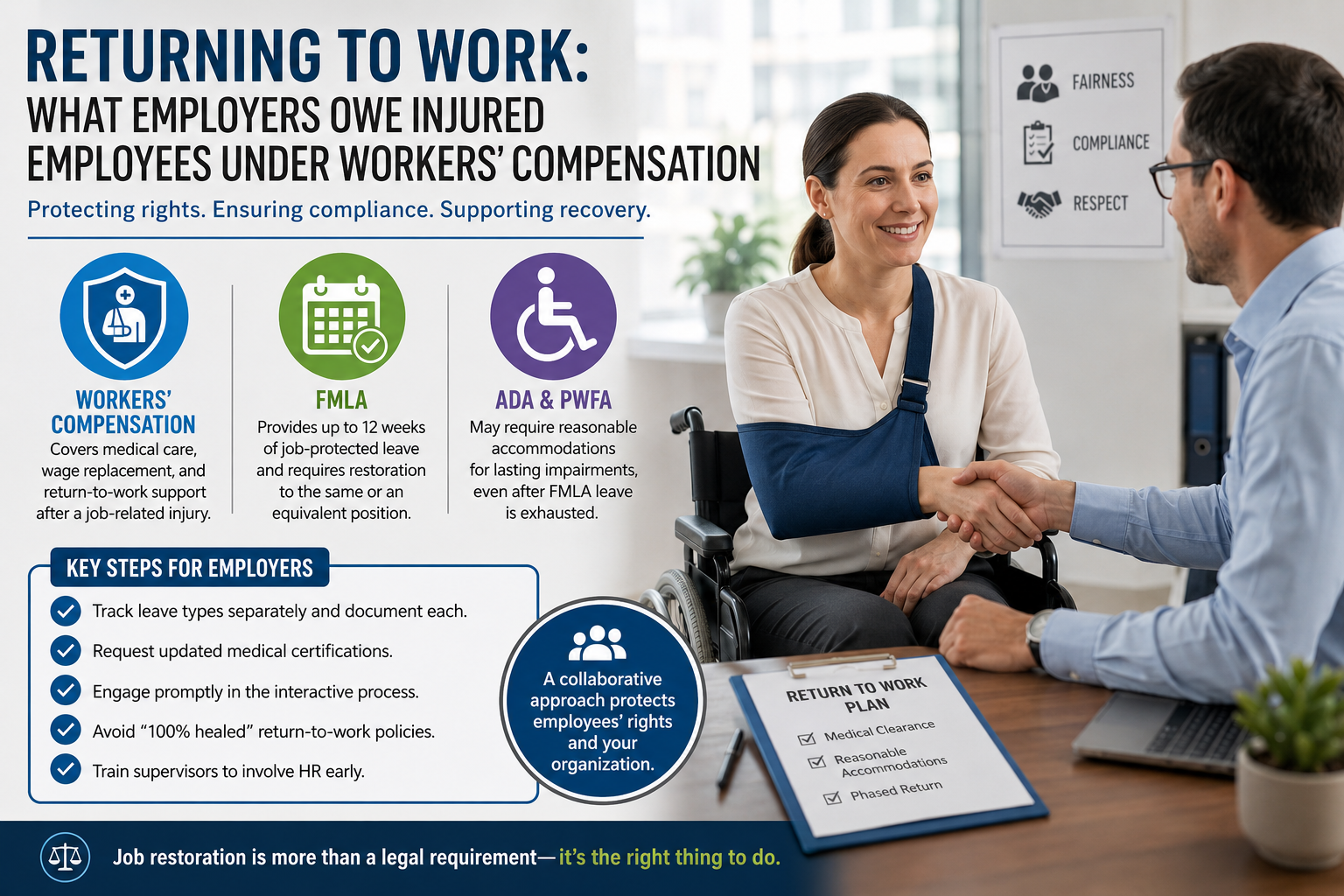
Workers' compensation, which addresses medical treatment, wage replacement, and return-to-work coordination after a job-related injury or illness.
FMLA, which offers eligible employees up to 12 weeks of job-protected leave and requires restoration to the same or an equivalent position.
ADA (and the Pregnant Workers Fairness Act, where applicable), which may require reasonable accommodations for employees with lasting impairments, even after FMLA leave is exhausted.
Because these three frameworks have different eligibility rules, different timeframes, and different definitions of "disability" or "serious health condition," an employer can be technically compliant with one law and still in violation of another. Treating a workers' comp claim as a single, self-contained process — without checking whether FMLA or ADA obligations also apply — is one of the most frequent compliance mistakes organizations make.
The Interactive Process: The Bridge Between Recovery and Reinstatement
When an employee's recovery involves lingering restrictions — lifting limits, reduced hours, modified duties — employers are generally expected to engage in what's known as the interactive process under the ADA. This means sitting down with the employee, reviewing medical documentation, and exploring reasonable accommodations that would let them perform the essential functions of their role, or a comparable one.
Skipping this step, or assuming an employee simply can't return because they're "not 100%," is a legal risk. Reasonable accommodations might include:
A temporary light-duty assignment
A modified schedule or phased return
Equipment changes or workstation adjustments
Reassignment to a vacant, equivalent position
Employers are not required to create a new position or eliminate essential job functions, but denying accommodation without a documented, good-faith review of the options invites both ADA and workers' comp disputes.
Timing Matters: Coordinating Leave and Reinstatement Rights
FMLA leave and workers' comp leave often run concurrently, which employers should designate clearly and communicate to the employee in writing. If FMLA's 12-week entitlement runs out before the employee is medically released, job restoration protections under FMLA end — but ADA obligations may continue if the employee's condition qualifies as a disability. This is the exact overlap zone that trips up even experienced HR teams: an employee might lose FMLA reinstatement rights on paper while still being entitled to accommodation and consideration for their old job under the ADA.
Multi-state employers face an added layer of complexity, since state-specific leave laws and workers' comp statutes vary widely in how they define job protection periods, light-duty requirements, and retaliation protections for injured workers.
Reducing Liability: Practical Steps for Employers
To manage job restoration compliantly, organizations should:
Track leave types separately — designate FMLA, workers' comp, and any state leave concurrently and document each.
Request updated medical certifications at key milestones rather than assuming status.
Engage promptly in the interactive process whenever restrictions are identified.
Avoid blanket "100% healed" policies, which courts have repeatedly found to violate the ADA.
Train supervisors to escalate return-to-work questions to HR rather than making informal decisions on the floor.
The Bottom Line
Job restoration after a workplace injury sits at the intersection of workers' compensation, FMLA, and ADA — and no single law tells the whole story. Employers who treat these frameworks as separate checklists, rather than an integrated process, risk both employee harm and significant legal exposure. A consistent, well-documented approach to leave tracking and accommodation review is the most reliable way to protect both the business and the employee's right to return to meaningful work.
FAQs
1. Does workers' compensation guarantee my job back after an injury?
Not on its own. Workers' comp mainly covers medical costs and wage replacement; job protection during recovery usually comes from FMLA or ADA obligations running alongside the claim.
2. What happens if my FMLA leave runs out before I'm medically cleared to return?
FMLA job-protection ends once the 12 weeks are used, but if your condition qualifies as a disability, your employer may still need to consider reasonable accommodations under the ADA.
3. Can my employer make me return to full duty with no restrictions?
Generally no. Requiring employees to be "100% healed" before returning, without considering accommodations, is a practice that has been challenged under the ADA in many cases.
4. What should I do if my employer denies a light-duty request?
Ask for the decision in writing and request a formal interactive process discussion. If restrictions and documentation support a modified role, a blanket denial may violate ADA or workers' comp return-to-work rules.
Comments
Log in or sign up to join the conversation.