

The markets are, ahem, unsettled these days. But the Iran war isn’t the main culprit. Three other events are potentially both scarier and longer-lasting:
The Fed Flirts With Tighter Money
New Fed chair Kevin Warsh presumably went through an interview process in which President Trump or his surrogates demanded lower interest rates and Warsh agreed.
Then, Warsh shows up to chair his first meeting of Fed governors and learns that nearly half of them want to raise the Fed Funds rate. He eventually wrangles a unanimous decision to leave the rates unchanged, but the odds of a rate increase later this year now exceed 50%:
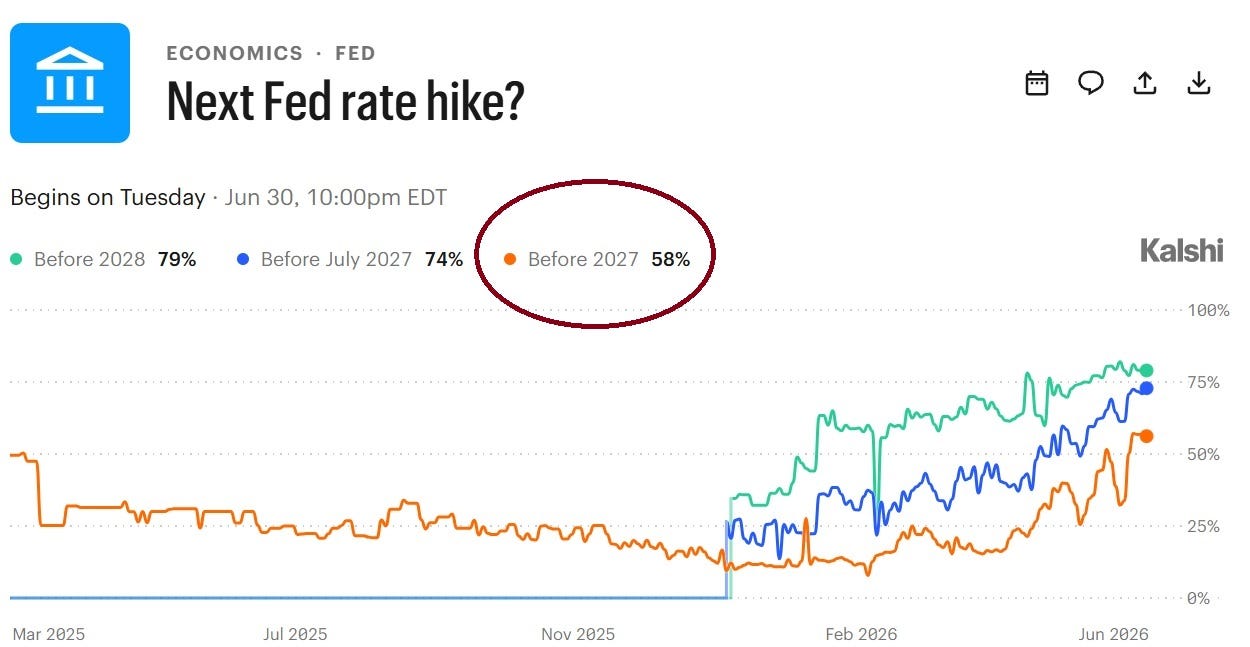
Stock markets love “liquidity” and fear rising interest rates. So the prospect of Fed tightening is, by itself, enough to explain the past week’s equity volatility.
SpaceX Opens Its Books
Elon Musk’s SpaceX (SPCX) conglomerate (rockets, space-based internet, AI) went public on June 12, spiking and then giving back its initial gains.
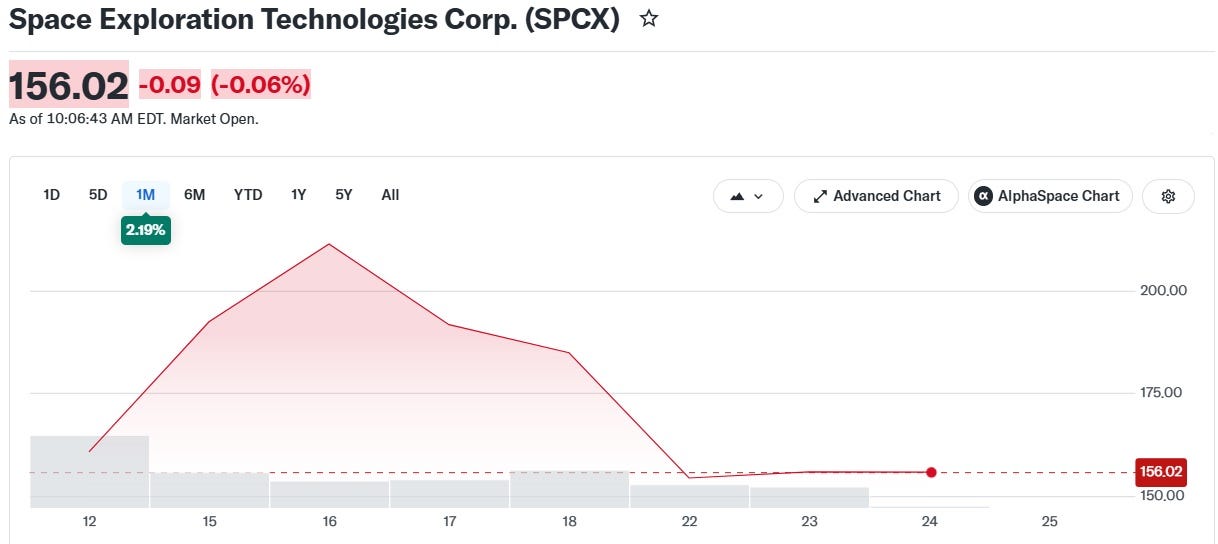
Along the way, investors got a look at its valuation, which, to put it mildly, is surreal. At 100 times sales, this is the most richly priced IPO since the 1990s dot-com era. Here’s an AI summary:
SpaceX trades at approximately 100 to 115 times trailing sales, a valuation that analysts describe as “absurdly expensive” and historically unsustainable for a capital-intensive industrial company.
Key Financial Context:
Revenue vs. Valuation: The company reported $18.67 billion in sales for the last year, yet its post-IPO market capitalization reached roughly $2.2 trillion, creating the extreme multiple.
Analyst Warnings: Comparisons to historical peaks like Amazon (which stayed below 20x sales during its fastest growth) and Sun Microsystems highlight that SpaceX’s multiple leaves little room for error.
Profitability Issues: Despite Starlink revenue growth, the acquisition of xAI pushed the company to a net loss of $4.94 billion in the last fiscal year, with the valuation implying a 300x multiple on adjusted EBITDA.
Market Sentiment: Historical IPO data suggests large offerings with such rich valuations often underperform over the next one to three years, with some analysts predicting significant downside as lock-up periods expire.
The bursting of financial bubbles is frequently marked by big events that (in retrospect) signal the party’s end. The remaining handful of cautious investors wonder if SpaceX’s IPO is such a signal.
Hyperscaler Cash Flow Evaporates
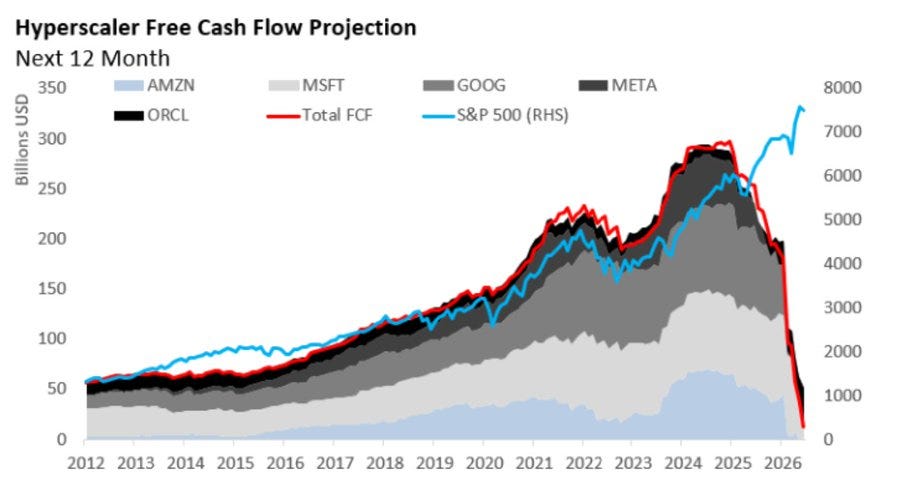
The companies building AI data centers — now known as “hyperscalers” — were previously software developers with wide profit margins and massive cash flow. But by pivoting to data centers, they’ve morphed into hardware firms. Traditionally, hardware generates way less free cash flow than software.
The magnitude of this change is just beginning to dawn on the markets.
Collision Course
To sum up, tighter money is on a collision course with evaporating Big Tech cash flow and excessively exuberant stock valuations. In a rational world, this would cause an equity bear market followed by a recession.
Let’s see how rational we are.

Comments
Log in or sign up to join the conversation.