

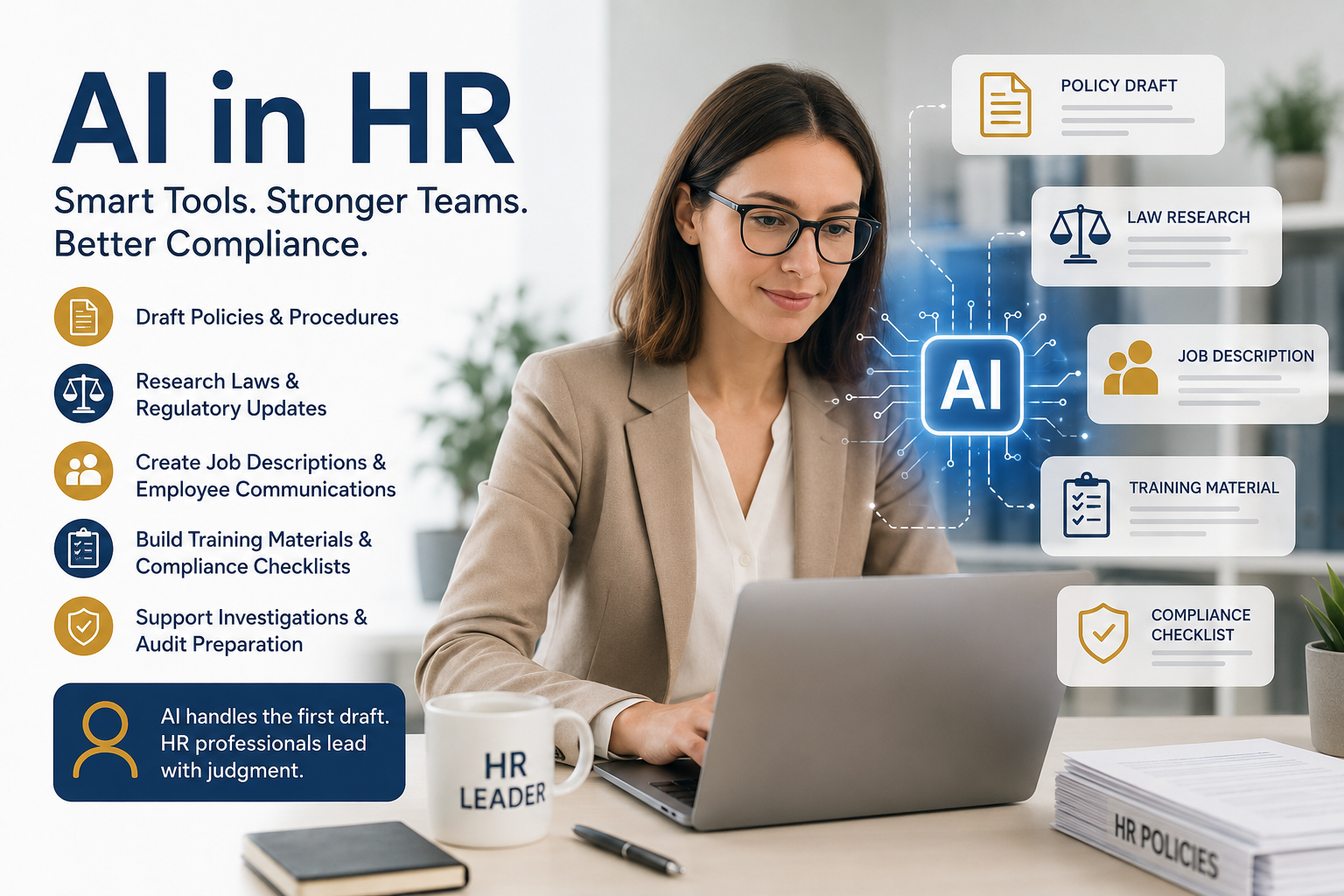
AI in HR has moved past the buzzword stage. Human resources teams are no longer asking whether artificial intelligence belongs in their department; they're asking how to use it well. From policy drafting to employment law research, AI tools like Claude are becoming everyday assistants for HR professionals who are stretched thin and expected to move fast without sacrificing accuracy. This shift toward AI-powered HR compliance and productivity tools is reshaping daily workflows in ways that are practical, measurable, and immediately useful.
Below are real-world examples of how AI is being applied across common HR functions, along with what HR leaders should know before adopting these tools at scale.
Drafting HR Policies and Procedures
Writing a new workplace policy from scratch, or updating an old one to reflect current law, can eat up hours of an HR professional's week. AI assistants can generate a first draft of a policy in minutes, whether it's a remote work policy, an anti-harassment statement, or an AI usage guideline for employees. The HR team still reviews, edits, and finalizes the language, but the heavy lifting of structuring the document and covering standard provisions happens much faster. This is one of the clearest examples of artificial intelligence in human resources delivering time savings without cutting corners on quality.
Researching Employment Law and Regulatory Updates
Multi-state compliance is one of the most demanding parts of modern HR work. Laws around pay transparency, leave entitlements, and workplace safety vary by state and change frequently. AI tools can help HR professionals quickly summarize a new regulation, compare requirements across states, or explain how a legal update might affect existing policies. This doesn't replace legal counsel, but it gives HR teams a faster starting point when they need to understand what's changed and where to focus their attention.
Creating Job Descriptions and Employee Communications
Recruiters and HR generalists often write dozens of job postings, offer letters, and internal announcements every month. AI-generated first drafts of job descriptions, onboarding emails, and performance review templates free up time for the more strategic parts of the role, like interviewing candidates or coaching managers. Because the tool can match tone and structure to a company's existing style, HR teams end up with communications that still sound like their organization, just produced in a fraction of the time.
Building Training Materials and Compliance Checklists
Preparing for an audit, a new hire orientation, or a manager training session usually means pulling together material from several sources. AI in HR can help outline training content, build compliance checklists, and organize documentation in a consistent format. This is especially useful for smaller HR teams that don't have a dedicated learning and development function but still need to deliver polished, compliant training materials.
Supporting Investigations and Audit Preparation
When HR needs to prepare for an internal investigation or respond to an external audit, organizing timelines, summarizing documentation, and drafting interview questions can be time-consuming. AI tools can help structure this information logically, which speeds up preparation while leaving all judgment calls and final decisions in human hands.
Where AI in HR Still Needs Human Oversight
None of these use cases mean HR professionals can set AI loose and walk away. Employee data privacy, legal accuracy, and ethical use all require a human reviewer at every step. AI-generated content should always be checked against current federal and state law before it's finalized, especially for policies tied to compliance requirements. Used this way, AI becomes a productivity partner rather than a replacement for HR judgment.
The Bigger Picture
The organizations getting the most value from AI in HR are the ones treating it as a tool for speed and consistency, not a substitute for expertise. Whether it's drafting a policy, researching a regulation, or preparing training content, the pattern is the same: AI handles the repetitive first draft, and HR professionals apply the judgment, compliance knowledge, and organizational context that only they can provide. As more HR teams adopt these tools, the professionals who learn to prompt effectively and review critically will be the ones who see the biggest gains in both accuracy and time saved.
FAQs
1. What is AI in HR used for most often?
AI in HR is most commonly used for drafting policies, writing job descriptions, researching employment law updates, and building training or compliance materials. It speeds up repetitive writing and research tasks so HR teams can focus on higher-level decision-making.
2. Can AI tools replace HR professionals?
No. AI tools handle first drafts and research support, but final decisions, legal review, and employee-facing judgment calls still require a trained HR professional. AI works best as an assistant, not a decision-maker.
3. Is it safe to use AI with employee data?
AI should never be given sensitive employee data like Social Security numbers, medical records, or confidential personnel details. HR teams should use general prompts and anonymized information to stay compliant with data privacy standards.
4. How does AI help with multi-state HR compliance?
AI can quickly summarize and compare employment law requirements across different states, helping HR professionals spot differences faster. This research should still be verified against official state and federal sources or legal counsel before being applied.
Comments
Log in or sign up to join the conversation.