
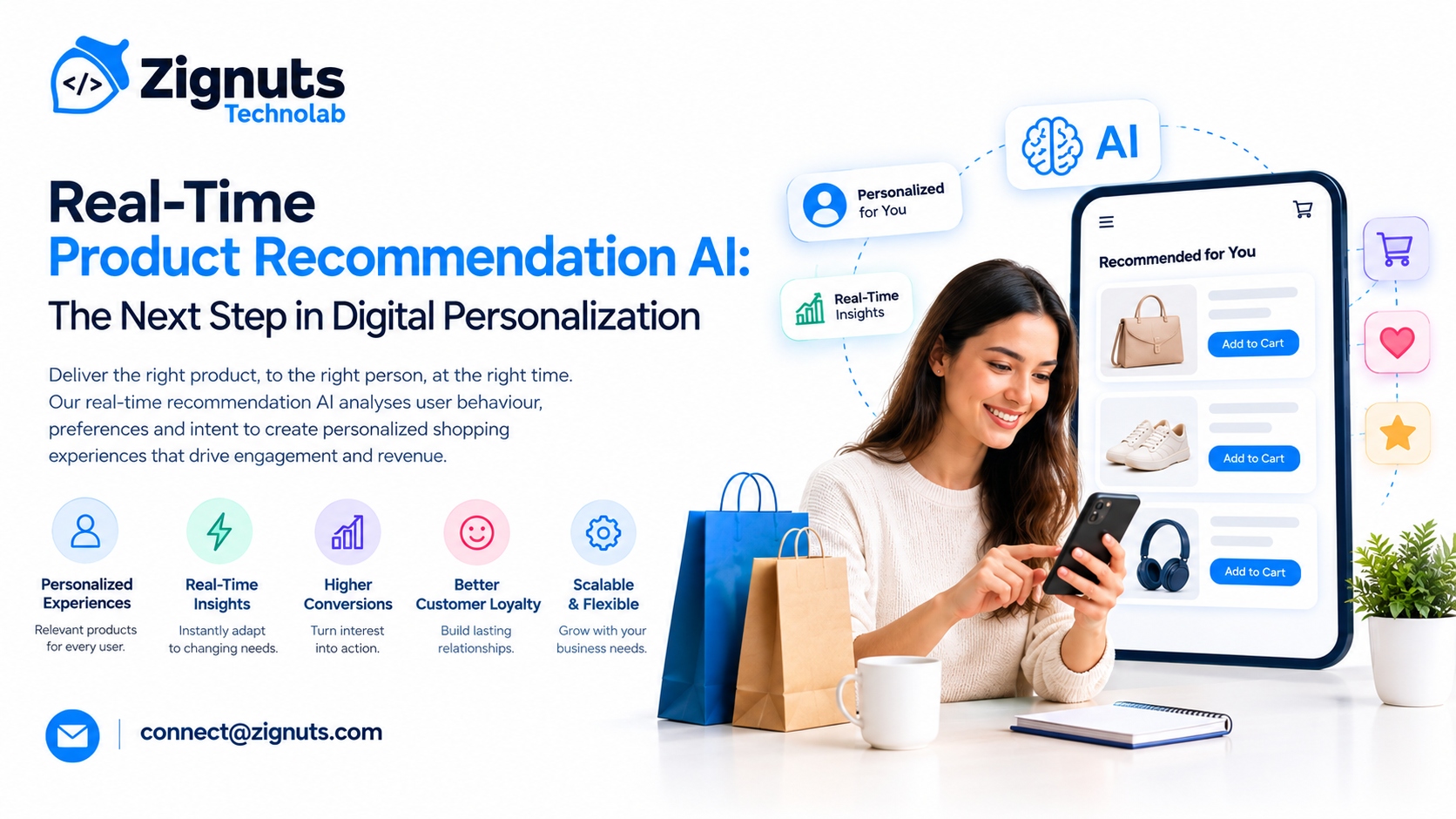
Customers can change their minds in seconds. A shopper may search for one product, compare alternatives, explore reviews, and suddenly move toward a completely different category. Static personalization cannot always keep up with these changes. Real-Time Product Recommendation AI gives businesses a way to respond to current customer behavior and deliver product suggestions that reflect what shoppers appear to need at that moment.
Traditional recommendation systems often depend heavily on historical information. Past purchases, previous searches, and long-term preferences remain valuable, but they do not always explain what a customer wants right now. Real-time recommendation technology adds current-session signals to the decision process, allowing businesses to adjust product discovery as customer intent evolves.
For retailers and digital commerce leaders, this creates an opportunity to make personalization more responsive. Instead of showing customers recommendations based only on what they did previously, businesses can combine historical behavior with current activity, product information, availability, context, and business rules. The result can be a more dynamic shopping experience that helps customers discover relevant products while supporting broader commercial objectives.
2027 Insights: Real-Time Recommendations Become More Adaptive
Expected Direction in 2027 | Potential Business Impact | Strategic Priority |
|---|---|---|
Current-session behavior becomes more important | Recommendations can better reflect immediate customer intent | Strengthen real-time behavioral data |
Product recommendations become more contextual | Suggestions can account for factors beyond purchase history | Connect behavioral, product, and business signals |
AI ranking becomes more dynamic | Product visibility can change as customer behavior changes | Invest in flexible ranking infrastructure |
Personalization expands across digital touchpoints | Customers can receive consistent recommendations across journeys | Integrate recommendation services across channels |
These are forward-looking expectations, not guaranteed outcomes. The actual impact will depend on data quality, technology architecture, customer behavior, and business execution.
Why Real-Time Product Recommendations Matter
Digital shopping journeys are rarely linear.
A customer may start with a broad search.
Then they may select a category.
Next, they compare several products.
They might read reviews.
Then they return to search.
Every interaction changes the available information about what the customer may want.
If recommendations remain unchanged throughout this journey, personalization can become disconnected from current intent.
Real-time recommendation AI addresses this by continuously processing relevant signals and adjusting recommendations accordingly.
The goal is not to react to every click.
The goal is to recognize meaningful changes in customer intent.
From Historical Personalization to Real-Time Intent
Historical personalization answers questions such as:
What has this customer purchased before?
Which categories do they frequently browse?
What products have they interacted with?
What preferences appear repeatedly?
Real-time personalization adds another question:
What is this customer trying to accomplish right now?
That distinction can be valuable.
A customer who previously purchased premium electronics may currently be searching for a budget accessory.
A shopper who usually buys one product category may suddenly be preparing for a different event.
Historical behavior provides context.
Current behavior provides immediacy.
Combining both can create a stronger recommendation experience.
How Real-Time Product Recommendation AI Works
A real-time recommendation system typically brings together customer events, product information, contextual signals, candidate generation, ranking models, and the customer-facing application.
A simplified workflow looks like this:
Customer Activity → Real-Time Data Processing → Candidate Products → AI Ranking → Personalized Recommendations → Customer Interaction
The customer's activity generates signals.
Real-time processing makes those signals available to the recommendation layer.
The system identifies potential products.
An AI ranking process evaluates their relevance.
Recommendations are delivered to the customer.
The resulting interaction creates another signal.
This allows the recommendation process to continuously respond to customer activity.
What Signals Can Influence Recommendations?
Real-time product recommendations can use a combination of historical and current information.
Potential signals include:
Current search query
Products viewed during the session
Click behavior
Cart activity
Previous purchases
Product attributes
Customer preferences
Product availability
Pricing context
Category engagement
Session history
Customer lifecycle stage
Not every business needs every signal.
The most valuable signals are those that improve recommendation relevance without creating unnecessary complexity.
Why Product Context Matters
Customer behavior alone does not determine whether a recommendation is useful.
Product context also matters.
Suppose a recommendation model identifies a product as highly relevant, but the item is unavailable.
Showing it may create frustration.
Similarly, a product might match customer interests but conflict with inventory, pricing, geography, business policies, or other operational constraints.
A strong recommendation architecture therefore combines AI predictions with business rules.
This creates a practical balance between model intelligence and commercial reality.
Real-Time Recommendations Across the Shopping Journey
Homepage
The system can personalize products based on known preferences and current activity.
Search
Product rankings can be influenced by current queries and behavioral signals.
Product Pages
Customers can receive related or complementary recommendations based on what they are currently viewing.
Cart
The system can identify potentially relevant accessories or complementary products.
Checkout
Businesses can present carefully selected recommendations when appropriate, while avoiding unnecessary distractions.
Post-Purchase
Recommendations can support replenishment, complementary products, or future discovery.
Each stage has different customer intent.
The recommendation strategy should therefore change according to the journey.
Business Value of Real-Time Product Recommendations
Real-time recommendation AI can support several business objectives.
Faster Product Discovery
Customers can find relevant products without navigating every category.
More Relevant Cross-Selling
Complementary products can be recommended according to current context.
Better Customer Experience
Customers can receive suggestions that reflect their immediate activity.
Increased Engagement
Relevant recommendations can encourage deeper exploration.
Improved Product Visibility
Products that match current customer interests can receive more appropriate exposure.
Better Personalization
The experience can evolve during the same customer session rather than remaining static.
The actual business outcome depends on the use case and implementation quality.
Where Real-Time Recommendation AI Creates the Most Value
Digital Situation | Real-Time Recommendation Opportunity | Potential Outcome |
|---|---|---|
Customer changes search direction | Update product ranking based on current intent | More relevant discovery |
Customer views multiple related products | Surface complementary or alternative products | Easier comparison |
Customer adds a product to cart | Recommend suitable accessories | More useful basket expansion |
Returning customer starts a new journey | Combine history with current behavior | More contextual personalization |
Customer repeatedly explores a category | Adjust recommendations toward that interest | Faster product discovery |
Product availability changes | Prioritize suitable available alternatives | Better shopping continuity |
The best use cases are those where customer intent changes quickly enough that real-time adaptation creates meaningful value.
The Role of AI in Product Ranking
Recommendation AI is not limited to identifying similar products.
It can also help rank multiple possible recommendations.
Imagine that a customer is viewing a laptop.
Potential recommendations could include:
A laptop bag
Wireless mouse
Monitor
Keyboard
Warranty plan
Another laptop
A software product
Not all of these are equally relevant.
An AI ranking system can evaluate signals and determine which candidates deserve priority.
This can help businesses move from simple "related products" logic toward more context-sensitive recommendations.
Real-Time Does Not Mean Reacting to Everything
A common misconception is that real-time personalization requires responding to every customer action.
That can create unnecessary complexity.
A better approach is to identify meaningful events.
For example, a search query may provide a strong intent signal.
Repeated product views may indicate growing interest.
Adding a product to the cart can represent a significant change in the customer journey.
A minor interaction may not justify changing recommendations.
Businesses should therefore establish event priorities rather than reacting indiscriminately.
Data Infrastructure Behind Real-Time Recommendations
Real-time recommendation systems require a reliable data pipeline.
Depending on the scale and use case, the architecture may include:
Event collection
Stream processing
Customer data systems
Product catalogs
Feature stores
Recommendation services
Model inference
Monitoring systems
Latency also becomes important.
If the recommendation takes too long to appear, the customer experience can suffer.
However, businesses should define acceptable response times according to the customer journey instead of pursuing extremely low latency without a clear business reason.
Cold Start in Real-Time Commerce
Real-time systems still face the cold-start problem.
A new visitor may provide little behavioral information.
A newly launched product may have limited interaction history.
Businesses can address this by combining multiple recommendation methods.
For new customers, systems can use:
Current search behavior
Session activity
Product attributes
Popularity signals
Context
Explicit preferences
For new products, content-based methods and product metadata can provide useful information before sufficient interaction history becomes available.
Avoiding Over-Personalization
Personalization can become counterproductive when recommendations become too narrow.
If a customer views one type of product and the platform continues showing only similar items, the experience may limit exploration.
Businesses can introduce controlled diversity.
Recommendations can combine:
Highly relevant products
Related alternatives
New products
Different price points
Complementary items
This can help maintain both relevance and discovery.
Privacy and Customer Trust
Real-time recommendation systems can process a large amount of behavioral information.
That makes privacy and governance especially important.
Businesses should define:
What behavioral data is collected
Why it is collected
How it is processed
Who can access it
How long it is retained
Which personalization controls customers have
What applicable privacy requirements must be followed
A recommendation should feel helpful, not invasive.
Trust should therefore be part of the system design.
Measuring Recommendation Performance
Real-time recommendation AI should be measured at several levels.
Customer Metrics
Recommendation clicks
Product discovery
Session engagement
Repeat visits
Customer interaction
Commerce Metrics
Conversion
Average order value
Cross-sell performance
Repeat purchases
Revenue-related outcomes
Technical Metrics
Recommendation latency
System availability
Data freshness
Model performance
Recommendation coverage
The right measurement framework depends on the business objective.
A recommendation intended to improve product discovery may have different success criteria from one designed for basket expansion.
Build Versus Buy
Organizations should carefully evaluate whether to build a custom recommendation platform or use an existing technology.
Build When Customization Matters
Internal development can make sense when recommendation intelligence is strategically important and the organization needs control over:
Data
Ranking logic
Business rules
Model architecture
Integrations
Infrastructure
Buy When Speed Matters
A third-party platform can help accelerate implementation when requirements are relatively standard.
However, businesses should evaluate:
Customization
Data ownership
Scalability
Vendor dependency
Pricing
Model transparency
Consider a Hybrid Strategy
A hybrid model can combine external recommendation infrastructure with proprietary customer data, business logic, or ranking capabilities.
Executive Questions Before Investing
Leadership teams should ask:
Where does customer intent change quickly?
Which customer journey would benefit most from real-time recommendations?
Which behavioral signals are available?
How reliable is our event infrastructure?
What level of latency is actually required?
Which business rules must control recommendations?
What customer and product data can be used responsibly?
How will recommendation quality be measured?
How will new customers and products be handled?
How will the system prevent repetitive recommendations?
What technical infrastructure is already available?
Should we build, buy, or use a hybrid model?
These questions help ensure that real-time personalization is tied to a practical business case.
Practical Implementation Roadmap
Step 1: Select a High-Value Use Case
Choose a journey where changing customer intent creates a meaningful recommendation opportunity.
Step 2: Define Success
Establish customer, commercial, and technical metrics before development.
Step 3: Map Customer Events
Identify which behaviors provide meaningful real-time signals.
Step 4: Strengthen the Data Pipeline
Ensure customer and product events can be processed at the required speed and reliability.
Step 5: Build the Recommendation Layer
Develop candidate generation, ranking, business rules, and delivery mechanisms.
Step 6: Start With a Controlled Pilot
Deploy recommendations in one part of the customer journey.
Step 7: Test Different Strategies
Evaluate relevance, diversity, ranking, and business outcomes.
Step 8: Monitor Continuously
Track data quality, latency, recommendation performance, and customer response.
Step 9: Scale Across the Journey
Expand to additional product pages, search, cart, homepage, and post-purchase experiences when justified.
Common Challenges
Real-time product recommendation AI can create several technical and business challenges.
Latency
Recommendations need to be generated quickly enough to support the customer experience.
Data Quality
Incorrect events can produce incorrect personalization.
Integration
Recommendation services may need to connect with commerce platforms, catalogs, customer data systems, analytics tools, and applications.
Model Drift
Customer preferences and product catalogs change over time.
Recommendation Bias
Popular products can receive excessive exposure.
Privacy
Behavioral data requires appropriate governance.
Operational Complexity
Real-time systems can require more monitoring and infrastructure than batch-based personalization.
These challenges should be included in planning from the beginning.
The Future of Product Personalization
Real-time recommendation technology is likely to become increasingly connected to the broader digital customer journey.
Instead of treating recommendations as isolated product widgets, businesses can use recommendation intelligence across search, navigation, product discovery, promotions, cart experiences, and post-purchase engagement.
The next stage is not simply faster recommendations.
It is more context-aware decision support.
A customer may not only receive a recommendation for a product but also a suggestion that reflects what they are currently trying to accomplish.
This creates the possibility of digital commerce experiences that adapt continuously while remaining aligned with customer preferences and business rules.
Conclusion
Real-Time Product Recommendation AI is changing digital personalization by allowing businesses to respond to customer behavior as it happens. Instead of relying exclusively on historical preferences, organizations can combine current-session activity, product context, behavioral signals, and business rules to make recommendations more relevant.
The technology can support product discovery, engagement, cross-selling, customer experience, and other commercial objectives. But real-time capability should not be adopted simply because it sounds advanced.
Businesses need a clear use case, reliable data, appropriate infrastructure, measurable objectives, and responsible personalization practices.
For executives and founders, the key question is simple: where does customer intent change quickly enough that real-time intelligence can create meaningful value?
When that question has a clear answer, real-time recommendation AI can become more than a personalization feature. It can become a strategic capability for creating digital experiences that respond to customers at the moment decisions are being made.
Frequently Asked Questions
1. What is Real-Time Product Recommendation AI?
Real-Time Product Recommendation AI uses current customer behavior, historical information, product data, context, and AI-based ranking to provide product recommendations that can change as the customer journey evolves.
2. How is real-time recommendation different from traditional recommendation systems?
Traditional systems may rely heavily on historical behavior and periodically updated data. Real-time systems can incorporate current-session activity to adjust recommendations more quickly.
3. What data can real-time recommendation systems use?
They can use search activity, product views, clicks, cart actions, purchases, product attributes, preferences, session behavior, availability, and other relevant signals.
4. Is real-time recommendation AI only useful for e-commerce?
E-commerce is a major application, but similar technology can support marketplaces, SaaS, media, travel, digital services, and other platforms where customer intent changes during a session.
5. Does real-time recommendation require complex infrastructure?
It can. Depending on the use case, businesses may need event processing, scalable APIs, recommendation services, model inference, monitoring, and low-latency data pipelines.
6. How can businesses avoid over-personalization?
Businesses can combine relevant recommendations with controlled diversity, alternatives, new products, and appropriate business rules rather than repeatedly showing only highly similar products.
7. How should businesses measure real-time recommendation success?
Measurement should be connected to the objective. Relevant indicators can include product discovery, recommendation engagement, conversion, average order value, cross-selling, repeat purchases, and technical performance.
Comments
Log in or sign up to join the conversation.