


We expect a 25bp hike on 28 October by the Reserve Bank of New Zealand. Since the dovish September meeting, rising oil prices, higher front-end rates globally and weakness in the NZ dollar all point to risks of inflation overshooting 4.0% in 4Q. Off-meeting commentary has supported market bets on another hike, and we expect a hawkish-leaning statement
In September, the Reserve Bank of New Zealand raised rates to 2.75% but pushed back against expectations for a large tightening cycle. Its projections pointed to the next hike only in December or 1Q27 and a 3.25% peak in 2028-2029.
The picture has turned increasingly hawkish since then. We now expect a hike on 28 October, in line with market pricing, accompanied by a hawkish statement. We expect another hike in either December or February, with a slight preference for February, and see chances of another move later in 2027. Our terminal rate estimate is 3.25-3.5%.
Markets input has been hawkish for the RBNZ
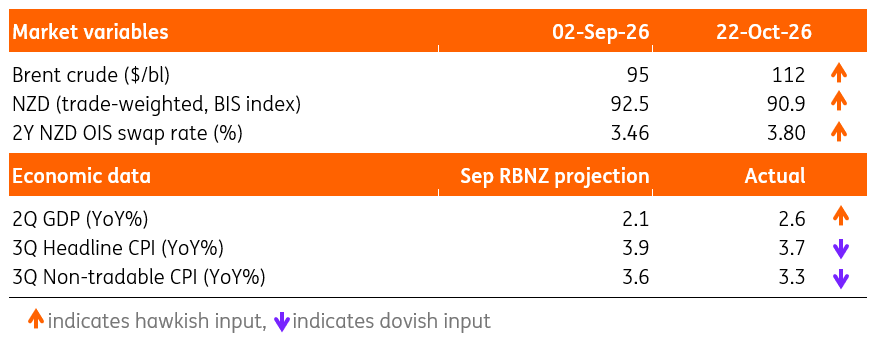
A lot has changed since September
Third-quarter inflation slowed from 4.1% to 3.7%, below both the RBNZ’s 3.9% estimate and our 3.8% forecast. Non-tradable CPI, a measure of core inflation, came in at 3.3% versus the RBNZ’s 3.6% estimate. In isolation, those numbers would have reinforced September’s dovish message and argued for an October hold. Other developments, however, have argued for earlier action:
Higher energy prices. The RBNZ’s September projections assumed oil prices would gradually decline. Instead, they have risen around 20% since the September meeting. That has materially increased the chances of 4Q inflation exceeding 4.0%, compared with the RBNZ’s 3.9% estimate, and remaining stickier afterwards.
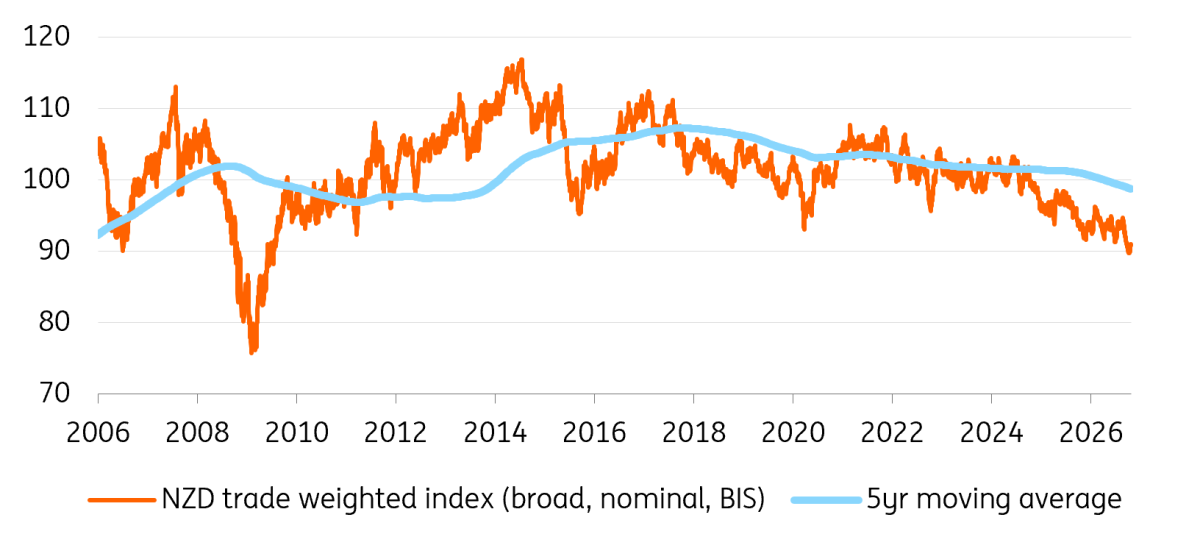
Weaker Kiwi dollar. The trade-weighted value of NZD tumbled 4% in September, and is at the lowest since 2009 (chart below). The RBNZ has been one of the culprits behind a weak NZD, and while it doesn’t normally react to FX moves, the depreciation is increasing imported inflation risk.
Resilient growth. Second-quarter GDP surprised to the upside at 2.6% YoY, against the RBNZ’s 2.1% estimate. Activity surveys suggest growth may remain around 2.0% in both 3Q and 4Q, leaving the RBNZ more room to fight inflation with higher rates.
Hawkish repricing elsewhere. US two-year swap rates have risen around 35bp since the start of September, with NZD 2yr swaps following 33bp higher. Australia’s increase was smaller at 15bp, but so is the starting point for rates. The RBA raised rates again to 4.6% in September and kept the door open for more.
Kiwi dollar at the lowest since the GFC
Hawkish comments seemed to greenlight October move
RBNZ Chief Economist Paul Conway’s comments on 15 October helped cement market expectations for an October hike despite softer 3Q inflation. He described this month’s meeting as “wide open”, contrary to what the rate projections had suggested, acknowledged market pricing and highlighted upside risks to the 3.9% 4Q inflation projection from higher oil prices and NZD depreciation.
The focus on 4Q inflation seemed to us to be a signal for markets to look past the softer 3Q data. Governor Anna Breman reinforced that message today, highlighting concerns about a higher 4Q figure and effectively neutralising any dovish impact from the release. Markets now price in 21bp for this meeting. The proximity of New Zealand’s 7 November general election does not seem a sufficient reason for the RBNZ to deliver a big dovish surprise by holding rates.
Hawkish hike to help NZD
We see little reason for the RBNZ to hike and pair the move with dovish signals. Renewed focus on the currency means its communication may be more market-aware than usual, while resilient growth allows it to err on the hawkish side.
There are no new projections at this meeting, giving the RBNZ more flexibility to adjust its policy message through the statement without sounding committal on the rate path. We think the message will focus on a) keeping the door open to a December hike; and b) signalling that the hiking cycle can be longer and faster than previously estimated. We expect this to validate market pricing for around 75bp of tightening by end-1Q27.
We saw good upside potential for NZD in our latest monthly FX update, as the currency looked cheap by short-term valuation metrics and there was room for further hawkish repricing in NZD front-end rates. Our 0.570 one-month target has already been reached, and we admit further NZD/USD gains depend more on global/US developments than domestic factors. Still, the pair is roughly 1% undervalued in the short term, and some emerging USD idiosyncratic weakness around AI concerns, combined with a hawkish RBNZ hike, can help build a stronger floor and leave potential for further exploration.



Comments
Log in or sign up to join the conversation.