

The Reserve Bank of New Zealand should hike rates by 25bp on 2 September, in line with expectations. We also think they will retain a bias for more tightening, but the bar to match markets' very hawkish expectations for the next year is set high. The new set of projections carries some dovish risks and can weigh on NZD.

RBNZ to hike, but bar is high for hawkish surprise
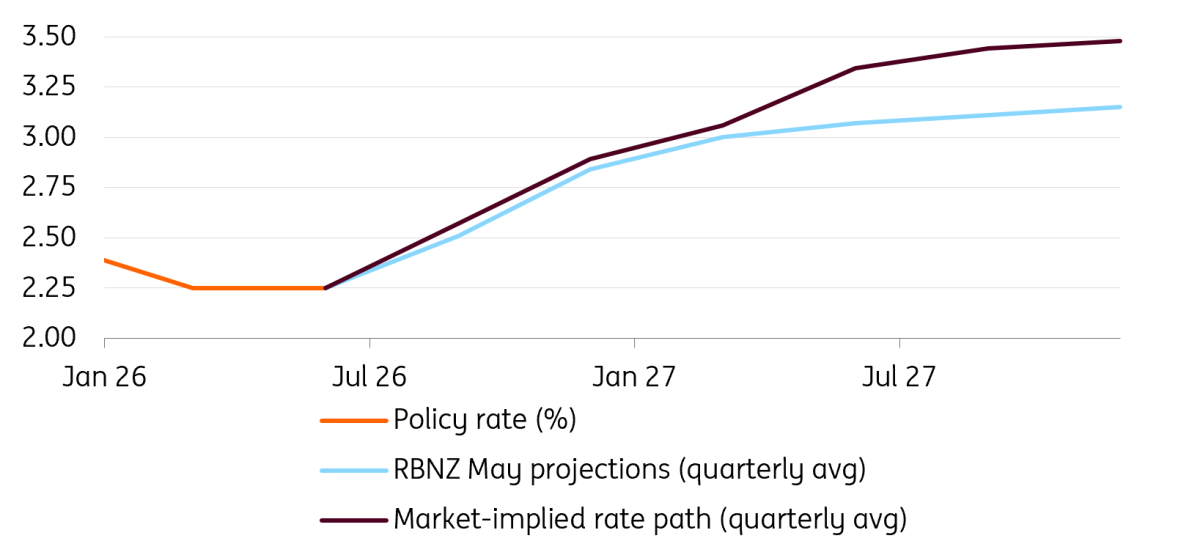
We expect the Reserve Bank of New Zealand to increase its overnight cash rate (OCR) by 25bp to 2.75% on 2 September. When rates were last hiked in July, the RBNZ said that “some further reduction in monetary stimulus is likely to be required”. In its May projections, based on higher oil price assumptions, signalled rates could reach 3.0% by year-end and remain there throughout 2027.
Markets are currently matching those projections for 2026, but are even more hawkish for 2027, despite lower energy prices. A September hike is fully priced, with another expected by year-end. Beyond that, the OIS curve implies a further 50bp of tightening, taking rates to 3.50% by mid-2027.
Against this backdrop, we see scope for dovish risks heading into the meeting. The bar for the RBNZ to validate the market's aggressive tightening expectations appears high.
Markets even more hawkish than May's RBNZ projections
Inflation should be revised lower
Since the July hike, New Zealand has released its 2Q inflation and labour market data. CPI rose from 3.1% to 4.1%, marginally below the RBNZ’s 4.2% forecast, largely due to higher energy prices. Employment growth surprised to the upside at 0.5% quarter-on-quarter versus an expected 0.1%, but a sharp increase in participation pushed the unemployment rate up unexpectedly, from a revised 5.4% to 5.6%.
Taken together, the data fully support a September hike and argue for retaining a hawkish bias. That said, the inflation projections released at this meeting should be revised lower. We expect headline inflation to fall back below 4.0% from 3Q26, rather than 1Q27 as projected in May. As a result, rate projections may not need to move higher, leaving 3.0% as the peak of the tightening cycle. With markets pricing a peak of 3.50% by mid-2027, that could be seen as a dovish outcome. There is also a risk that not all RBNZ members are equally convinced by the case for further tightening, leading to a more nuanced and less hawkish message.
Rates heading to 3.0%, NZD upside limited
Our call for the RBNZ is for two more hikes. One at this September meeting, and another either at the December or February meeting. We are less convinced than markets on further hikes. Growth and labour markets are cause for concern and a decline in oil prices could send inflation below worrying levels earlier than expected.
For FX, we see downside risks for the NZD around this meeting, given the high hurdle for the RBNZ to validate market pricing. Further out, we still think a repricing of dovish Fed expectations, even after Warsh’s hawkish Jackson Hole speech, can lift NZD/USD into year-end. However, a less hawkish RBNZ than markets anticipate could limit gains and keep the pair capped around 0.60, our current year-end target.


Comments
Log in or sign up to join the conversation.