

There is a long list rationalizing Friday's powerful thrust. The list runs the gamut from the return of central banker domination of markets to the end of corrective market action running a slew of short-sellers. From the renewed push on risk-averse investors chasing yield again to new glory times and a full recovery of what often the same guys called a bear market days ago. (Of course latter arguments defy the earnings recession issue as now prevails, and would persist for some time 'even if' currency devaluations were halted.)
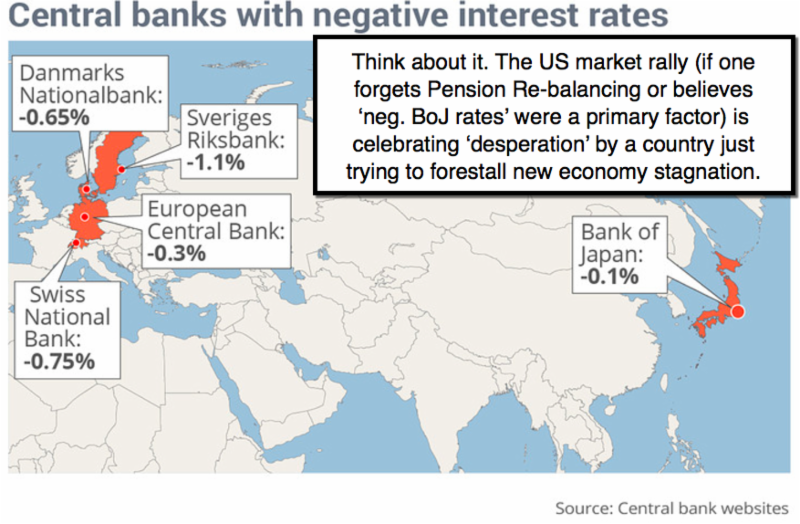
You know what's missing from that list, (or the loss of attached behavior to Oil at least in Friday's session)? What's missing is the reason we were wary all week about an upward move that related to 'Pension Re-balancing'. The answer is that interest rates continue to fade; and yes that reflects 'disinflation' as they prefer to call deflation; while all of this inflames the global currency war, which cannot end well. Should the proper reaction to this scramble (to an S&P zone we were hoping-for anyway on the rebound) be consternation, that central banks like the BoJ are just acting in economic desperation, with no special reason to believe that more doses that failed before will succeed now?
For instance; how well has Japan done with the race to zero; now below zero? If there's a laboratory experience on easy rates and Quantitative easing; it's the Tokyo experiment. What's also not focused upon is how these moves, if by any chance they actually triggered the dramatic economic recovery and inflation; by definition would accelerate the destruction of wealth that's gone on for years. In a sense consumers (or those not dependent on inflation-adjusted income) have actually seen a relative retention of purchasing power during deflationary times. Perhaps that's why not everyone is happy central banks want to build debt to a level that only a runaway inflation and currency debasing could resolve.

A celebration of monetary stimulus, against the backdrop of Debt they created, coming in the form of a rapid recovery, of course would be counterproductive in terms of the consumer (and the CPI); and would reverse the Dollar's gains. So, that would improve export profitability, but diminish the Dollar's buying power. But on Friday the Dollar was strong, as we expected (as well as our warning of danger if one tried fading the rally because it was Pension Re-balancing juiced by the BoJ move), which might not have been entirely coincidental.

Perhaps central banks know how tough higher prices would be (in the US that would spike the CPI and compel increased Social Security payments; hardly a desirable impact on the Treasury); although they do want to repay our Debt viadepreciated Greenbacks, if they can. Will they be able to? I suspect not. Going forward you'll now see other countries, not just China (but including them) likely given no choice but to resume competitive devaluations; even as Beijing tried to calm this down by saying they'd support currency stability. Probably not now.

San Francisco Fed President Williams gave a talk during market hours Friday. He in no way endorsed Japan's move. In fact he said the United States was strong enough to withstand what's going on in Asia; basically suggesting thatFriday's drama celebrates ideas perennially low rates will lift financial assets, regardless of what it means for the economy or most American workers.
Technically- Friday's rally finally achieved our 'relief rally' objective, with March S&P futures finishing, in case you smiled; at an interesting number: 1929.
Our ideal projection ten days ago from the low-day ('war of -Cash S&P- 1812'), as I'd expressed surprise we didn't get there sooner, was the low-to-mid 1900's; roughly S&P 1920-1950. Well finally we're in that range. And also approaching the next time-zone when we thought, ten days ago at the lows, that the market would re-enter a difficult, and potentially, risky post-rebound area.

I've heard a few analysts both 'push' buying stocks and others suggesting fade rallies; so this suggests a tussle that won't be over instantly; though as I've said I have no problem with the market running into another barrier; though this time it won't be quite so simple as stopping in its tracks and heading straight down.
I realize we're 50% short from March S&P / E-mini 2065 after enormous gains; and throughout this erratic rebound to month-end re-balancing, I've said we'll only come out of the next 25% percentile if the futures reach the 1960's vicinity, which would protect a huge 100 handle gain on that part. From the get-go we'd said 'we're playing with house money' having taken so much gain from the still half-position-live 2065 short; that we realize the next part could be exited at a higher or lower level, as market volatility makes available.

Speaking of that Volatility; the characteristics of sudden leaps and smashes for the S&P or other indexes, is reflective of illiquidity, not solidly liquid investment conditions. Expect to see more of this in what will likely be a lot of churning.
In sum: after thinking we were too optimistic looking for the low-to-mid 1900's for the March S&P; we're there. Right where it needed to occur; the Pension Re-balancing at January's end; coincident with (unless intentionally correlated as was rumored days earlier) the BoJ's desperate economic devaluation. It's so sad that the monetarists continue to fight the battles that they know work poorly (or maybe things would be 'even worse' if they didn't take that approach).

Either way it encourages investors to chase rallies for 'yield', not for profitability of companies people invest in. And therein lies the rub of 'Earnings Recession' in US stocks, partially-exacerbated by a stronger Dollar facilitated by not only a well-known misguided Fed approach (beyond the emergency years ago) but by competitive devaluations that basically speed-up the 'race to the bottom'.
Hope to regenerate a repeat upward cycle now, should be dashed, since you'll not likely get a Fed policy reversal (just listen to SF Fed Williams), plus investor awareness of the 'earnings recession' is greater now than during propaganda in financial media last year, pretending earnings and GDP were stronger than the Government reduced guidance (Atlanta Fed for-instance; St. Louis Fed as well) or even the guidance from many major companies. The focus on FANG stocks in a sense tells one how bereft the market is of broad multi-sector leadership.

We look forward to interesting trading swings coming right up; as there's now a growing contradictory debate about upward moves versus fading the rallies. So you probably get both; I've even noticed pundits trying to have it both ways, by pushing investors to chase stocks rebounding, while saying fades will be tried.
The latter will occur; and the former should provide existing opportunities for a lot of investors and managers who were insufficiently proactively sidelined or in shorts, ahead of projected 'brick-wall of resistance' pummeling to start-off 2016 along with expectation of a rally in late January running into early-February trouble.
Weekend (final) MarketCast
Last hour (intraday Friday) MarketCast
Comments
Log in or sign up to join the conversation.