

US consumer price inflation came in tame, yet bond yields end up where they were, or higher. The culprit? Higher real yields. The US fiscal deficit for July subsequently came in high, adding to the pressure. There's a degree of comfort here at elevated yields, and it's not really all about inflation. That said, the meandering war backdrop is of no help
US CPI was good (as expected), while the fiscal deficit was bad (also as [we] expected)
There was no big market reaction to the benign CPI report for July. Market break-evens have been discounting a benign inflation story for some time now, with break-evens comfortably below the 2.5% printed for core inflation. Still, it was a good number, and better for the front end than the back end on the theory that it takes pressure off the rate hike narrative. That said, higher real yields were the chief underpinning on the day, and that's in fact been thematic over the past number of months. The thing is, real yields today are not high. They are normal. Back to where they were pre-GFC. Which suggests they can remain elevated.
The US fiscal deficit for July came in at USD432bn – high! The cumulative fiscal deficit is now running at USD1.8tr. That's some USD170bn higher vs 2025. It's now homing in on coming in some USD200bn higher than for fiscal year 2025. Not a number that bonds typically get excited by, as for bonds, it's really all about the issuance number and profile. But this does place upside to issuance pressure ahead, which should add some credit pressure to the determination of long-end rates. The deficit had been shielded by tariff income. Tariff refunds are part of the issue. But the underlying picture is tending to turn net sour also.
The overall prognosis here is for the 10yr Treasury yield to trend towards the 4.75% to 5% area. Going above is not an option that Treasury Secretary Bessent would accept. But getting close is the trade.
Count down to the reopening of the SSA primary market
The public sector EUR primary market is currently still in its summer break. Although we are seeing some issuers on the government side maintain their activity, others, like Italy or Spain, have cancelled upcoming bond auctions for August.
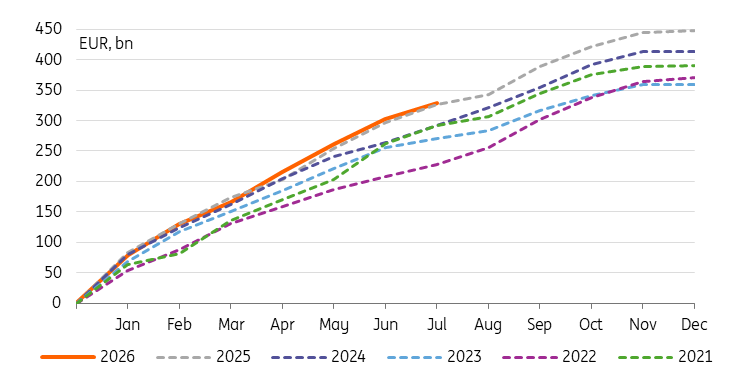
In the broader EUR-denominated Sovereign, Supranational and Agency (SSA) space, the last benchmark deal dates back to early July, and there has been a drought since mid-July. Last year, it was the German issuers, one Lander issuer followed by KFW, who were first to come out after the summer break around this time of the year – i.e. mid-August. We have now seen IBB (Investitions Bank Berlin) mandate a bank for a €0.5bn social bond tap, but a first EUR SSA benchmark deal should come soon after, with next week likely to see the primary market reopening in full swing. That said, many issuers are entering the second half of the yearly issuance cycle with their funding progress already well advanced.
EUR SSA issuance progress compared to previous years
Thursday’s events and market view
After a benign CPI reading largely in line with market expectations, the attention turns to producer prices, where slightly hotter monthly increases are anticipated. The year-on-year rate is still expected to slip below 5%. With an eye on the labour market, the jobless claims numbers will be followed closely, with the weekly initial claims at already low levels. Two Fed speakers are lined up with Hammack and Barkin.
Out of Europe, we will get the UK’s monthly GDP numbers as well as industrial production data for June. We will also see the eurozone’s industrial production data for June.
With Italy’s auctions for Thursday cancelled, bond supply will only come from the US with the sale of a new 30y bond (US$25bn).



Comments
Log in or sign up to join the conversation.