

The Monetary Policy Council left rates unchanged in July. The National Bank of Poland statement has a neutral tone, while the somewhat higher 2027 inflation projection than our forecast may reflect differing assumptions about oil prices. Policy rates are set to stay at the current level this year. The dovish tone may put additional pressure on the zloty
In line with analysts’ expectations, including ours, the Monetary Policy Council (MPC) left the National Bank of Poland (NBP) interest rates unchanged, with the reference rate still at 3.75%; the most recent 25bp cut took place in March.
Rationale behind the decision
Low inflation readings for May and June allow the MPC to further soften its tone, but the renewed jump in oil prices argues for caution. The MPC opted for a wait-and-see approach. The decline in inflation to the 2.5% target in June mainly reflects lower oil prices and a surprisingly sharp fall in food prices. At the same time, core inflation remains around 3%, while the full expiry of the government measures, which had kept fuel prices lower (cuts in excise duty and VAT rates), clearly pushed up petrol station prices at the start of July.
The post-meeting statement has a neutral tone and is very short. Apart from updates reflecting the latest data and the main conclusions from the latest inflation projection, it contains no important new information. The statement notes the clear decline in oil prices, weaker economic conditions in Poland’s immediate external environment and the recent fall in inflation. At the same time, it observes that despite the recent decline in inflation, global inflation is higher than at the beginning of the year and uncertainty remains elevated, particularly in connection with the conflict in the Middle East.
New projection shows higher inflation than in March
In line with our expectations, compared with March this year, the July NBP macroeconomic projection revised the inflation path for 2026-27 upwards and the economic growth path for 2026-27 downwards. The March, low inflation NBP projection assumed oil market conditions from before the war, which is why the July projection is higher than the previous one.
The NBP sees inflation in 2027 higher than our forecasts. This is probably related to the cut-off date for the projection, 17 June, the day the preliminary US-Iran agreement was signed. A week before that date, oil was above US$90/bbl, and two weeks before it was above US$100/bbl. Therefore, oil price assumptions underlying our and the central bank forecasts may differ.
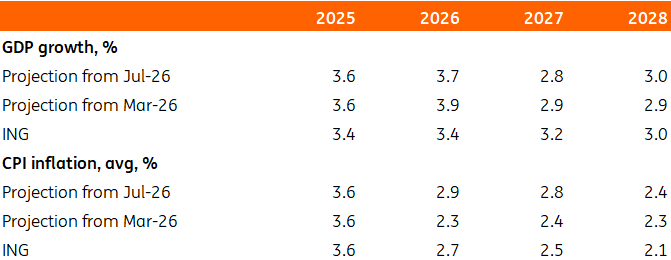
The projection points to a possible undershoot of the inflation target in 2028, with inflation averaging 2.4% year-on-year, but the March projection showed a similar picture, at an average of 2.3% YoY.
According to the NBP, annual average CPI inflation will reach 2.9% in 2026, compared with 2.3% in March, then 2.8% in 2027, previously 2.4%, and 2.4% in 2028, previously 2.3%. GDP growth is expected to be 3.7% in 2026, versus 3.9% in the March projection, 2.8% in 2027, previously 2.9%, and 3.0% in 2028, previously 2.9%.
However, the March projection painted an optimistic picture of inflation as it did not take into account the US-Iran war and its impact on oil prices. In the current projection, the CPI inflation forecast for 2027 appears too high, which may reflect a greater pass-through of higher energy prices into other prices or a more conservative oil price assumption.
Comparison of the July and March NBP projections
Source: National Bank of Poland, ING reserach.
Our view
In our view, rates will remain unchanged until the end of the year. We think the next move will be a cut, most likely in 2027, when inflation may fall below the 2.5% target. For now, renewed escalation of the conflict and the jump in oil prices call for a cautious softening of the MPC’s tone. In addition, the Council needs more time to observe inflation over the coming months.
The tone of tomorrow’s press conference by governor Adam Glapiński will be important for the short-term outlook for the zloty. In recent weeks, the zloty has underperformed regional currencies. The Czech central bank still does not rule out rate hikes, and the curve prices in a 50bp rise in rates. The dovish rhetoric of the National Bank of Hungary has had only a limited negative impact on the forint because of strong euro area convergence play. Poland, however, remains far from adopting the euro. Therefore, any further softening of the NBP’s tone could weaken the zloty even more, giving exporters some breathing space.


Comments
Log in or sign up to join the conversation.