

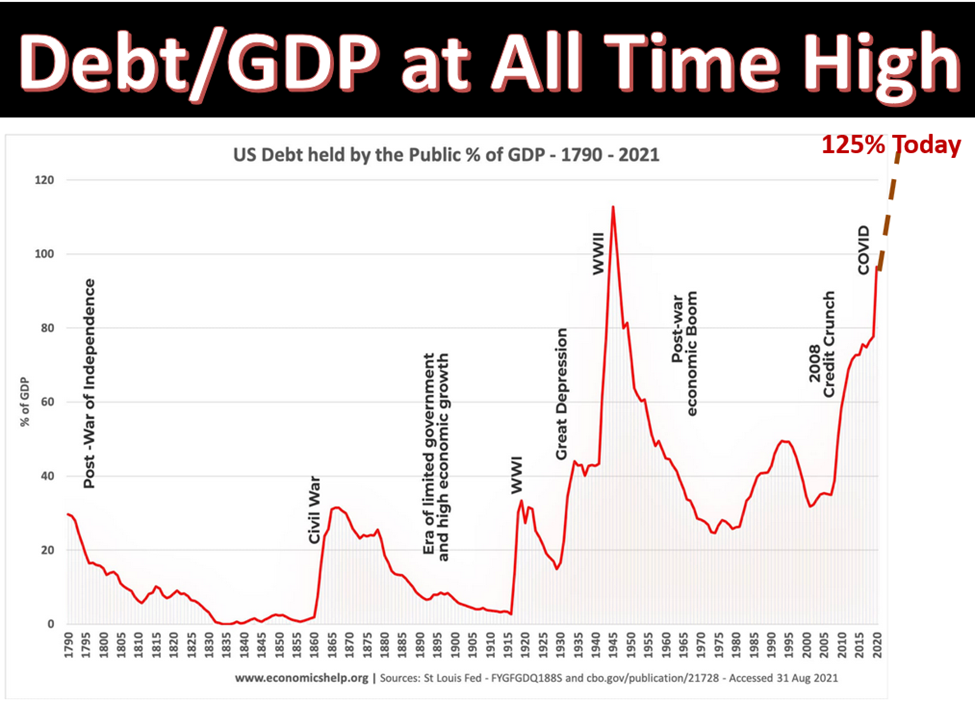
At 125% of GDP, US national debt is at its highest level ever. “Highest ever” is probably “too high.”
· The blended interest rate on our debt is currently 2.5%. This rate is going up and so is the amount of debt – a double whammy.
· Precious metals and commodities provide inflation protection, as do Treasury Inflation Protected Securities (TIPS). Stocks are not a good inflation hedge.
Current interest of $995 Billion on our $39 Trillion national debt is 125% of our $31 Trillion GDP, its highest level ever and headed even higher. Here’s how and why increases in interest expense can’t be stopped. Debt monetization will bring rampant inflation.
Interest expense
As shown in the following graph, we are paying 2.55% interest on our $39 Trillion national debt, so $995 billion, making it our 3rd largest expense behind Social Security and Medicare. 2.55% is well below (by 1.15%) the current yield curve, so the blended rate will increase if the Federal Reserve leaves interest as-is or higher.
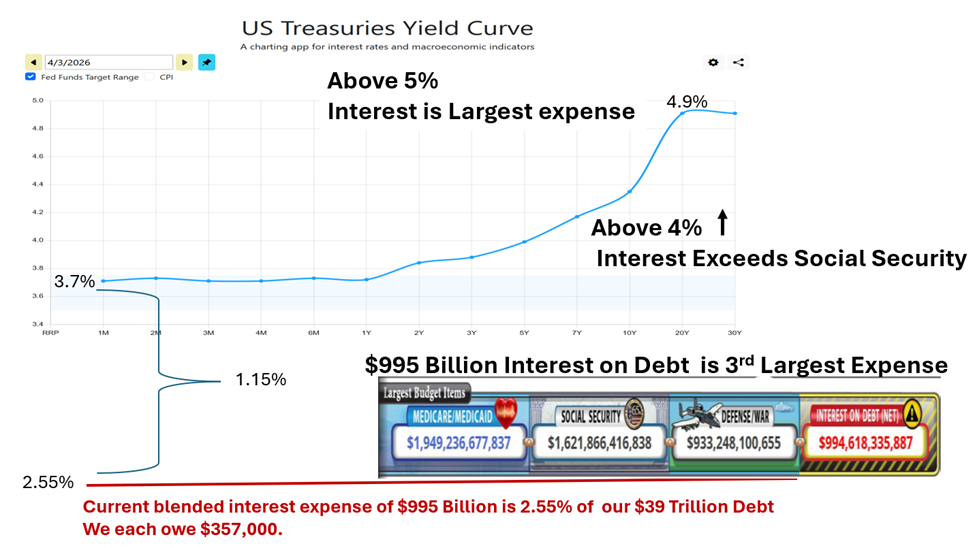
The Treasury increases its borrowing by $2 Trillion each year, which means that new bonds are issued that yield at least 3.7% currently, driving up blended interest expense above the current 2.55% and increasing our individual share above the current $357,000. If the blended rate reaches 5%, debt service will become our largest expense.
The Fed could move to lower interest rates, but this exacerbates inflation that is already on an upward trajectory.
Double whammy
The amount of our debt is increasing AND the interest on that debt is also increasing, leading us to question how high is too high. Part of the answer lies in the fact that our current debt at 125% of GDP is its highest ever, even higher than after WWII. Highest ever “feels” like it’s probably too high. Something will break, like monetizing the debt, basically money printing that fuels inflation fires.
Adding to this concern, President Trump has requested approval to increase National Defense spending well above the currently budgeted $933 Billion. The wars in Ukraine and Iran have cost more than $700 Billion so far and growing, so not much left in a $933 Billion budget.
Conclusion
Inflation fears are not new. But the current path is beyond alarming. We are spending our way into a rampant inflation catastrophe. That is why gold and commodities are being bid up in price and will likely continue to be bid up. Investors see the inflation threat and are protecting themselves.
Treasury Inflation Protected Securities (TIPS) also defend against inflation. It will be interesting to see if the Treasury limits or halts new issues of TIPS. Will the promise be kept to tie coupons to inflation?
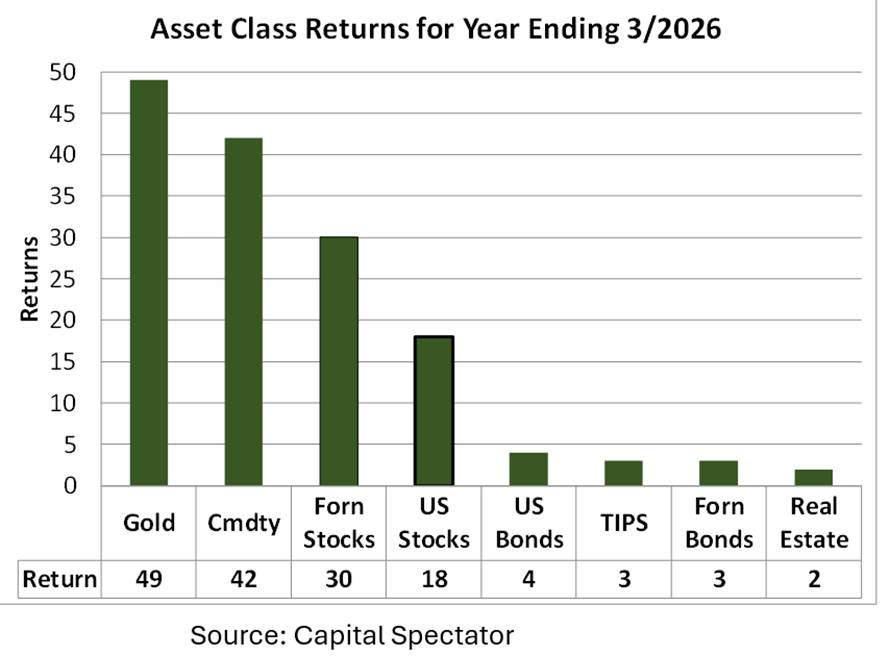
Diversification into inflation protected securities is smart at this time. I’ll even suggest TIPS even though they are not currently among the best performing asset classes. Stocks are not a good inflation hedge, although investors have recently preferred non-US stocks over expensive domestic stocks.
What do you think? Are you protecting yourself against inflation? Should you?



Comments
Log in or sign up to join the conversation.