

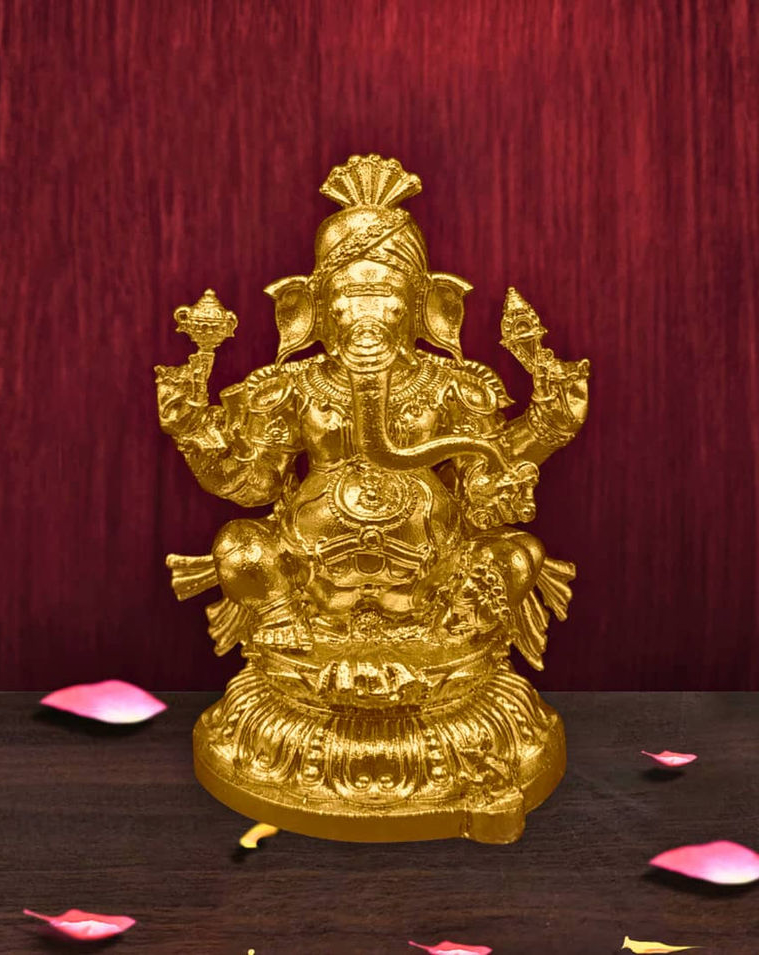
Raja Ganapathy, the regal, crowned form of Lord Ganesha seated upon a royal throne, is one of the most majestic depictions in the Ganapathy tradition, and this brass rendering is available at IdolBrass for devotees drawn to the sovereign aspect of the elephant-headed god. While most homes are familiar with Ganesha as the gentle remover of obstacles, Raja Ganapathy presents him instead as a king among gods, radiating command, authority, and unshakeable confidence.
Seated beneath a royal canopy and adorned with the ornaments of kingship, this form is invoked by those who seek not just the clearing of hurdles but the strength and stature to lead. Idol Brass continues the tradition of crafting this powerful form in enduring brass for home worship and devotional collections.
Who Is Raja Ganapathy?
Raja Ganapathy, whose name translates directly to "King Ganapathy," is regarded as one of the thirty-two celebrated forms of Ganesha described in the Mudgala Purana and related Ganapathya texts, known collectively as the Dwatrimshad Ganapati. Where other forms of Ganesha emphasise wisdom, playfulness, or protection, Raja Ganapathy embodies sovereignty itself, depicted as a monarch seated on a jewelled throne with all the trappings of royal power.
Classification Among the Ganapathya Forms
Within Ganapathya tradition, the thirty-two forms of Ganesha are each associated with a particular boon or aspect of life, ranging from Bala Ganapathy, the childlike form, to Vira Ganapathy, the warrior. Raja Ganapathy occupies the place reserved for dominion and leadership, worshipped by those who hold or aspire to positions of responsibility, whether in family, business, or public life.
Names and Regional Variations
Across South India, this form is also referred to as Rajamathanga or simply "the enthroned Ganapathy," and appears in temple sculpture flanked by attendants and royal insignia rather than in the more familiar solitary seated posture seen in household shrines.
The Story Behind the Royal Form
The Ganapathya tradition holds that Ganesha, though born of Shiva and Parvati in Kailasa, was granted dominion over all obstacles and beginnings by his parents, a status that in effect made him ruler over the very forces that determine success or failure in any undertaking. Raja Ganapathy is the form that makes this kingship visible, depicting him not merely as a household deity to be appeased before a task, but as a sovereign already seated in command of the outcome.
The Throne and Its Meaning
Temple legend describes the Simhasana, the lion-footed throne on which Raja Ganapathy sits, as a seat that no ordinary being could occupy, since it represents the authority to grant or withhold success. The Chattra, or royal umbrella, held above his crowned head signals that his rule extends over both the visible world of action and the unseen world of fate that shapes it.
A Form Invoked Before Great Undertakings
Unlike the simpler household Ganapathy murtis installed for daily worship, Raja Ganapathy has traditionally been invoked by kings, merchants, and community leaders before campaigns, ventures, or major decisions, a practice that continues today among devotees beginning new businesses, contesting elections, or taking up positions of leadership.
Temple and Shrine Associations
While Ganesha is worshipped in nearly every temple across India, the enthroned Raja Ganapathy form finds particular prominence in temple sculpture and processional bronzes carried during major festivals, where his royal bearing is meant to be seen and honoured by the gathered community rather than approached only in private prayer. In many South Indian Ganapathy shrines, a Raja Ganapathy image is installed alongside the principal deity specifically to be worshipped during Vinayaka Chaturthi processions, when devotees seek his blessings for the year's undertakings in a public, celebratory setting.
Spiritual Significance of Raja Ganapathy
Authority and leadership: Raja Ganapathy is sought by those stepping into positions of responsibility, from new business owners to elected leaders, for the confidence and command his form represents.
Command over obstacles, not just their removal: Where household Ganapathy worship asks for hurdles to be cleared, Raja Ganapathy worship asks for the standing and strength to face them directly.
A festival presence: His enthroned form is closely tied to the public, communal character of Vinayaka Chaturthi, when devotees gather to honour Ganesha's dominion together rather than individually.
A reminder of rightful rule: Devotees regard this form as a teaching on governing wisely, since Raja Ganapathy's authority is always shown paired with calm benevolence rather than harshness.
Why Is Raja Ganapathy Different from Other Forms of Ganesha?
Where Bala Ganapathy shows the god as an innocent child and Lambodara emphasises his large belly as a symbol of abundance, Raja Ganapathy alone is shown enthroned with the full regalia of kingship.
Household worship of Ganesha typically centres on personal, everyday requests, while Raja Ganapathy is more often invoked for larger undertakings involving leadership or public responsibility.
His iconography, with the Simhasana throne, Chattra umbrella, and attendant figures, is closer to royal temple sculpture than to the simpler solitary Ganapathy murtis found in most homes.
Among the thirty-two forms, few carry as direct a connection to governance and public authority as Raja Ganapathy, making him a distinct choice for those in positions of leadership.
Conclusion
Raja Ganapathy stands apart among the many forms of Ganesha as the one that reveals his kingship openly, seated on a throne with the full bearing of a sovereign rather than a household deity. For those who seek not only the clearing of obstacles but the confidence and authority to lead, this enthroned form offers a distinct devotional focus rooted in centuries of temple and festival tradition.
Comments
Log in or sign up to join the conversation.