


Having been exposed to the prison system over a period of time, I can vouch for what the author is proposing and the state is establishing. People do make mistakes. However, if society continues the punishment during and after parole, it becomes harder for a parolee to reestablish themselves in society. As it stands today, parolees do have difficulty finding jobs. Imprisonment is a costly exercise.
If Oklahoma has a policy assisting parolees, I hope they would further enhance the law and policies to assist parolees who are reentering society.
Let’s take this a step further. Many of us were drafted at 19 years of age. I got out in 71, brought home a wife, and came back to Chicago. I had a high school education. It was not enough to make some serious money to support a wife. Indeed, she went to work at a secretary to the VP of Patents and Trademarks and made more money. There was no future in my job. Her working allowed me to go to college
Back to college part time and working at a Retirement Home as a maintenance person. Made same amount of money. But I could set my hours and went to Lewis to attach a BA with a minor in Math. Three years later I had a BA. Later went for a Masters. Does this apply to people just out of prison and on parole. No! It just shows it is difficult to improve your status if you can not make enough money and gain additional education too.
It is even worst for those families living on one salary or can not necessarily afford to go back to school due to a low income. The author of the following article has it correct.
~~~~~~~
“Want to improve reentry outcomes? Raise the minimum wage”
– by Cole Allen
In 2016, voters approved State Questions 780 and 781, putting policies in place that have reduced our prison population and directed millions into much-needed community services. Nearly a decade later, Oklahoma voters on June 16 will have the opportunity to approve another measure that will further improve outcomes for justice-involved people: raising the minimum wage through State Question 832.
A person working a full-time job at Oklahoma’s current minimum wage – $7.25 per hour – earns below the federal poverty level for a single person. Raising the minimum wage will improve the economic prospects for hundreds of thousands of Oklahomans and their families, and it will specifically help improve the outcomes for the thousands of people leaving Oklahoma’s prisons each year. Even under the best circumstances, people leaving prison face significant barriers to successfully re-entering society. Poverty can make those barriers nearly insurmountable. Raising the minimum wage can help lower those barriers, improve outcomes, and, in turn, benefit all Oklahomans.
Reentry is hard. Poverty makes it harder.
Upon leaving incarceration, people face several immediate challenges, such as securing housing and finding employment. Incarceration can create gaps in rental history, which can be made worse because of Oklahoma’s harsh sentencing practices, even for nonviolent property and drug offenses. In 2021, the median time served for larceny-theft offenses was more than 20 months, and nearly 35 months for drug trafficking offenses. Having such a long gap in rental history and formal employment would make securing housing and a job hard for anyone; a history of involvement in the justice system makes both even more difficult. Formerly incarcerated people are at higher risk of homelessness and joblessness than the general population.
Even though many incarcerated people work in technical jobs and obtain vocational certification while incarcerated, employers outside of prison may not accept these certifications or overlook this experience because the person had a criminal conviction, regardless of the offense. As a result, the education and skills people develop in prison do not always translate into applicable fields upon release, limiting the potential for better-paying jobs. Additionally, laws and regulations can exclude people with a felony conviction from working in some good jobs that require licensing, further limiting employment opportunities for justice-involved people.
Very often, people leaving incarceration are forced to take whatever employment opportunities they can, even if those jobs don’t pay enough. This often means that it takes years after release for people to get their earnings back on track. One report that looked at more than 50,000 people leaving federal prison found that during the first year after release, people earn about 53 percent of the median income of the general population; after four years, they earn only about 84 percent of the median income of the general population.
These disparities are even more pronounced for Black people leaving incarceration, who face barriers from a “racialized reentry” process. Systemic and societal racial disparities compound the specific obstacles that justice-involved people face, making reentry even more difficult. Financial struggles, even among people with a job, can contribute to negative reentry outcomes, including reincarceration. Financial instability limits housing opportunities, especially for individuals who have been convicted of a felony. Limited income also increases the pressure of paying fines and fees assessed as part of a conviction. Because Oklahoma’s legal system is underfunded, it relies heavily on fines and fees to pay for even basic operations, creating a cycle that punishes poverty and keeps people trapped in the system.
Raising the minimum wage would help ease some challenges of reentry
Raising Oklahoma’s minimum wage would help ensure that justice-involved people can increase the likelihood of successfully reentering society after incarceration and avoid reoffending, known as recidivism. Research has shown that higher wages have a measurable effect on recidivism among people recently released from prison: the more money someone makes, the less likely they are to return to prison. A project in Florida found that individuals who received a guaranteed income after release from prison were far less likely to reoffend than those who did not, in part because having a more adequate income helps reduce many of the financial barriers of the reentry process. If higher wages make a significant difference on an individual level, it follows that raising the minimum wage could have similarly positive effects across society.
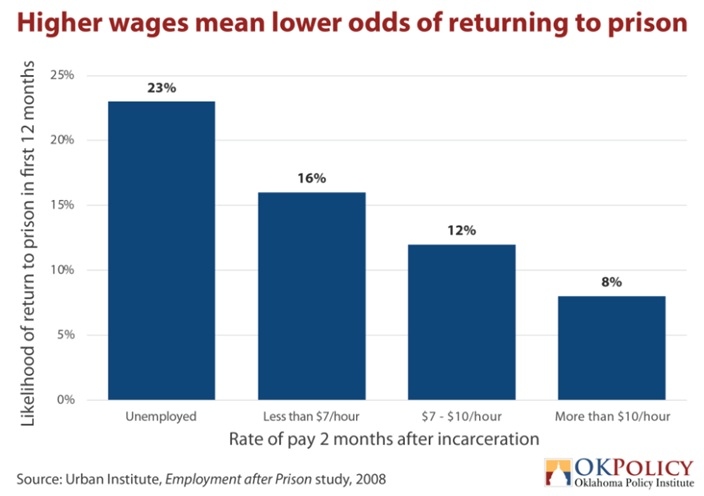
Additional research has demonstrated just that. One study found that between 2000 and 2014, which saw several minimum wage increases from the federal government and more from state governments, increases in the minimum wage led to decreases in recidivism risk. In other words, people are less likely to return to prison after release when the minimum wage increases. Further research has shown that raising the minimum wage has similar reducing effects on incarceration rates at large.
The decrease in recidivism is likely attributable to several factors:
First, higher wages in formal employment act as a disincentive for people to pursue illegal income sources, such as theft or drug trafficking. Put simply, when people know they can pay their bills with the wages they legally get from a job, they are less likely to turn to crime to make money.
Second, minimum wage increases may actually increase employment opportunities for justice-involved people, contrary to common fears that raising the minimum wage reduces job opportunities. and
Finally, raising the minimum wage would help lower broader barriers like housing affordability, healthcare access, and community engagement. When these barriers are easier to overcome, people leaving incarceration are more likely not just to survive, but thrive in their communities.
Improving reentry outcomes benefits all Oklahomans
When people successfully reenter society after incarceration, they can reunite with their families, join the workforce, and positively contribute to their communities. These are not just individual successes; they also benefit the state at large. Research has shown that minimum wage policies raise the total earnings of low-wage workers, while having little to no effect on the overall availability of jobs.
The whole state benefits when people are able to work, pay taxes, and put money back into local economies. The whole state benefits when children are raised in a more stable home by parents who make enough money to meet their needs. Further, taxpayers would benefit greatly from reducing incarceration. Taxpayers would save an average of $19,000 per year for every person who avoids re-incarceration due to successful reentry. Oklahomans who want to increase public safety should go to the polls on June 16 and vote YES on SQ 832 to raise Oklahoma’s minimum wage.

Comments
Log in or sign up to join the conversation.