

US freight railroads have long been used as a barometer of the country's economic health, continue to show declines in traffic, suggesting the industrial recession could persist into 2020.
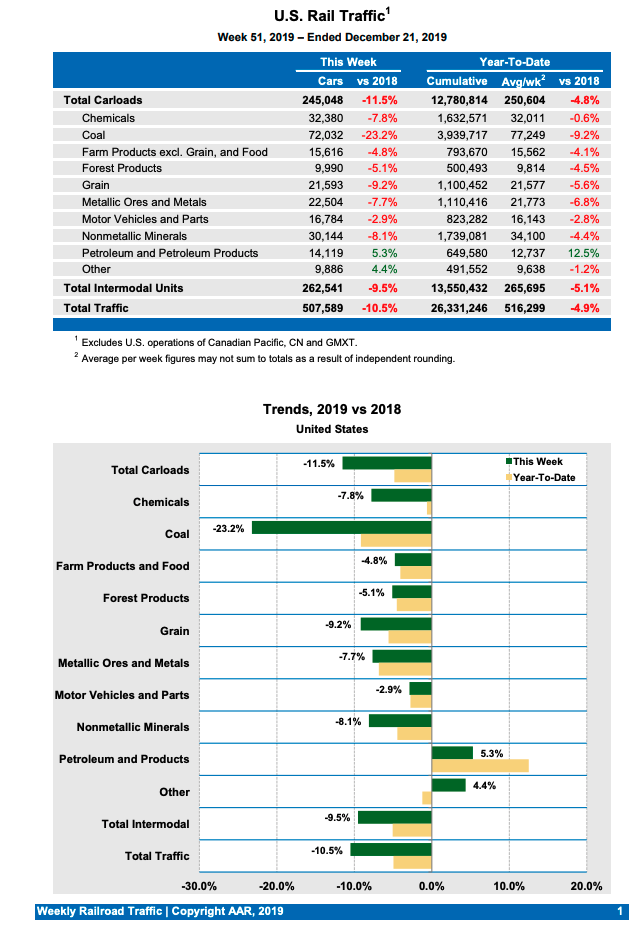
The Association of American Railroads (AAR) published a new report that shows US weekly rail traffic for the week ending December 21 was down 10.5% to 507,589 carloads and intermodal units compared with the same week last year.
Total carloads for the week were 245,048 carloads, down 11.5% compared with the same week in 2018, while weekly intermodal volume was down 9.5% to 262,541 containers and trailers.
The AAR tracks ten carload commodity groups on a weekly basis -- with Petroleum and Petroleum Products and Other segments showed marginal growth over the week as all other segments including Chemicals; Coal; Farm Products excl. Grain, and Food; Forest Products, Grain, Metallic Ores and Metals; Motor Vehicles and Parts; and Nonmetallic Minerals registered declines.
For the first 51 weeks of 2019, US rail traffic across all segments was 12,780,814 carloads, down 4.8% from the same period last year; and 13,550,432 intermodal units, down 5.1% from last year. Total rail traffic in the first 51 weeks was 26,331,246 carloads and intermodal units, a 5.9% drop over last year.
(Click on image to enlarge)
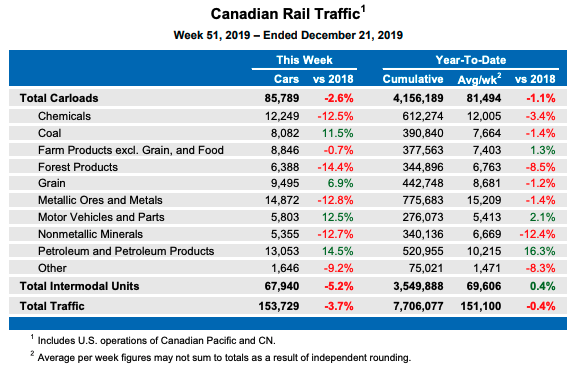
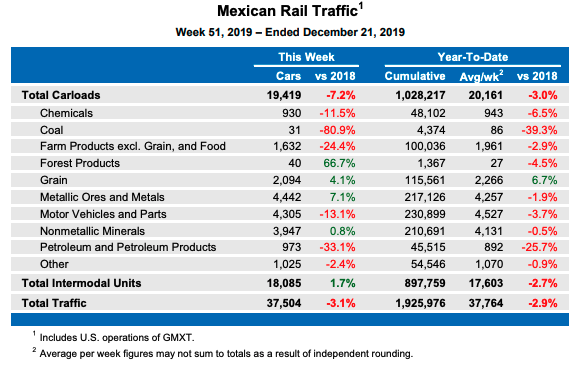
Canadian and Mexican railroads also reported traffic declines for the week and in the first 51 weeks as both countries are teetering if not already in a recession.
(Click on image to enlarge)
(Click on image to enlarge)
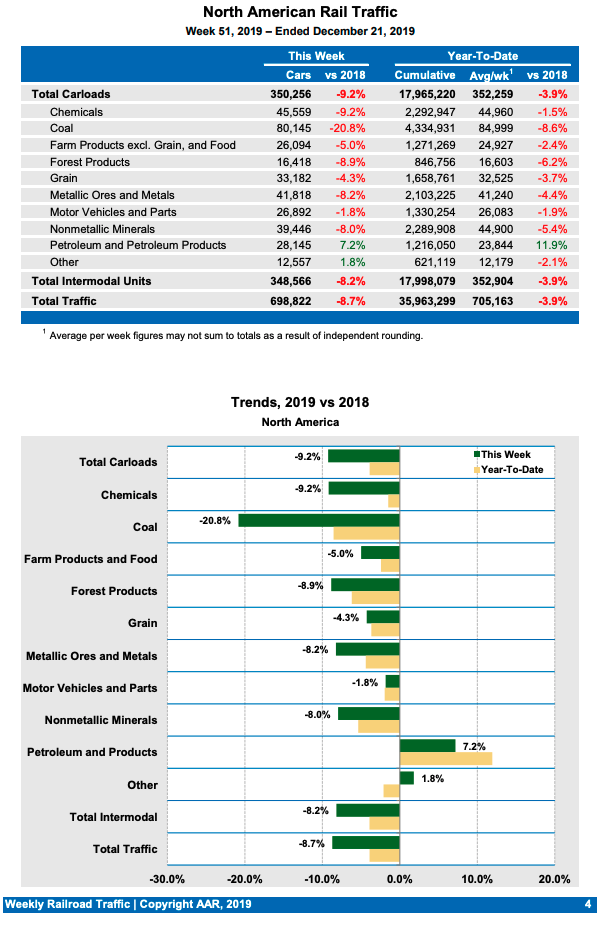
North American rail volume for the week was down 9.2% to 350,256 carloads over the same week last year, and 348,566 intermodal units, down 8.2 % over the previous year. Total combined weekly rail traffic in North America was 698,822 carloads and intermodal units, down 8.7%.
North American rail volume for the first 51 weeks of 2019 was 35,963,299 carloads and intermodal units, down 3.9% compared with 2018.
(Click on image to enlarge)
In a separate report, AAR described how 400,000 railcars currently sit in storage amid slumping rail demand.
But it's not just rail traffic that is tumbling, class-8 truck orders collapsed last month, all of this is a symptom of an industrial recession that shows no signs of abating into 2020.



Comments
Log in or sign up to join the conversation.