

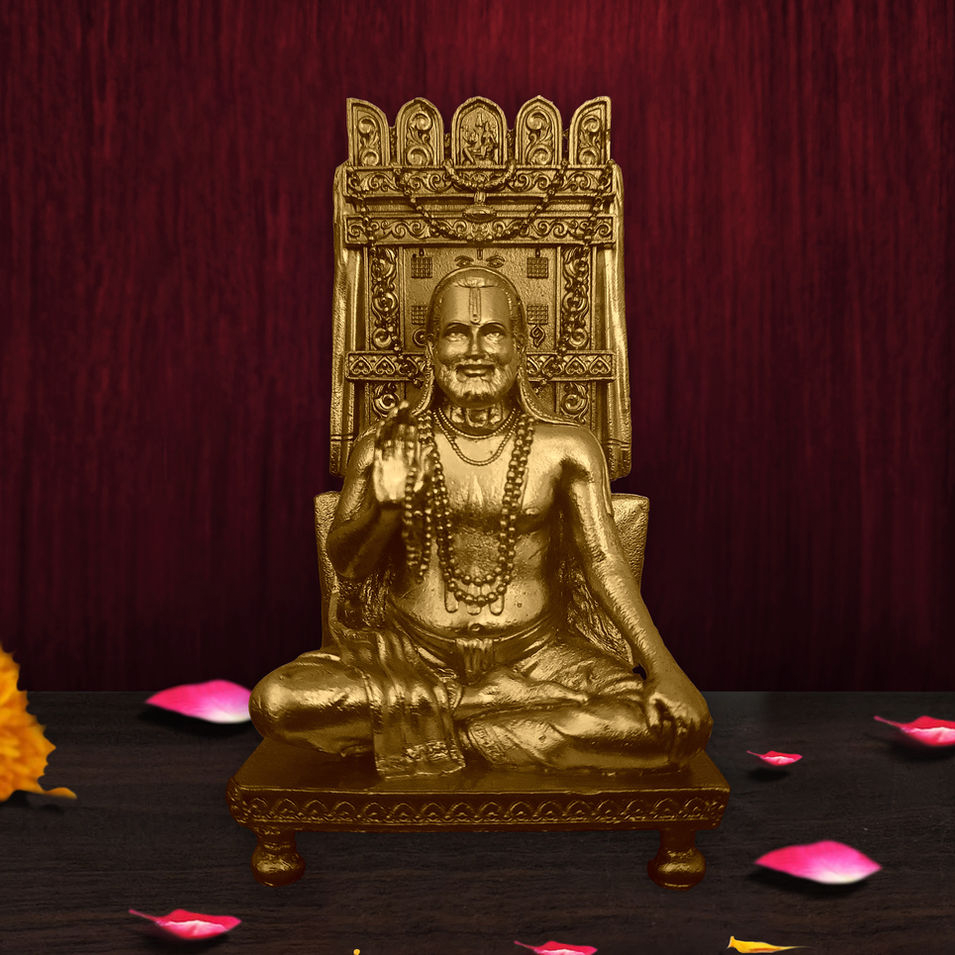
Raghavendra Swamy, revered across South India as one of the greatest saints of the Dvaita Vedanta tradition, remains a living presence for millions of devotees more than three centuries after he entered his eternal meditation. This finely detailed Raghavendra Swamy brass idol from IdolBrass's collection captures the saint in his familiar seated posture, veena in hand, ready to bring his quiet, protective grace into any home shrine.
Born as Venkatanatha and later known as Guru Raya, Raghavendra Swamy's life was one of scholarship, renunciation and unwavering devotion to Lord Vishnu, culminating in his decision to enter a living Brindavana at Mantralayam, where he is believed to continue blessing devotees to this day. Idol Brass presents his story here, alongside the symbolism carried in every idol crafted in his likeness.
Who Is Raghavendra Swamy?
Early Life and Birth as Venkatanatha
Raghavendra Swamy was born in 1595 as Venkatanatha in the town of Bhuvanagiri, Tamil Nadu, into a family devoted to Vedic learning and music. From a young age, he displayed remarkable skill in scriptural debate and in playing the veena, talents that would later define both his scholarship and his iconography.
Lineage in the Madhva Tradition
Venkatanatha belonged to the Dvaita Vedanta school founded by the 13th-century philosopher Madhvacharya, a tradition that holds Lord Vishnu as the supreme, independent reality and the soul as eternally distinct from the divine. He studied under and was later initiated into monastic life by his guru, Sudhindra Tirtha, receiving the name Raghavendra Tirtha upon taking sannyasa.
Regarded as an Incarnation of Prahlada
Devotees and tradition hold Raghavendra Swamy to be a reincarnation of Prahlada, the young devotee of Vishnu famed for his unshakeable faith even in the face of his father Hiranyakashipu's fury. This belief lends Raghavendra Swamy's own life of steadfast devotion an added layer of divine continuity.
Iconography and Symbolism of Raghavendra Swamy
The Ascetic's Form and the Veena
Idols and images of Raghavendra Swamy typically depict him seated in serene meditation, draped in the saffron robes of a sannyasi, with a tulasi mala around his neck and a veena resting beside or within his hands — a lasting tribute to his musical gift and his devotion expressed through sound.
The Brindavana as a Sacred Symbol
Unlike many deities represented through elaborate multi-armed forms, Raghavendra Swamy's iconography is deliberately simple and human, reflecting his identity as a realised guru rather than a cosmic being. The mound-like Brindavana shrine he is enshrined within is itself considered a sacred symbol, representing his continued living presence rather than a memorial to the departed.
The Story of Raghavendra Swamy's Life and Renunciation
A Scholar's Early Struggles
As a young man, Venkatanatha married and, by his own account, endured a period of considerable poverty despite his scholarly brilliance, a hardship that is often cited by devotees as proof that even the most devoted souls face trials before their true purpose unfolds.
Renunciation and Ascension to the Mutt
Following a period of deep contemplation, Venkatanatha took sannyasa in 1614 under his guru Sudhindra Tirtha and was renamed Raghavendra Tirtha. In 1621, he ascended to the pontifical seat of the Kumbakonam Mutt, a position he held with distinction for the next five decades.
A Prolific Defender of Dvaita Philosophy
During his tenure, Raghavendra Swamy composed more than forty scholarly commentaries defending and elaborating upon the works of Madhvacharya, Jayatirtha and Vyasatirtha. His commentary on the Sudha, a key Dvaita text, earned him the honorific title Sudha Parimalacharya, cementing his place among the tradition's foremost philosophers.
Miracles That Deepened Devotion
Tradition holds that Raghavendra Swamy performed several miracles that strengthened the faith of those around him — among them, restoring a stolen pearl necklace to its rightful owner through his spiritual insight, and transforming meat offered to test his purity into fruit before it touched his hands.
Entering the Living Brindavana
In 1671, at the age of seventy-six, Raghavendra Swamy chose to enter a living Brindavana on the banks of the Tungabhadra River at Mantralayam, a village gifted to him by the Nawab of Adoni. Rather than passing away in the conventional sense, he is believed by devotees to remain in a state of continuous meditation within the shrine, accessible to this day for the welfare of those who seek his blessings.
Raghavendra Swamy and the Mantralayam Shrine
The Mantralayam Brindavana, situated on the tranquil banks of the Tungabhadra in present-day Andhra Pradesh, stands as the spiritual heart of Raghavendra Swamy's legacy. Pilgrims travel from across South India to seek his blessings, offer prayers and participate in the daily rituals conducted at the shrine much as they would at a temple dedicated to a living guru. The Aradhana festival, held annually to commemorate his entry into the Brindavana, draws vast crowds and is marked by continuous chanting, musical offerings and communal feeding, reflecting the deep devotion he continues to inspire.
Spiritual Significance of Raghavendra Swamy
A Guru Who Remains Present
Central to Raghavendra Swamy's veneration is the belief that he did not depart in death but chose to remain accessible to devotees, making him, in the eyes of the faithful, a living guru rather than a historical figure of the past.
Protector and Wish-Fulfiller
Devotees turn to Raghavendra Swamy for protection from hardship, for success in education and endeavours requiring scholarly focus, and for the resolution of long-standing difficulties, believing his intercession to be swift and compassionate.
A Bridge Between Scholarship and Devotion
His life exemplifies the union of rigorous philosophical scholarship with heartfelt bhakti, offering devotees a model in which intellectual discipline and surrender to the divine are not opposing paths but complementary ones.
Why Is Raghavendra Swamy Different from Other Hindu Saints and Gurus?
Nature of presence: While most saints are venerated through memory and teachings after their passing, Raghavendra Swamy is believed to remain physically present and accessible within his living Brindavana.
Iconographic simplicity: Where deities are often shown with multiple arms and celestial weapons, Raghavendra Swamy's form remains resolutely human — a seated ascetic with a veena, reflecting his identity as a realised soul rather than a cosmic being.
Basis of veneration: His worship rests on documented scholarship and a historical lineage within the Madhva tradition, rather than solely on Puranic legend.
Mode of blessing: Devotees seek him specifically for scholarly success, resolution of disputes and protection from hardship, drawing on his own life as a scholar who overcame adversity.
Conclusion
Raghavendra Swamy's journey — from a scholar enduring early hardship to one of the most revered gurus of the Dvaita tradition, and finally to a saint who chose to remain eternally present for his devotees — continues to inspire faith across generations. His life stands as a testament to the power of disciplined scholarship joined with unwavering devotion, a legacy carried forward in every act of prayer offered at Mantralayam and in every home that welcomes his likeness with reverence.
Comments
Log in or sign up to join the conversation.