
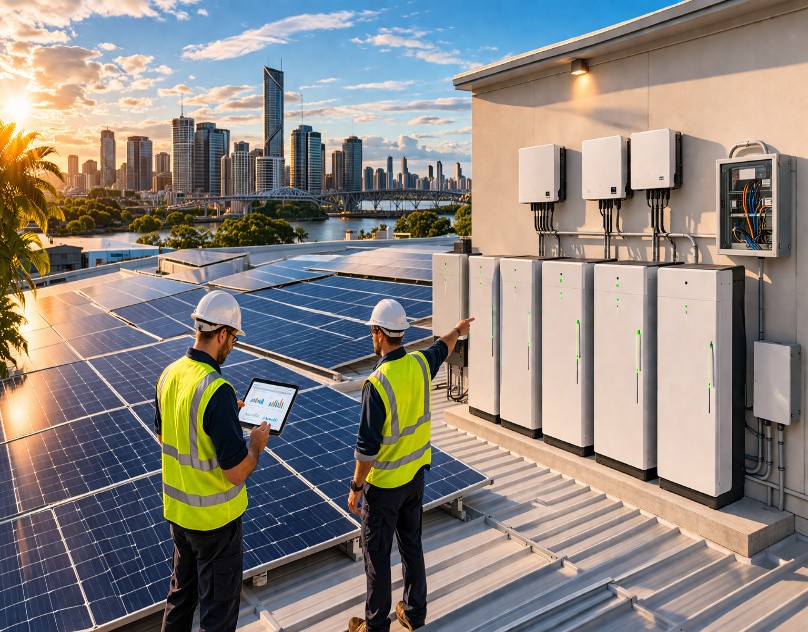
Queensland's 2026 battery rebate landscape is transforming the economics of commercial solar system investment for Sunshine Coast businesses. Combining federal STC rebates with the Queensland battery storage rebate now cuts upfront costs significantly, making it one of the strongest windows for commercial adoption in years.
Key Takeaways
Queensland businesses can stack federal STC rebates with state battery rebates in 2026
Commercial solar system payback periods on the Sunshine Coast now average 2.5 to 3.5 years
The federal STC scheme continues to reduce by one docket annually until 2030
Battery rebates apply to systems paired with commercial solar, not standalone storage
Sunshine Coast businesses that install before mid-2026 capture the highest STC value
Incentives are not automatic; correct paperwork and CEC-accredited installers are required
What Does the Queensland Battery Rebate Cover for Solar?
Queensland's current battery rebate framework targets businesses installing battery storage alongside a new or existing commercial solar system. The scheme is administered through the Queensland Government's energy transition fund, targeting commercial premises with annual electricity consumption above 20 MWh.
Eligible Sunshine Coast businesses can receive a subsidy of up to $3,000 per installed battery unit, capped at two units per commercial property. For a business installing a 30kWh storage system alongside solar power commercial infrastructure, this subsidy meaningfully reduces the effective cost of entry.
"Queensland has consistently led the nation in commercial solar uptake, and the 2026 battery incentive framework is designed to maintain that momentum. The combination of federal and state support makes the business case compelling for most commercial operators," says Kane Thornton, CEO of the Clean Energy Council. (https://www.cleanenergycouncil.org.au/)
Claims must be submitted within 12 months of installation. The rebate applies only to batteries installed by a CEC-accredited retailer, and the system must pass an electrical safety inspection by a licensed electrician.
How Does the Federal STC Rebate Work for Commercial Solar?
The federal government's Small-Scale Technology Certificate scheme remains the most significant financial incentive for commercial solar system installations in Queensland. Each certificate represents one megawatt-hour of expected generation over the system's first 10 years, and certificates are created at installation and sold on the STC market.
A 100kW commercial solar system on the Sunshine Coast generates approximately 950 to 1,050 STCs depending on roof orientation and system configuration. At current market prices of $37 to $40 per certificate, that translates to $35,000 to $42,000 in upfront rebate value, applied at point of sale by your installer.
The critical timing issue is that the STC deeming period reduces by one year on 1 January each year until 2030. A commercial solar installation in April 2026 generates significantly more STCs than the same installation in January 2027. For a 100kW system, that difference can be $3,500 to $5,000 in lost rebate value by waiting six months past the new year.
"The staircase reduction in STCs is a real deadline that businesses often underestimate. For large commercial installations, the value lost by delaying can be substantial," says John Grimes, CEO of the Smart Energy Council. (https://smartenergy.org.au/)
Businesses considering solar power commercial investment should factor the STC timeline into their decision-making. The incentive does not disappear in 2026, but it is worth more now than it will be in 2027 or 2028.
Which Sunshine Coast Businesses Can Stack Solar Incentives?
The most advantageous position is available to Sunshine Coast businesses that qualify for both the Queensland battery rebate and the federal STC scheme simultaneously. Qualifying requires meeting separate criteria for each program, but most commercial premises can access both.
For the STC scheme, the system must be installed by a Clean Energy Council Approved Retailer using panels and inverters on the approved product list. For the Queensland battery rebate, the commercial premises must consume more than 20 MWh annually and install a battery system of at least 10kWh alongside their commercial solar system.
Industries that consistently qualify on the Sunshine Coast include hospitality businesses, medical centres, retail operations, light manufacturing, and commercial farming operations. These sectors typically run high daytime loads that pair well with solar generation, and their energy intensity makes them eligible for the Queensland threshold.
Businesses operating outside normal hours or with predominantly evening load profiles may qualify for the battery rebate specifically because battery storage allows them to capture solar generation for evening use. A licensed electrician and CEC-accredited solar retailer can assess eligibility and handle the paperwork for both schemes simultaneously.
For any Sunshine Coast business exploring stacked incentives, speaking to an accredited installer early is essential. Rebate funds are not unlimited, and some programs close when allocated funds are exhausted. Acting promptly is the best way to secure your place in the current funding round.
What Do the Real Numbers Look Like for a 100kW Solar System?
A 100kW solar power commercial installation on the Sunshine Coast currently costs $85,000 to $110,000 before incentives, depending on panel and inverter selection. After applying the federal STC rebate, the effective cost drops to $50,000 to $70,000 for most installations. Adding a 30kWh battery system adds $20,000 to $30,000 before the Queensland rebate reduces it by up to $6,000.
Annual savings for a 100kW commercial solar system on the Sunshine Coast average $22,000 to $35,000 depending on self-consumption rate, feed-in tariff arrangements, and electricity tariff structure. Businesses with 75% or higher self-consumption sit at the upper end of that range.
Payback periods for 2026 installations, accounting for current incentives and electricity prices, average 2.5 to 3.5 years for well-designed systems. That compares favourably to any alternative capital investment a business can make.
Conclusion
Queensland's 2026 incentive environment represents a genuine window for Sunshine Coast businesses to act. Stacking federal STC rebates, the Queensland battery storage rebate, and accelerated depreciation compresses payback periods to under three years for most well-designed commercial solar system installations. The STC scheme reduces value every January, so mid-2026 installations capture more rebate than those deferred to 2027. AHLEC Solar has helped Sunshine Coast businesses navigate these incentives and install quality solar systems for over 35 years. Get in touch to book a site assessment and confirm your eligibility across all three programs before funding closes.
FAQ
How much is the Queensland battery rebate for commercial solar systems?
Queensland's commercial battery rebate in 2026 provides up to $3,000 per battery unit installed alongside a commercial solar system, capped at two units per commercial property. Eligible businesses must consume more than 20 MWh annually and use a CEC-accredited installer. The rebate is applied after installation and requires submission of paperwork within 12 months of commissioning.
Can Sunshine Coast businesses still claim STCs in 2026?
Yes. The federal Small-Scale Technology Certificate scheme remains active through 2030. A 100kW commercial solar system installed on the Sunshine Coast in 2026 generates approximately 950 to 1,050 STCs worth $35,000 to $42,000 at point of sale. The number of STCs reduces each January, so 2026 installations capture more value than those deferred to 2027.
Do I need to install battery storage to access QLD commercial solar rebates?
Not necessarily. The Queensland battery rebate specifically requires battery storage alongside the commercial solar system. However, federal STC rebates apply to solar-only installations. Businesses can access STC rebates without batteries, but the Queensland state rebate requires a combined solar and battery installation meeting the minimum battery size threshold of 10kWh.
How long does a commercial solar system take to pay back in Queensland?
Most Sunshine Coast commercial solar installations in 2026 achieve payback within 2.5 to 3.5 years when accounting for current STC rebates, Queensland electricity prices averaging 34 cents per kWh, and realistic self-consumption rates. Businesses with predominantly daytime electricity loads and self-consumption above 70% sit at the shorter end of that range.
Can Queensland businesses claim accelerated depreciation on a commercial solar system?
Yes, eligible Queensland businesses can claim accelerated depreciation on a commercial solar system under the ATO's instant asset write-off provisions. Businesses with annual turnover below $10 million can immediately deduct the full net system cost in the year of installation, reducing the effective cash cost by up to 30% for companies in the standard corporate tax bracket.
#CommercialSolar #SolarBattery #SolarSavings #SolarAustralia #EnergyEfficiency
Comments
Log in or sign up to join the conversation.