


Image: Bigstock
For the 216 S&P 500 companies that have reported Q2 results, or 43.2% of the index’s total membership, total earnings are up +58.1% from the same period last year on +12.2% higher revenues, with 86.6% beating EPS estimates and 77.3% beating revenue estimates.
This is a notably better showing from these 216 index members relative to other recent periods, both in terms of the earnings and revenue growth rates as well in terms of the beats percentages. The EPS and revenue beats percentages for these 216 index members are notably tracking above the averages for this group of companies over the preceding 20 quarters.
The Q2 earnings and revenue growth rates have been boosted by Micron's (MU) blockbuster quarterly results and Alphabet's (GOOGL) unrealized gain on its SpaceX (SPCX) stake. However, the earnings and revenue growth rates would still compare favorably with other recent periods when we exclude Micron and Alphabet from these results. Excluding Micron and Alphabet, Q2 earnings for the remaining 214 index members that have reported Q2 results would be up +17.8% (vs. +58.1% otherwise) on +9.8% higher revenues (vs. +12.2% otherwise).
For the Finance sector, we now have Q2 results from 69.7% of the sector’s market capitalization in the S&P 500 index. Total earnings for these Finance companies are up +25.1% from the same period last year on +16.2% higher revenues, with 87.3% of companies beating EPS estimates and 78.2% beating revenue estimates. This is a notably better performance from these Finance companies relative to what we have seen from the group in other recent periods.
Broad Q2 Outperformance Sustains Positive Revisions Trend Despite Consumer Discretionary & Staples Drag
The Q2 earnings season continues to validate our bullish outlook on corporate earnings. An above-average percentage of companies are topping consensus top- and bottom-line estimates while offering constructive commentary for upcoming quarters.
This solid execution is sustaining a positive revisions trend, with Q3 earnings estimates rising across 8 of the 16 Zacks sectors since early July—extending the favorable momentum observed in recent quarters. Positive revisions have been particularly notable in Energy, Basic Materials, Tech, and Finance.
Conversely, 7 of the 16 Zacks sectors have seen their Q3 estimates revised lower this month, led by cuts in Consumer Staples, Consumer Discretionary, and Autos.
The pressure on Consumer Staples directly reflects the exhaustion of sector pricing power. Procter & Gamble's (PG - Free Report) recent earnings miss and conservative outlook underscore escalating consumer pushback against price hikes, which had previously driven sales growth and margin expansion.
While everyday essentials typically provide steady defensive cash flows, budget-strained shoppers are increasingly migrating to private-label store brands or paring back unit purchases. P&G is hardly an isolated case—recent updates from Conagra Brands (CAG - Free Report) and PepsiCo (PEP - Free Report) confirm a broader industry pattern of weakened pricing power and stagnant volume growth.
The Earnings Big Picture
The chart below shows S&P 500 expectations for 2026 Q2 in terms of what was achieved in the preceding four periods and what is currently expected for the following three quarters.
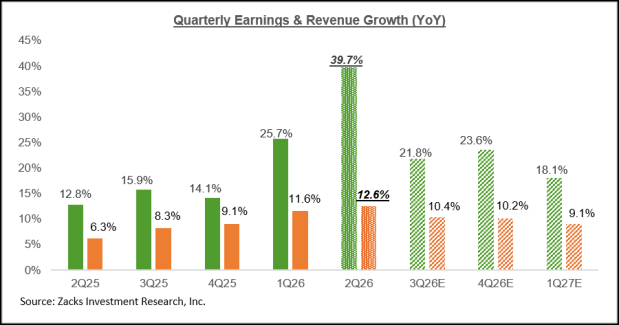
Image Source: Zacks Investment Research
The chart below shows the overall earnings picture for the S&P 500 index on an annual basis.
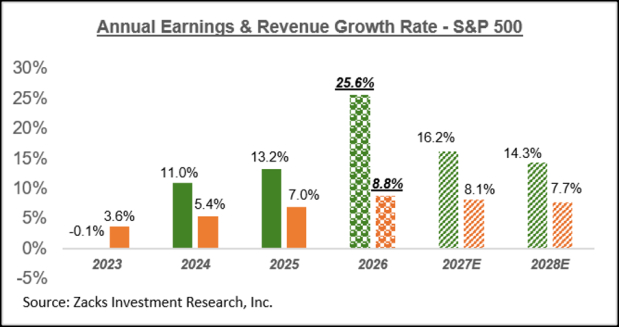
Image Source: Zacks Investment Research
The chart below shows the significant contribution of the Tech sector to the aggregate growth picture. The chart also shows how critical Nvidia (NVDA), Micron, and Alphabet are to the 2026 aggregate growth tally.
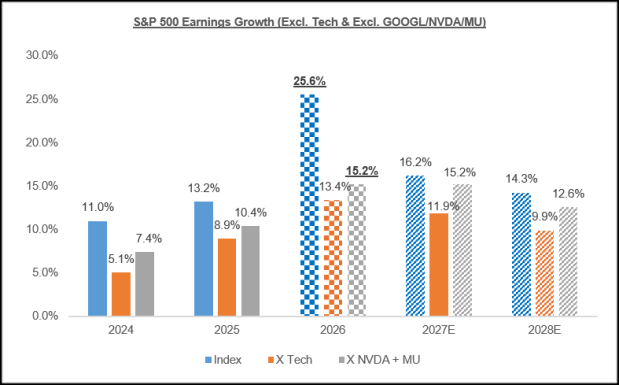
Image Source: Zacks Investment Research
Estimates for full-year 2026 have also been steadily going up, particularly since the start of March. The chart below shows the evolution of aggregate S&P 500 earnings estimates since last July.
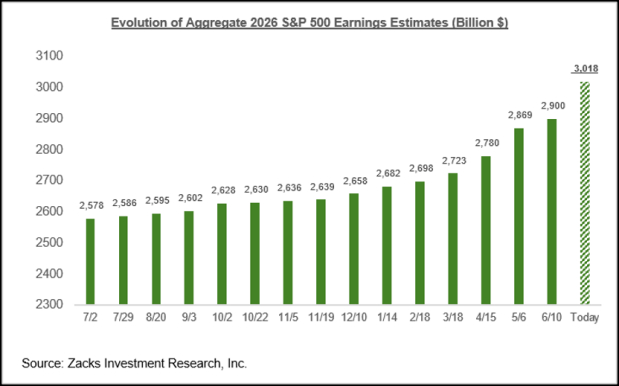
Image Source: Zacks Investment Research
Full-year 2026 earnings estimates have increased for 11 of the 16 Zacks sectors since the start of March, with the most pronounced gains at the Energy, Basic Materials, Tech, Industrials, Utilities, and Business Services sectors. On the negative side, estimates have been under pressure for the Transportation, Autos, Medical, and Consumer Discretionary sectors since the start of March. History suggests that these favorable revisions will get a boost from the Q2 earnings season and updated management guidance.



Comments
Log in or sign up to join the conversation.