

The Advance Estimate for Q2 GDP, to one decimal, came in at 2.1% (2.06% to two decimal places), a decrease from 3.1% for the Q1 Third Estimate. Investing.com had a consensus of 1.8%.
Here is the slightly abbreviated opening text from the Bureau of Economic Analysis news release:
Real gross domestic income (GDI) increased 1.0 percent in the first quarter, compared with an increase of 0.5 percent in the fourth quarter. The average of real GDP and real GDI, a supplemental measure of U.S. economic activity that equally weights GDP and GDI, increased 2.1 percent in the first quarter, compared with an increase of 1.3 percent in the fourth quarter (table 1).
The increase in real GDP in the first quarter reflected positive contributions from exports, PCE, nonresidential fixed investment, private inventory investment, and state and local government spending that were slightly offset by a negative contribution from residential fixed investment. Imports, which are a subtraction in the calculation of GDP, decreased (table 2). [Full Release]
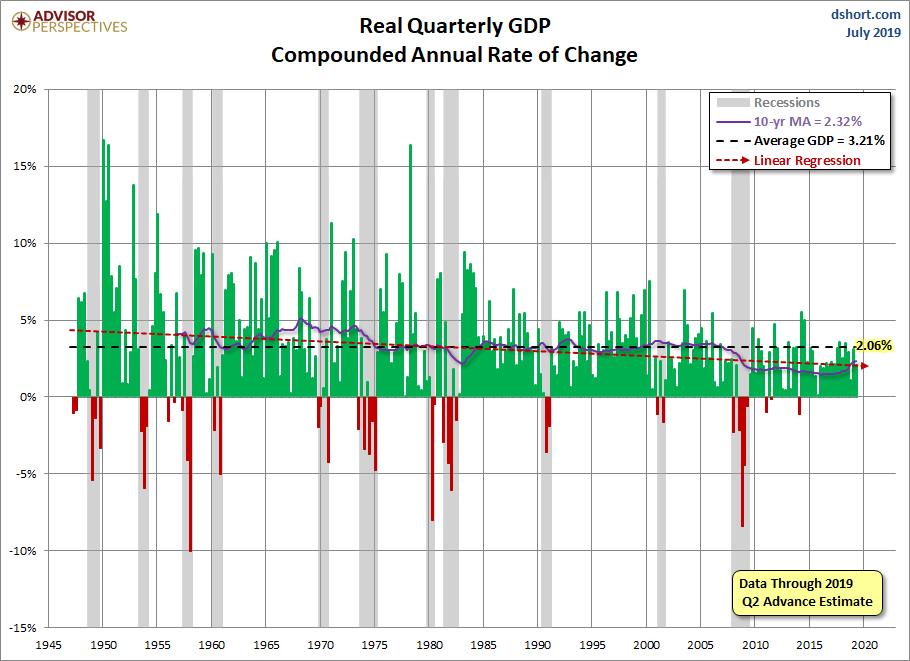
Here is a look at Quarterly GDP since Q2 1947. Prior to 1947, GDP was an annual calculation. To be more precise, the chart shows is the annualized percentage change from the preceding quarter in Real (inflation-adjusted) Gross Domestic Product. We've also included recessions, which are determined by the National Bureau of Economic Research (NBER). Also illustrated are the 3.21% average (arithmetic mean) and the 10-year moving average, currently at 2.32%.
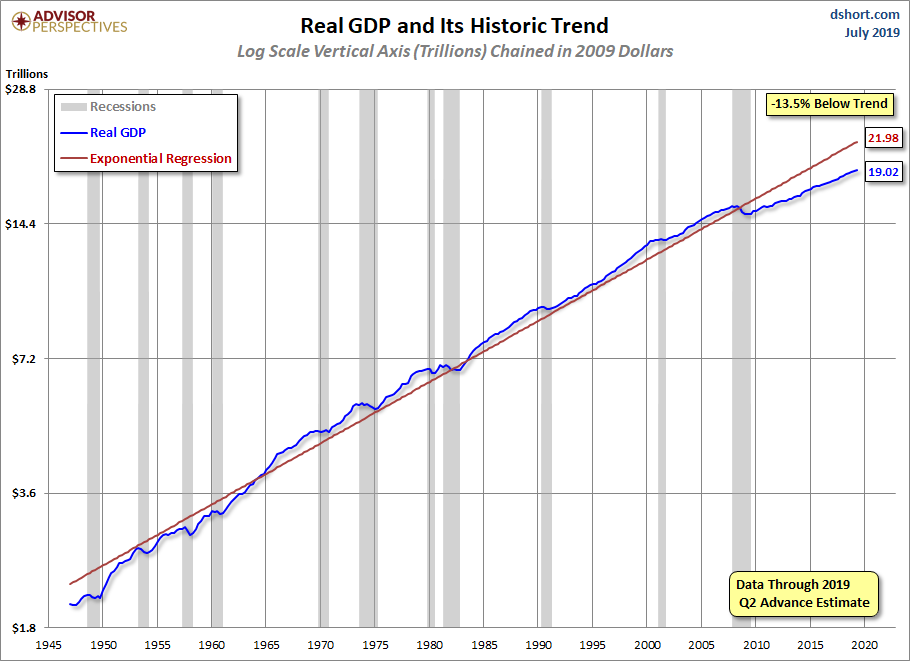
Here is a log-scale chart of real GDP with an exponential regression, which helps us understand growth cycles since the 1947 inception of quarterly GDP. The latest number puts us 13.5% below trend.
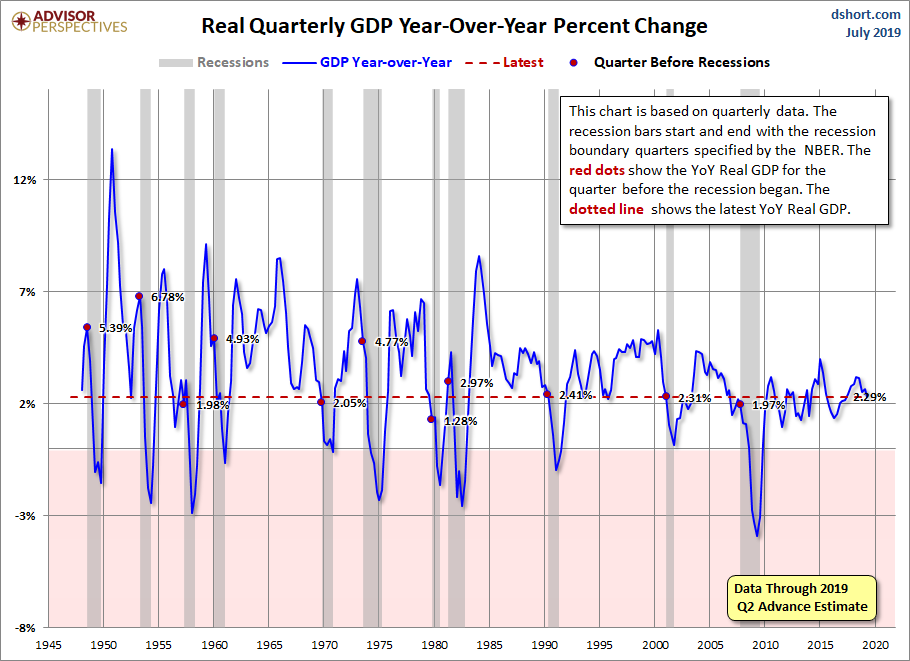
A particularly telling representation of slowing growth in the US economy is the year-over-year rate of change. The average rate at the start of recessions is 3.35%. Four of the eleven recessions over this timeframe have begun at a higher level of current real YoY GDP.
In summary, the Q2 GDP Advance Estimate of 2.1% was slightly better than expected and much lower than the Q1 Third Estimate.

Comments
Log in or sign up to join the conversation.