
Comparing Q1 FY2026 (April 23, 2026) → Q2 FY2026 (July 23, 2026)
The transformation narrative Intel has been building since Lip-Bu Tan arrived now has a second data point. The April call introduced the vocabulary — cultural reset, supply as the binding constraint, foundry confidence, 14A as the multi-customer platform. The July call tests how much of that vocabulary survived contact with an additional quarter.
Most of it did. Some of it hardened considerably. One thread changed register in a way that deserves attention.
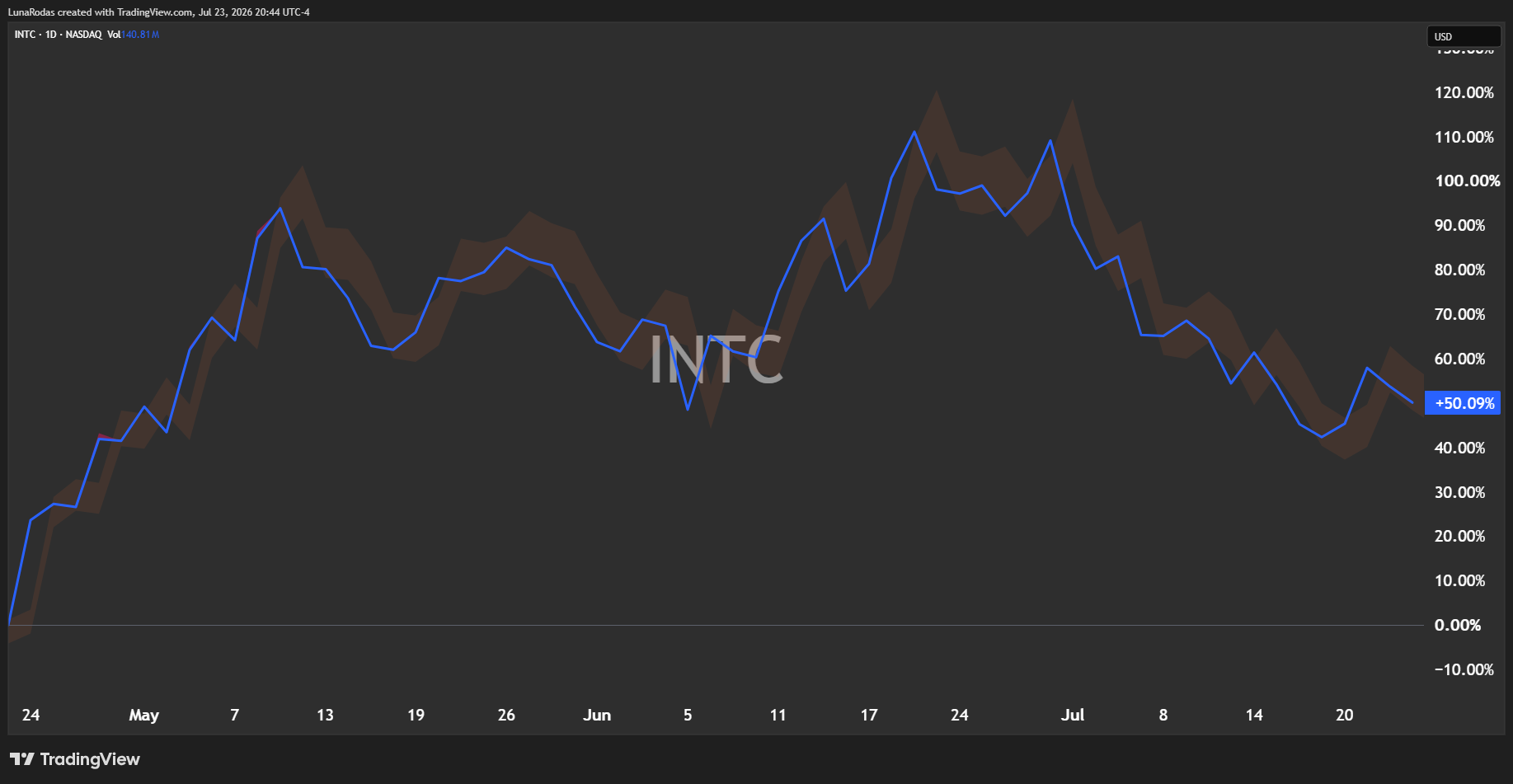
Delivered
The supply-demand gap — and exceeding guidance for a seventh consecutive quarter
The April framing was unambiguous: demand was running ahead of supply across all businesses, Xeon CPUs most acutely. The claim was that the constraint was real, not managed. “Demand continues to run ahead of supply for all our businesses, especially for Xeon server CPUs.” The implication was clear — Intel wasn’t leaving money on the table strategically; it genuinely couldn’t fulfill the orders in front of it.
The July results confirm this wasn’t posturing. Revenue came in at $16.1 billion, $1.8 billion above the midpoint of guidance. Non-GAAP EPS of $0.42 against guidance of $0.20. Gross margin beat by 280 basis points. David Zinsner noted that “despite exceeding our expectations for wafer outs in the quarter, strengthening demand continues to outstrip our growing supply.” The gap between supply and demand, if anything, widened in absolute terms even as output improved.
This is the seventh consecutive beat. The pattern is no longer a surprise; it is the baseline. What shifts in meaning is not the beat itself but the magnitude — and whether management’s language is keeping pace with the results.
It is. Tan’s prepared remarks opened with “solid execution” and immediately anchored the claim in specifics: yields improving, cycle times tightening, 18A output approximately 25% above internal targets and up more than 50% quarter-over-quarter. The April promise was that supply would grow every quarter. It did.
18A yield trajectory
The April call established a specific claim: “18A yields are now running ahead of the internal projections.” This was positioned as a meaningful inflection, not merely incremental progress. The commitment embedded in that statement is that yields would continue improving — the implication being that Panther Lake’s cost structure would improve as a consequence.
July confirms and extends. Intel Foundry drove down the cost of its primary Panther Lake SKU by roughly 50% year-to-date, with an additional 20% reduction targeted by year-end and “further meaningful reductions planned in 2027.” Zinsner also noted that Q3 quarter-to-date 18A yields are “trending ahead of targets set in March.” The bar Tan set for year-end yields, he confirmed, will be hit by mid-year.
🟠 Narrative Inertia — The cost improvement data is real. But gross margin guidance for Q3 is flat at 42% despite this progress. Zinsner explained: Panther Lake and Granite Rapids are growing as a share of mix, and they remain below corporate average margins because they’re early in their life cycle. The language around 18A improvement hasn’t slowed — if anything, it’s gotten more specific — while the gross margin line stays flat. The divergence isn’t damning; it’s a known dynamic management described in April. But it bears watching whether yield progress eventually shows up in the margin structure or becomes a recurring explanation for why it doesn’t.
Xeon server momentum — and the CPU/GPU ratio thesis
April introduced what may be Intel’s most important narrative asset right now: the claim that the CPU is reinserting itself as the foundational layer of AI infrastructure. The ratio argument — training runs at seven to eight GPUs per CPU, inference at three to four to one, agentic workloads approaching parity — was presented as emerging structural reality, not wishful thinking. The phrase used in April was “structural reason I’m confident that CPU franchise will continue to be a meaningful growth engine.”
July delivered the numbers that give that claim weight. DCAI revenue of $6.3 billion, up 24% sequentially and 59% year-over-year, described as “meaningfully ahead of expectations.” Q2 year-over-year server growth was called “the strongest on record.” Xeon 6 characterized as “one of the fastest ramping products in Intel history.”
The ratio language from April returned in July’s Q&A, this time with a harder edge: Zinsner said Intel “now believe we’re almost in parity at this point and could eventually even skew more to CPUs on a unit basis.” The conditional “moving back towards CPU” from April became “almost in parity” by July. The direction of travel in the language matches the direction of the business results.
Advanced packaging (EMIB-T) — backlog growth
April mentioned “additional growth in customer backlog in the quarter” for advanced packaging. Zinsner noted that demand for packaging was already tracking at “billions of dollars per year” rather than the hundreds of millions he had naively anticipated.
July confirms momentum is intact. Tan described EMIB-T customer interest as “very high,” backlog as “growing,” and yield and reliability as “hitting targets.” Zinsner committed capital: packaging capacity investment is accelerating, with substrate procurement underway ahead of customer ramps in 2027. The April framing was demand is real. July’s framing: now we’re spending to meet it.
Reprioritized
Terafab / SpaceX-xAI-Tesla partnership
The April call featured a striking passage in Tan’s prepared remarks. He invoked Elon Musk by name: “I can think of no better partners than Elon Musk. We recently announced our partnership with SpaceX, xAI, and Tesla to support Terafab.” The framing was ambitious — a potential refactoring of silicon process economics, an “unconventional” approach to manufacturing efficiency.
In July, Terafab is not mentioned. Once.
This is not absence — it is movement from prepared remarks to nowhere. In April, the partnership was prominent enough to appear in the CEO’s opening statement alongside the core strategic priorities. In July, a call lasting well over an hour with extensive foundry discussion does not reference it.
Management did not disclose the nature of the Terafab relationship in April in enough detail to judge whether it was a volume commitment, a process licensing exploration, or something more conceptual. That ambiguity was present then and remains unresolved now. What has changed is the level of emphasis. A partnership introduced at the CEO level in prepared remarks in April — framed around shared conviction with one of the most-watched names in technology — is no longer being actively surfaced.
🔴 Evaporated Narrative — No update, no acknowledgment, no “stay tuned.” The silence is clean.
External foundry customer announcements
April carried a specific forward-looking commitment: “We expect to see earlier design commitments emerge beginning in the second half of 2026 and expanding into the first half of 2027.” That timeline, anchored to the second half of this year, was one of the clearest narrative debts on the call.
July’s treatment is more hedged. Tan’s prepared remarks described “increasing momentum on customer engagements for Intel 14A” and expressed confidence in the 14A’s competitive position. He discussed PDK milestones — 0.5 complete, 0.9 on track for October — as indicators that customers are “starting to get excited.” Zinsner tied the CapEx ramp to “confidence in customers” but did not cite a single new external customer by name or describe a committed design win.
When Vivek Arya from Bank of America pressed directly — “when will that confidence be backed by actual customer announcements?” — Tan answered with process milestones rather than customer signals. The logic offered: once customers see PDK 0.9 in October, design commitment conversations will begin in earnest.
The April commitment was that design commitments would emerge in the second half of 2026. The July answer is that October’s PDK milestone is the precondition for those conversations. Whether that represents a fulfilled commitment, an in-process one, or a quiet extension of the timeline is a question the transcript does not resolve. The second half of this year is not over. But the language has moved from “design commitments will emerge” to “once they see PDK 0.9, they’ll get excited.”
ASIC business — scale revision
In April, Zinsner disclosed the ASIC business was “at a run rate north of $1 billion.” The framing was: bigger than most people realize, strong base to grow from.
In July, Zinsner disclosed the business is now “approaching a $2 billion run rate” and he sees it reaching “$4 billion in the not too distant future.” The business scaled meaningfully in a single quarter.
🟡 Convenience Pivot — the April “$1 billion” figure now appears to have reflected a different accounting perimeter. Aaron Rakers from Wells Fargo noted in the July Q&A that the prior quarter disclosed a “$1.2 billion run rate.” Zinsner’s July disclosure of “approaching $2 billion” suggests either significant in-quarter growth, a change in what is counted as ASIC revenue, or some combination. The category appears real and growing. The definitional consistency between what was disclosed in April and what is being disclosed now is worth tracking.
De-Emphasized or Absent
GPU development — the “quietly building” admission
April contained an unusual moment of disclosure. In response to a question about competition with Arm, Tan said: “Besides CPU, we’re also quietly building up the GPU with a new hire. We are moving into the accelerators, and so that we can serve the customer from the edge and then to the physical AI.” This was not in the prepared remarks — it surfaced in Q&A. But it was a named initiative: a new hire, a deliberate move into accelerators.
July does not mention GPU development. Accelerators appear in the context of the ASIC strategy — the stated ambition to expand “from networking to compute, and eventually accelerators” — but the specific GPU initiative introduced in April receives no update.
This may be intentional. Tan’s general style is to avoid pre-announcing capabilities until they are closer to delivery. The April disclosure may have been more candid than planned. But an initiative introduced as a named strategic move in Q&A — “quietly building” is still naming it — and then absent entirely from the next call lands as a de-emphasis.
Mobileye / “All Other” segment
April’s CFO remarks allocated space to the “All Other” category, noting revenue of $628 million, up 9% sequentially, “due to a strong quarter for Mobileye.” The segment collectively delivered operating profit of $102 million.
July does not mention Mobileye. Given that the business is no longer a fully consolidated subsidiary — Intel divested the majority of its stake in Mobileye over 2023-2024 — what remains in this category is now described differently, and the July call structure reflects that the segment no longer merits individual mention.
Free cash flow targets
April’s closing remarks included the following commitment: “Excluding the buyout of the Fab 34 joint investment, we still expect positive adjusted free cash flow for the full year.”
July’s treatment of cash flow is materially different in tone. Zinsner described CapEx now expected to exceed $20 billion in 2026 — “up significantly versus our expectations entering the year” — with 2027 CapEx “significantly above the 2026 levels.” In response to a direct question about whether the product business alone can fund these investments, Zinsner noted: “if we’re super successful, which we’re driving to, we may need to tap the capital markets.” Separately, he acknowledged that back-end investments “could be a drag to cash flow next year and make getting it to a positive number a little bit more challenged.”
The April commitment was positive free cash flow for the full year. The July framing is that 2027 free cash flow “to a positive number” is “a little bit more challenged.” The goalposts appear to have moved from 2026 full-year positive FCF to a more ambiguous posture where even the 2027 target is conditional. The underlying logic — strong demand, high-ROI capital deployment — is present and coherent. Whether the original April commitment remains intact is less clear.
Narrative Positioning
From recovery to supply constraint as the defining story
Eighteen months ago the question about Intel was survival. Tan himself acknowledged this in April: “A year ago, the conversation about Intel was about whether we could survive. Today is about how quickly we can add manufacturing capacity.” July advances that frame further. The opening claim — “the strongest revenue growth in more than 15 years” — is designed to close that chapter definitively. The transformation story is no longer about turning around a declining business; it is now about capturing a supply-constrained market.
This is a genuine narrative shift, and the financial results support it. What changes between April and July is not the direction but the confidence level. The April language included phrases like “we remain mindful that the macroeconomic and geopolitical environments are dynamic” and explicit acknowledgment that rising input costs “could impact demand for our product at some point in the year.” July retains some prudence — PC demand is expected to be sub-seasonal in the second half — but the macroeconomic hedges from April are quieter in July. The environment is being read as more certain.
CapEx discipline: from constraint to conviction
The April call established a clear principle, articulated by Zinsner: Intel would not commit significant capital until customer signals were concrete. The specific language was that external foundry customer signals would be “more concrete in the back half of this year and into early next year,” and the CapEx would follow.
July’s CapEx announcement — more than $20 billion in 2026, 2027 “significantly above” that — could be read as validating the April principle (customers committed, capital followed) or as anticipating it. Zinsner offered the clearest statement on this in the final Q&A: “You can read that now inversely, given our confidence around next year, that we must have pretty significant confidence in our customers, or we wouldn’t be putting the POs in place today.”
That is a strong claim. It is also unverifiable from the transcript. Customer commitments that Zinsner is referencing are not named, and the distinction between “committed demand” and “strong demand signals” is doing a lot of work.
Q&A: Response Quality Tracker
Vivek Arya (Bank of America), on external foundry customer announcements: “When will that confidence be backed by actual customer announcements?”
Tan’s response pivoted to process milestones — PDK 0.5 complete, PDK 0.9 on track for October, yield progress on 14A. He described customers as “starting to get excited” once they see PDK milestones, and said the level of engagement gives him confidence. The question asked for a timing commitment on customer announcements. The response provided a technology milestone schedule. The gap between the question and the answer is the gap between what investors want to know and what management is prepared to say.
Aaron Rakers (Wells Fargo), on ASIC business: “Based on what was disclosed last quarter, it’s about a $1.2 billion run rate business now growing well for the company.”
Zinsner’s response disclosed a “approaching a $2 billion run rate” — a significant upward revision from both Rakers’ framing and the April disclosure of “>$1 billion.” The question was about growth profile and margins. Zinsner provided a TAM claim ($100 billion) and a forward run rate target ($4 billion) without directly addressing ASIC-specific margin structure. Lip-Bu added examples (Fortinet, IPU) without closing the margin question. The revenue trajectory is increasingly concrete. The margin disclosure remains deferred.
The Gap Report is narrative intelligence, not investment advice.
Quotes are verbatim from publicly available earnings call transcripts. This analysis reflects an interpretation of language and tone shifts between calls
Comments
Log in or sign up to join the conversation.